

By Valentine Opaluwa Ejeh
Conceptual Framing
Security cooperation between states is best understood through the lens of strategic institutionalism, which emphasises that durable partnerships depend not merely on shared threats but on compatible governance capacities and credible institutions (Keohane, 1984; North, 1990). Within this framework, external security assistance succeeds only when domestic administrative systems can absorb, coordinate, and sustain policy commitments.
Nigeria’s current engagement with the United States illustrates this principle with particular clarity.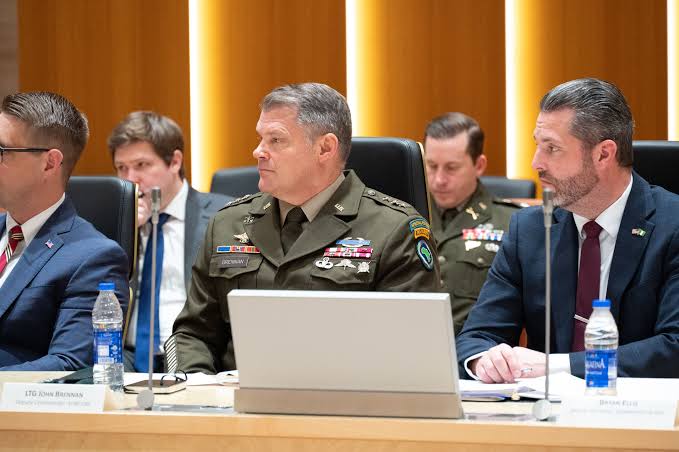
Strategic Partnership and Interest-Based Alignment
Recent engagement by the United States Army and broader American security leadership reflects a realist recalibration of U.S.–Nigeria relations. Rather than framing Nigeria as a passive recipient of security assistance, the partnership increasingly recognises Nigeria as a regional security actor whose stability directly affects West African and transatlantic security interests. This shift aligns with realist and neoclassical realist perspectives, which hold that states cooperate most effectively when interests—not sentiment—drive alignment (Waltz, 1979; Rose, 1998).
The establishment of the U.S.–Nigeria Working Group in Abuja, led by Lt. Gen. John Brennan alongside senior Nigerian officials, represents an attempt to institutionalise this interest-based cooperation. By prioritising coordination, accountability, counterterrorism, and civilian protection, the framework reflects best practices in contemporary security governance, particularly the move away from ad hoc military assistance toward rules-based, institutional engagement (OECD, 2018).
Leadership, Preparation, and Strategic Vision
From a leadership perspective, President Bola Ahmed Tinubu’s approach reflects what political scientists describe as elite strategic learning—the accumulation of experience that shapes decision-making long before formal authority is attained (Hermann, 2003). His administration’s emphasis on economic restructuring, diplomatic repositioning, and security partnerships suggests a strategic orientation informed by long-term exposure to power dynamics, alliance formation, and statecraft.
Comparatively, similar patterns can be observed in countries such as Indonesia under Joko Widodo, where long-standing elite experience enabled strategic re-engagement with global partners, particularly in maritime security and counterterrorism (Aspinall & Mietzner, 2019).
The Administrative Capacity Constraint
However, political economy literature consistently demonstrates that vision without administrative capacity produces policy fragility (Fukuyama, 2013). The primary vulnerability facing Nigeria’s current trajectory is not ideological incoherence but bureaucratic weakness—manifested in inconsistent execution, poor inter-agency coordination, and communication failures.
Samuel Huntington’s classic distinction between political mobilisation and institutionalisation remains relevant here. He argued that instability arises when political ambition outpaces institutional development (Huntington, 1968). In Nigeria’s case, ambitious strategic repositioning risks being undermined by administrative shortcomings that erode both domestic trust and international confidence.
Comparative Lessons from Security Partnerships
Comparative evidence reinforces this concern. In Colombia’s security cooperation with the United States under Plan Colombia, success was not driven solely by external support but by significant domestic reforms in military professionalism, civilian oversight, and bureaucratic coordination (Isacson, 2010). Conversely, in states such as Afghanistan, extensive foreign security assistance failed to produce lasting stability due largely to weak institutions, fragmented authority, and governance deficits (SIGAR, 2021).
These cases underscore a central insight of institutional economics: external resources amplify existing capacity; they do not substitute for it (Acemoglu & Robinson, 2012).
Implications for Nigeria’s Strategic Repositioning
Nigeria’s engagement through the U.S.–Nigeria Working Group signals that the country is not experiencing strategic drift. On the contrary, it reflects deliberate repositioning within the global security architecture. However, the sustainability of this repositioning will depend on Nigeria’s ability to strengthen administrative competence, enforce accountability, and maintain policy coherence across the security sector.
Security partnerships operate on credibility. As principal–agent theory suggests, partners assess not only stated commitments but the reliability of agents tasked with implementation (Miller, 2005). Repeated administrative failures therefore impose reputational costs that extend beyond any single policy domain.
Conclusion
Nigeria stands at an inflection point where strategic opportunity intersects with institutional limitation. The foundations of meaningful security cooperation are being laid, supported by interest-based alignment and informed leadership. Yet history and comparative evidence caution that preparation alone is insufficient.
States that convert strategic vision into durable outcomes do so by investing in bureaucratic professionalism, institutional discipline, and governance reliability. Those that fail to close this gap often see opportunity dissipate into frustration.
History tends to reward preparation—but it consistently penalises administrative neglect.
Amb. Valentine Opaluwa Ejeh, PhD

References (Indicative)
Acemoglu, D. & Robinson, J. (2012). Why Nations Fail.
Fukuyama, F. (2013). What Is Governance? Governance Journal.
Hermann, M. (2003). Political Psychology and Leadership.
Huntington, S. (1968). Political Order in Changing Societies.
Isacson, A. (2010). Plan Colombia: Lessons Learned.
Keohane, R. (1984). After Hegemony.
North, D. (1990). Institutions, Institutional Change and Economic Performance.
Waltz, K. (1979). Theory of International Politics.