


By: Ashabu Lawal Rafukka
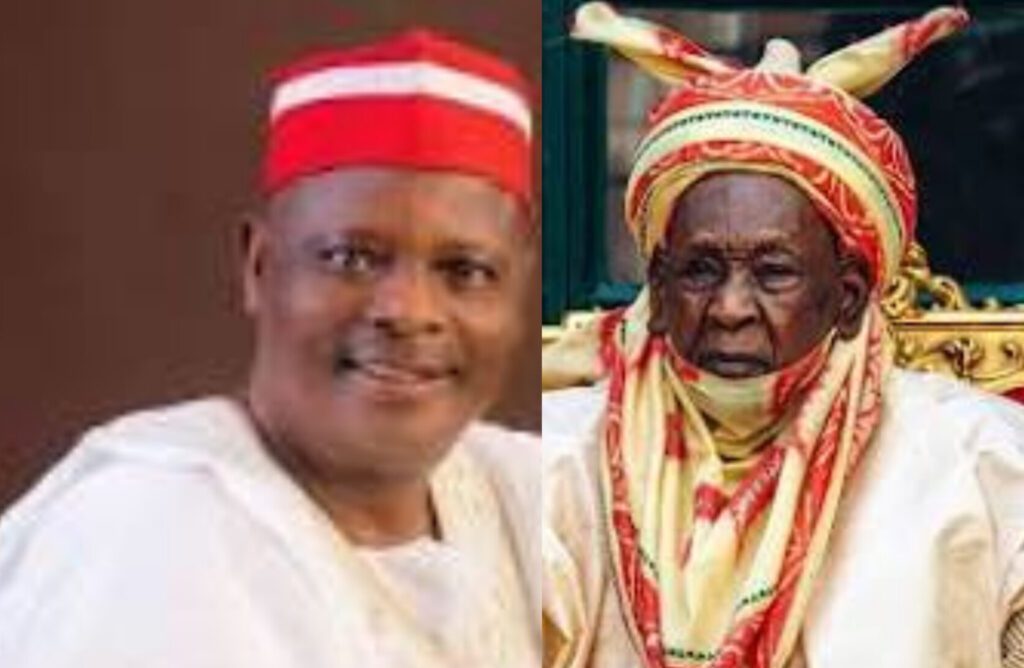
On Saturday, 19th July, 2025, Senator Dr. Rabi’u Musa Kwankwaso paid a condolence visit to the Emir of Daura, Alhaji Umar Farouk Umar, over the passing of former President General Muhammadu Buhari. The visit took place at the Palace of the Emir of Daura, Katsina State.
In the ancient town of Daura, where tradition speaks with authority and the weight of history commands silence, the words of a monarch resounded with rare gravity. His Highness, Alhaji Umar Farouk Umar, the Emir of Daura, a custodian of Northern heritage and guardian of cultural conscience, stood before his people not merely as a royal figure but as a seer, a philosopher, and a herald of national renewal. With the gaze of an elder who has seen empires rise and falter, the Emir looked into the heart of Nigeria’s troubled political landscape and spoke of a man he called the long-awaited messiah—Senator Dr. Rabi’u Musa Kwankwaso.


His words, calm but stirring, were not laced with mere formality. They were forged in the fire of reflection, conviction, and an aching desire to see Nigeria redeemed from the abyss of underdevelopment and misgovernance. And in Kwankwaso, the Emir saw not just a politician, but a vessel of redemption, a rare breed whose calling, he believes, is to salvage a nation on the brink of exhaustion.
“Me and you, we are one and the same thing,” the Emir declared, his voice echoing a bond deeper than politics. “I wish you God’s guidance. I wish you all the best in your future endeavors. Nigerians are earnestly looking up to you to salvage the country from the bondage we found ourselves.”
In that heartfelt benediction, the Emir spoke not as a king, but as a father yearning for the well-being of his household; as a statesman pleading for a generation; as a conscience crying out in a nation adrift. His message was both a blessing and a burden, a sacred torch passed to Kwankwaso—a man whose political vibrancy has long disturbed the status quo and whose passion for public service has carved deep imprints in the political soil of Nigeria.
And yet, these were not idle praises. For a monarch as revered and deliberate as the Emir of Daura, every word carried the weight of history and the solemnity of ancestral insight. When he said, “We need people like you to make Nigeria great and prosper,” it was not mere rhetoric. It was a national call to arms, a gentle but firm instruction to a leader whose moral spine and political acumen are becoming increasingly scarce in today’s governance landscape.
Kwankwaso, a former governor, senator, and presidential candidate, has built a reputation as a tireless worker and a pragmatic thinker. But beyond that, he carries a mystique—a defiance against failure, a spark of revolution cloaked in humility. From the streets of Kano to the corridors of Abuja, he has walked the path of servant leadership with resolve, never afraid to challenge power, never hesitant to build anew.
And now, with the Emir’s rare endorsement, Kwankwaso is being called not merely to participate but to lead—perhaps from within, perhaps alongside the current order, to steer Nigeria back from the shadows of lost dreams. The Emir urged him to “support the federal government in all that you can do.” Not out of political convenience, but because a house divided cannot stand. The message is clear: unity is not betrayal; participation is not surrender. It is the only way forward.
“My prayer,” the Emir intoned with solemn grace, “is for God to give you the opportunity to salvage this country and regain its lost glory.”
These are not ordinary prayers. In African cosmology, when a king prays for a warrior, the gods take note. When a monarch identifies a messiah, the people pause. The Emir’s pronouncement is not just about Kwankwaso—it is about Nigeria’s aching need for leadership with conscience, vision, and courage. It is about the hunger of a people who have waited too long at the gates of justice, prosperity, and unity.
In the Emir’s declaration, there is both poetry and prophecy. The messiah is not a supernatural figure but a human being molded by struggle, seasoned by time, and fired by a passion to lift others. Kwankwaso, in this metaphor, is not a savior above men, but a leader among them—called to walk with, not ahead of, the people. And if he heeds the call, if he can marry his brilliance with humility and his ideals with practical cooperation, he may indeed carry the hope of a nation too tired to dream, too wounded to march alone.
Let us not be deceived—salvation is not a solo journey. It requires collaboration. The Emir’s vision is strategic. If Kwankwaso joins hands with the APC-led administration—not in silent submission but in active contribution—there may be a chance to ignite the engine of progress once more. A house united by purpose can rebuild; a nation harnessed by hope can heal.
Kwankwaso has always defied simplicity. He is neither radical for its own sake nor conformist by design. He walks a tightrope between resistance and responsibility. But in this moment, the Emir asks him to tilt towards unity—not because all is well, but because healing begins with proximity. The North, battered by insecurity, unemployment, and lost potential, needs a political surgeon. The South watches with weary eyes. The entire nation holds its breath.
Can he answer the call?
In a country where political prophecy often falls into the abyss of forgotten speeches, the Emir’s words stand out like a monument carved into the soul of the nation. They are not political tactics but moral instructions. They are not endorsements for ambition but invitations to purpose.
“Carry on with your vibrancy and activeness in the process of making our dear country great,” the Emir urged. “Continue giving your best for the progress of our country.”
There is something inherently moving about a traditional ruler urging a politician not to fade into irrelevance, not to retreat into silence. The call is to keep the fire alive, to remain in the trenches, to keep the vision unblurred. Kwankwaso is being told that his time has not passed, that history is still unfolding, and that the pages of tomorrow may yet be inked by his deeds today.
In these trying times, when the weight of broken promises and shattered institutions seem to suffocate the breath of national hope, Kwankwaso’s potential return to the center of political action is not just strategic—it is spiritual. It is a metaphor of return: return to service, to conscience, to the people.
And in that return lies the possibility of redemption—not just for Kwankwaso, but for a country that has wandered too long in search of light.
Indeed, messiahs do not descend from the heavens. They rise from among the people. They carry scars, not halos. They are shaped by fire, not fantasy. And if the Emir of Daura, a voice of tradition and wisdom, has seen in Kwankwaso the possibility of a messiah, then perhaps it is time for the nation to look again—beyond the noise, beyond the factions, and see what he saw: a man not perfect, but willing; not flawless, but faithful.
And so, the road lies open. The moment calls. The future waits. Will Kwankwaso answer?
For Nigeria’s sake, we pray he does.
Ashabu Lawal Rafukka,, writes from Katsina