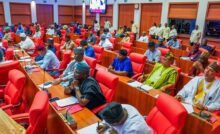
The Nigerian Senate on Thursday took a major step toward overhauling the country’s military legal framework as it passed for second reading the Armed Forces (Repeal and Re-enactment) Bill, 2025 (SB. 791) — a landmark legislation seeking to align the Armed Forces Act with democratic, constitutional, and operational realities.
Sponsored by Senator Abdulaziz Yar’adua (Katsina Central), the bill proposes a comprehensive reform to bring Nigeria’s military governance in line with international standards, judicial accountability, and modern defence principles.
Leading debate on the bill, Senator Yar’adua noted that the current Armed Forces Act, rooted in decrees of the 1960s and last consolidated in 2004, no longer meets the demands of a modern democracy or evolving security challenges.
“The Armed Forces of Nigeria remain the cornerstone of our sovereignty and national security,” Yar’adua said. “Yet our military law has not kept pace with the realities of today’s defence environment.”
The proposed legislation introduces several key reforms — including judicial review of military convictions, modernization of disciplinary procedures, replacement of outdated fines with salary-based sanctions, and the extension of fair-hearing rights to non-commissioned officers.
A major highlight of the bill is the prohibition of enlisting persons under 18 years of age, aligning Nigeria’s military recruitment process with the Child Rights Act and international humanitarian standards.
Explaining the details, Senator Tahir Monguno said the bill also seeks to end the use of military boards of inquiry as a substitute for proper trials, upholding the principle that “no one should be a judge in their own case.” He added that the reform strengthens the President’s constitutional authority as Commander-in-Chief while deepening military accountability under democratic oversight.
Several lawmakers welcomed the bill as a long overdue reform. Senator Ali Ndume (Borno South) described it as vital for “aligning the Armed Forces with Nigeria’s democratic journey,” while Senators Monguno and Samson Ekong (Akwa Ibom South) hailed it as a visionary blueprint for a modern and professional military institution.
Presiding over the session, Deputy Senate President Barau Jibrin commended the bill’s objectives, stressing that the country’s laws must evolve with time.
“This reform is necessary not only for the military but across all facets of national life,” he said.
The bill was unanimously approved for second reading and referred to the Senate Committees on Defence, Army, Air Force, and Navy for further legislative work, with a directive to report back within four weeks.
If enacted, the bill will modernize Nigeria’s Armed Forces Act, strengthen civil-military relations, and ensure due process in military administration. By subjecting convictions to court review, setting an 18-year enlistment benchmark, and codifying clearer chains of command, the legislation is expected to enhance discipline, professionalism, and accountability across the Armed Forces.
Senate Approves Bill Mandating Court Review of military convictions, 18-Year Enlistment