
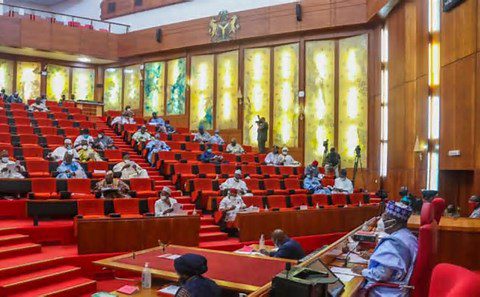
****Move seen as critical step to replace dwindling donor aid and rescue overstretched frontline services
Nigeria’s Senate has taken a bold step toward reshaping the future of public health financing by advancing a bill that would double the Basic Health Care Provision Fund (BHCPF) from 1 to 2 percent of the Consolidated Revenue Fund (CRF) — a move many see as long overdue in the face of dwindling donor aid and rising domestic health costs.
The amendment to the National Health Act (2014), sponsored by Senator Ipalibo Harry, Chairperson of the Senate Committee on Health, received strong bipartisan support when it passed second reading on Wednesday. Lawmakers hailed the initiative as a decisive investment in citizens’ welfare and a safeguard for Nigeria’s fragile healthcare system.

“This is both a legal and moral duty,” Senator Harry declared. “Section 14(2)(b) of the Constitution says the security and welfare of the people is the primary purpose of government. This bill gives meaning to that promise.”
For over a decade, the BHCPF — Nigeria’s first statutory mechanism for funding basic healthcare — has struggled to live up to expectations. Designed to guarantee a minimum package of essential services for all Nigerians, particularly the poor, it has been hobbled by inadequate funding and bureaucratic bottlenecks.
Today, the fund receives just one percent of national revenue. But with the country’s growing health demands, surging costs, and global donors gradually pulling out, that fraction barely scratches the surface.
According to the 2022 National Health Accounts, Nigerians now pay more than 75 percent of all health expenses out of pocket, pushing millions into poverty each year. The senator warned that without stronger domestic financing, Nigeria could soon be unable to sustain critical services such as immunization, maternal care, and epidemic response.
“As Nigeria transitions out of major donor programmes like Gavi and the U.S. Global Health Initiative, the full financial burden of essential health services will rest on our shoulders,” Harry cautioned. “We cannot afford to fail our people.”
Her argument echoes growing concern among policymakers and global partners about Nigeria’s heavy reliance on external support to sustain its health programmes. Donor fatigue and shifting international priorities have forced many low- and middle-income countries to rethink their financing models.
The proposed amendment, therefore, represents not just a fiscal adjustment but a strategic shift toward self-reliance — a move that aligns with the outcomes of the National Dialogue on Health Financing held in September 2025, where government agencies and development partners reached consensus on raising the BHCPF to 2 percent.
“Health is not a cost — it is an investment,” Harry told her colleagues. “This is about national productivity, stability, and human capital development.”
Lawmakers across party lines commended the initiative, describing it as one of the most consequential steps toward achieving Universal Health Coverage (UHC) in Nigeria.
Senators also highlighted the dire state of Primary Health Centres (PHCs) — many of which lack staff, equipment, and basic utilities — and argued that doubling the BHCPF could help revive these grassroots facilities.
Under the amendment, the fund will continue to be jointly managed by the National Primary Health Care Development Agency (NPHCDA) and the National Health Insurance Authority (NHIA), with annual audits and performance reports submitted to the National Assembly to ensure transparency and accountability.
If fully implemented, the proposed increase could unlock billions of naira in additional funding for essential services — from child immunization to disease surveillance — and reduce the financial pressure on households.
“Health is the heartbeat of development,” one senator remarked during debate. “By strengthening the foundation, we secure the future.”
For many public health advocates, the Senate’s move signals a rare moment of foresight in Nigeria’s policymaking — one that could help shift the country from crisis response to long-term planning.
The bill has now been referred to the Senate Committee on Health for further legislative scrutiny before its third reading and passage.

ri6u9w
Thực tế cho thấy, các vấn đề về giao dịch tại 888slot app rất hiếm khi xảy ra. Theo thống kê, tỷ lệ giao dịch có vấn đề chỉ chiếm chưa đầy 0.5%, thấp hơn đáng kể so với mức trung bình ngành là 2-3%.
888slot 888 slot Cùng với hệ thống bảo mật đạt chuẩn SSL 256-bit và đội ngũ hỗ trợ khách hàng 24/7, nhà cái từng bước xây dựng được hình ảnh một nhà cái trẻ nhưng cực kỳ bản lĩnh.