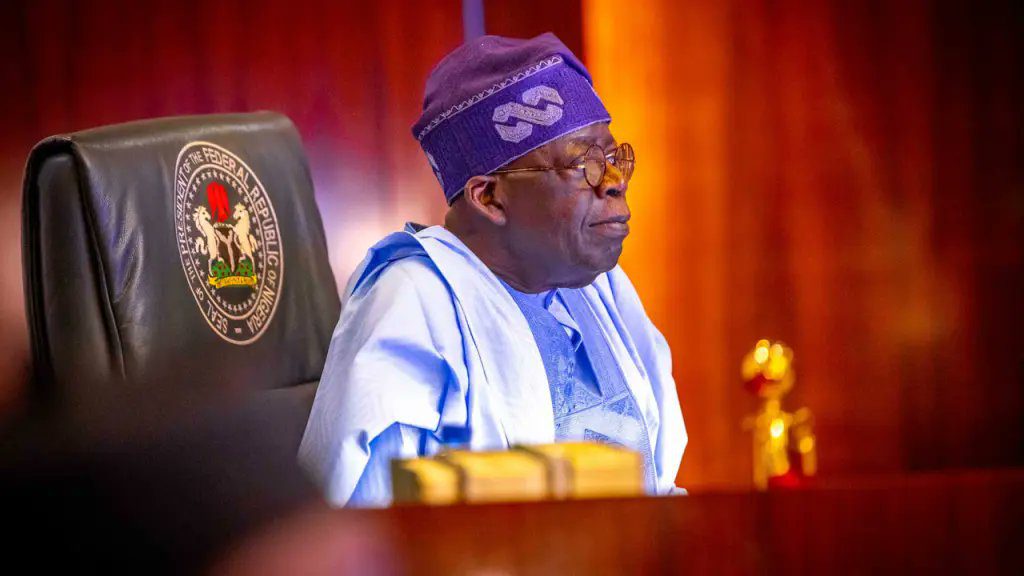
President Bola Ahmed Tinubu has declined to sign two bills recently passed by the National Assembly, citing provisions that he said conflict with existing laws, threaten fiscal discipline, and risk creating unsustainable precedents in public administration.
The development was formally communicated to lawmakers on Tuesday when Senate President Godswill Akpabio read the President’s letters during plenary.
Tinubu explained that while he recognized the objectives of the Nigerian Institute of Transport Technology Establishment Bill, 2025 and the National Library Trust Fund (Establishment, etc.) Amendment Bill, 2025, both contained provisions that could undermine transparency, economic stability, and good governance if enacted in their current form.

On the Transport Technology Bill, Tinubu flagged provisions that introduced unauthorized levies on trade, uncontrolled borrowing, and the power to invest government appropriations in securities.
The President particularly objected to Section 18(4a) of the bill, which sought to fund the institute through “1% of the freight on every import and export,” without the approval of the Federal Executive Council. According to him, this would overburden businesses and create an unregulated revenue stream outside the normal budgetary process.
He also faulted Section 20, which allowed the institute to borrow up to ₦50 million without presidential approval. Tinubu warned this could encourage repeated borrowing just below the threshold to evade oversight.
Similarly, Sections 21 and 23, which permitted investment of government-appropriated funds, were described as “fiscally dangerous” since the institute is not a revenue-generating agency.
“These provisions, if allowed, would not only undermine fiscal discipline but also create opportunities for financial abuse. For these reasons, I withhold my assent to the bill,” Tinubu wrote.In a separate letter on the Library Trust Fund Amendment Bill, Tinubu said the legislation, though laudable in its objectives, contained provisions that ran contrary to established federal laws and policies.
The President highlighted sections dealing with agency funding, taxation of national entities, remuneration of public service staff, and tenure/age limits for service, arguing that they would set a precedent “unsustainable and against the public interest” if allowed.
“For these reasons, I cannot grant presidential assent to the bill in its present form. I urge the Senate to revisit and address the identified issues,” the letter stated.
After reading the communications, Senate President Akpabio praised the President’s diligence and directed relevant committees to study the letters and rework the bills for reconsideration.
“This shows the seriousness with which Mr. President is reviewing every legislation we pass. It is now our responsibility to carefully address the issues he has raised,” Akpabio told lawmakers.
The Senate referred the Transport Technology Bill to the Committee of the Whole for further legislative action, while the Library Trust Fund Bill was directed to the Committees on Special Duties and Establishment and Public Service Matters for review.