


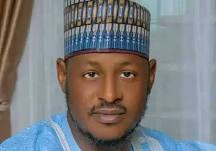
By: Dr Ibrahim Sani Kaita
Two years have passed since Governor Dikko Umar Radda took the reins of Katsina State. Two years marked not by flamboyance or noise, but by the quiet rhythm of a government focused on duty. In a region where peace has often been a fragile guest, Governor Radda’s firm hand has brought more than a measure of calm. His method has been clear: build people, secure the land, and let development speak for itself.
Security is not merely a word on a government memo—it is the breath of freedom for the farmer, the trader, and the schoolchild. From his first day in office, Governor Radda charted a different course in the battle against banditry. While others flirted with the idea of dialogue, his stance was direct and without ambiguity.

“We cannot treat crime as a negotiation,” said Dr Ibrahim Sani Kaita, a respected academic from Ahmadu Bello University, Zaria. “Governor Radda understood from the beginning that when you give evil a chair at the table, it soon takes the whole house.”
Rather than offer concessions to those who have spilled innocent blood, the administration intensified collaboration with security forces. Community-based surveillance, the use of local intelligence, and the establishment of a special security task force have significantly disrupted bandit activities. This zero-tolerance policy, though met with skepticism at the outset, has turned fear into a fading echo in many parts of the state.
Governor Radda’s approach to development begins where it should—at the root. With over 80% of Katsina’s population relying on agriculture, his government has returned attention to the land. Subsidized fertilizers, mechanized farming programs, and farmer cooperatives have emerged as pillars of the new agricultural policy.
But the vision extends beyond crops. Livestock development, a previously neglected area, now enjoys a structured focus. New grazing reserves, veterinary services, and training for herders aim to transform pastoral life from survival-based to profit-driven.
“His policies treat farmers and herders not as relics of a fading tradition but as key drivers of our future,” said Dr Kaita. “This is development that speaks the language of the people.”
In the classroom, the seeds of tomorrow are sown. Governor Radda’s investment in education has moved past the optics of new buildings into the realm of lasting change. Teacher recruitment and training have been prioritized, especially in rural areas where the light of education often dims too early.
A landmark program targeting girl-child education has also gained traction, reducing dropout rates and encouraging parental involvement. Infrastructure has improved, but more importantly, the system itself is being rebuilt.
“There is a quiet revolution in our schools,” Dr Kaita noted. “And this kind of change does not make noise—it grows silently until the harvest surprises even the skeptic.”
Health care in Katsina has long suffered from a lack of access and insufficient facilities. In the past two years, the state has seen the renovation of over 300 primary health care centers and the employment of additional medical personnel.
Mobile clinics now reach remote villages. Maternal and child health programs are saving lives where statistics once told grim stories. The introduction of a state health insurance scheme has allowed thousands of families to access treatment without the fear of financial ruin.
“This is not just a clinic here or a doctor there,” said Dr Kaita. “This is a philosophy of care, a belief that no life is too small to matter.”
A road is more than tar and gravel; it is a path to markets, to schools, to hope. Governor Radda’s infrastructural focus has seen the construction and rehabilitation of hundreds of kilometers of roads across the state. These roads are not merely aesthetic—they are arteries of economic and social life.
Remote communities that once stood forgotten have been reconnected. For farmers, it means produce reaches the market. For students, it means schools are accessible. For the sick, it means ambulances no longer stall on the way to help.
Respect cannot be decreed. It rises, slowly, from the soil of sincerity and action. Across Katsina, a quiet consensus is taking shape. The people, weary of lofty promises and recycled failures, now see in Radda’s government a mirror of what governance should be.
2027 may still be on a distant horizon, but for many, the thought of a successor does not yet arise with urgency. “He has made the seat smaller than the man,” Dr Kaita observed with a chuckle. “That’s rare. And it makes one think: why change what is finally beginning to work?”
Governance in northern Nigeria is no easy path. It is a road lined with thorns—security challenges, poverty, political cynicism. Yet, in these two years, something has quietly bloomed in Katsina. Not loud, not showy—but unmistakably real.
The administration of Governor Dikko Umar Radda has offered a model not built on charisma or slogans, but on work—persistent, people-centered, and principled. In the eyes of many, it is not merely a government in office. It is a government in service.
Dr Ibrahim Sani Kaita writes from Ahmadu Bello University, Zaria
