

Close Menu
National Update
    Facebook X (Twitter) Instagram
    Trending
    • A Look at Lean Government and Ostentation
    • CJN cautions judges on political ties, lawyers on forum shopping
    • FG’s Case Against Alleged Fake Agency Boss Falters Over Court Jurisdiction
    • Obidients Allege Double Standard as Political Violence Claims Spread
    • Onnoghen’s Ordeal: How Power Changes Hands, but History Never Forgets
    • Kogi Judiciary Finally Frees 1,768 Workers From Six-Year Promotion Freeze
    • INEC Disowns Fake Governorship Announcement Amid Candidate List Controversy
    • Rights Group Demands Probe of Umahi Over Coastal Highway Realignment
    Facebook X (Twitter) Instagram
    National UpdateNational Update
    Subscribe
    • News
    • Politics
    • Opinion
    • Economy
    • Entertainment
    • Health
    • Security
    National Update
    Home»Appointment

    Professorial Inaugural Lecture Highlights Nigeria’s Economic Challenges, Pathways to Progress

    By National UpdateDecember 24, 2024Updated:December 24, 2024 Appointment No Comments4 Mins Read
    Share
    Facebook Twitter WhatsApp LinkedIn Email

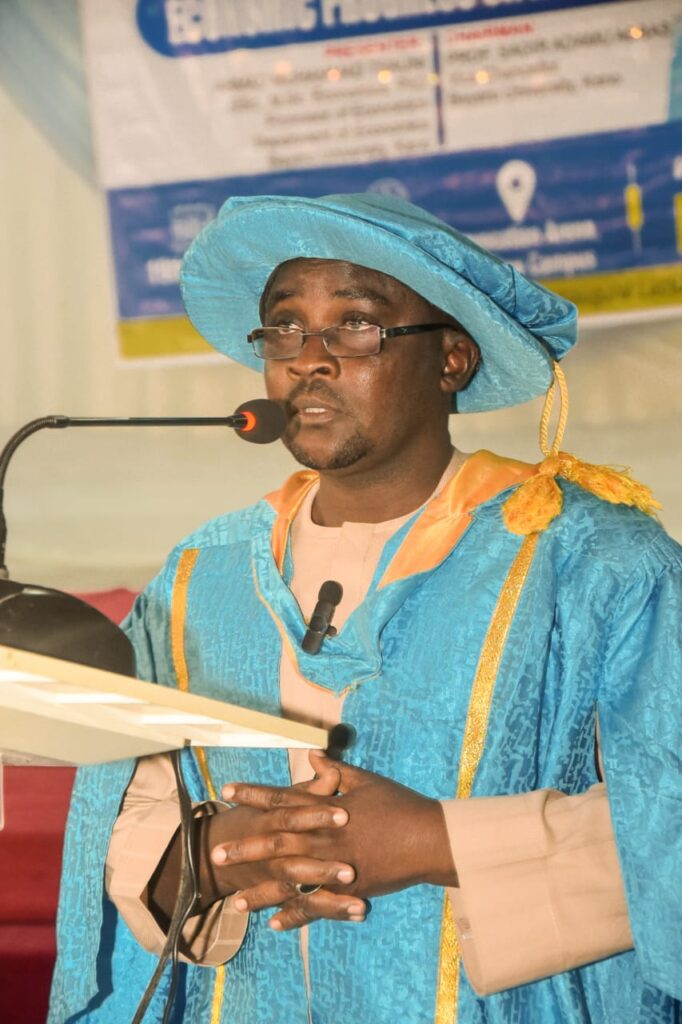
    It was a day of intellectual engagement as Professor Ahmad Muhammad Tsauni of the Department of Economics, Faculty of Economics and Management Sciences, Bayero University, Kano delivered a compelling Professorial Inaugural Lecture titled “Economic Progress on a Tightrope.”
    The lecture, which marked the 51st in the series, was held on Thursday, 19th December 2024, at the Convocation Arena and attracted a large and diverse audience. It served as a call to critically examine Nigeria’s economic trajectory and chart a more sustainable and inclusive path to growth.

    Professor Tsauni, a distinguished economist and scholar, attributed Nigeria’s underdevelopment to an overreliance on Western-inspired economic reforms, specifically the “Washington Consensus” model. He argued that Nigeria, like many low-income economies, depends heavily on developed nations for development models, technological expertise, and innovative ideas to drive growth. Consequently, Nigeria adopted the Washington Consensus, a set of free-market economic principles, as the foundation for economic reforms.

    Explaining the framework, Professor Tsauni outlined its key pillars, including fiscal discipline, public expenditure reform, tax restructuring, financial liberalization, competitive exchange rates, and trade liberalization. Other components include eliminating barriers to foreign investment, privatizing state-owned enterprises, deregulating markets, and securing property rights—all rooted in neoclassical economic theories advocating minimal government intervention.
    However, Professor Tsauni contended that these principles have proven unsuitable for Nigeria’s socio-economic and political realities. He highlighted how several Asian economies, such as China, India, Malaysia, and Singapore, deviated from the Washington Consensus and implemented customized reforms that fueled their rapid economic growth.
    He lamented that despite Nigeria’s adherence to the Consensus framework through numerous reforms over the decades, the country continues to experience sluggish growth. He argued that Nigeria must abandon this outdated model, as other successful nations have done, and develop economic strategies tailored to its unique challenges and opportunities.

    The scholar further identified factors impeding Nigeria’s economic progress, including rent-seeking behavior, weak political systems, knowledge gaps, macroeconomic instability, infrastructure deficits, corruption, policy inconsistencies, and a lack of adherence to the rule of law. According to him, these issues create an unfavorable business environment, stifle innovation, and perpetuate poverty.


    Despite painting a sobering picture, Professor Tsauni expressed optimism about Nigeria’s potential to reverse its fortunes.
    He proposed a shift in approach by adopting an economic model aligned with Nigeria’s peculiarities.
    This, he noted, would require bold reforms such as enhancing capital formation and infrastructure development, promoting exports of manufactured goods and broadening access to quality education
    Other bold necessary reforms included fostering entrepreneurship in semi-urban and rural areas, strengthening the informal sector to boost employment, addressing the energy crisis and ensuring policy stability and consistency
    Professor Tsauni emphasized the importance of developing a homegrown economic framework that reflects Nigeria’s cultural, social, and economic context. He stressed the need to invest in human capital, promote innovation, and uphold transparency and accountability.
    “No economic model can succeed without addressing indiscipline, corruption, vested interests, economic sabotage, leakages, and a lack of patriotism,” he asserted, regretting that such negative tendencies characterize many in leadership positions.
    Earlier, the Vice-Chancellor, Professor Sagir Adamu Abbas, who chaired the occasion, underscored the significance of inaugural lectures as platforms for addressing societal challenges. He urged other professors yet to deliver their lectures to expedite the process, assuring them of the university’s financial support.
    In his remarks, the Chairman of the Professorial Lecture Committee, Professor Ibrahim Isa, explained the delay in hosting inaugural lectures over the past three years. He revealed that over 300 professors are yet to deliver their inaugural lectures, emphasizing the need to clear the backlog.
    Professor Tsauni’s lecture stood out for its analytical depth and practical recommendations, offering a roadmap for Nigeria to break free from economic stagnation and build a prosperous future.

    Previous ArticleGeorgina Humphrey Honored with NITP Excellence Award for Championing Urban Development
    Next Article Terror on Ekiti Highway: Gunmen Kidnap Travellers, Demand N30m Ransom Per Victim

    Keep Reading

    Otti Joins Global Icons for 2026 Afro Awards in Los Angeles

    2027: Makinde Bolsters Media Team, Names Ex-NUJ FCT Chair Dunia Adviser

    Obidient Movement gets new coordinator as Tanko takes Obi’s Northern brief

    Kefas appoints professor Kalla as VC of Taraba tropical agriculture university

    Northern Senators felicitate New Gumel Emir

    JOSTUM Recruits 70 First-Class Alumni in Fresh Academic Workforce Drive

    Add A Comment

    Comments are closed.

    Advert
    VGC Advert
    Most Viewed Posts
    • Breaking: Intrigues, as ADC suspends its presidential candidate, Kachikwu, accuses him of blackmail (1,763)
      The African Democratic Congress (ADC) has suspended its presidential candidate Dumebi Kachikwu, from the party, accusing him of false, misguided and defamatory video he made and circulated, among other infractions. The party also considered Kachikwu's action as "smacks of crass irresponsibility, gross indiscipline, disingenuous scandalization and blackmail, and completely unfit of someone who wants to
    • Concerned Religious Prayer Forum Responds to Criticism of National Prayer Initiative (1,242)
      The Concerned Religious Prayer Forum has issued a statement clarifying its mission and responding to recent criticisms surrounding its seven-day national prayer initiative. Established as a non-governmental organization on January 9, 2024, the Forum emphasizes that it is an independent group composed of citizens motivated by a shared desire to promote peace, unity, and prosperity
    • Qatar Charity Empowers 60 Jigawa Widows, Vulnerable Persons with ₦300m (1,066)
      By Ahmed Rufa’i, Dutse The Qatar Charity Organization has donated economic empowerment equipment valued at over ₦300 million to 60 widows and vulnerable persons across the 27 local government areas of Jigawa State. The items were distributed during a ceremony held at the Banquet Hall of the Government House, Dutse, and presided over by the
    • Ex-Kogi Gov’s Arraignment Stalled at the instance of EFCC Counsels (1,008)
      The arraignment of the former Governor of Kogi State, Yahaya Bello, on an alleged money laundering case instituted against him by the Economic and Financial Crimes Commission (EFCC), has been adjurned to June 27, by the Federal High Court, in Abuja, based on an agreement by the counsels to the two parties. A new date,
    • North Central Serving Governor withdrew N60 billion cash in six years ― EFCC (949)
      A serving Nigerian governor has allegedly withdrawn N60billion from his state’s purse. The Economic and Financial Crimes Commission (EFCC) said that he has lifted about N60 billion cash from state coffers in about his six years in office. The governor remains unnamed and his state, partially identified as domiciling in the North Central of the

    Latest News

    A Look at Lean Government and Ostentation

    October 12, 2026

    CJN cautions judges on political ties, lawyers on forum shopping

    October 12, 2026

    FG’s Case Against Alleged Fake Agency Boss Falters Over Court Jurisdiction

    October 12, 2026

    Obidients Allege Double Standard as Political Violence Claims Spread

    October 12, 2026

    Onnoghen’s Ordeal: How Power Changes Hands, but History Never Forgets

    October 12, 2026

    Subscribe to Updates

    Get the latest creative news from FooBar about art, design and business.

    National Update
    Facebook X (Twitter) Instagram
    © 2026 National Update. Designed by Lamark Cre8ives.

    Type above and press Enter to search. Press Esc to cancel.