

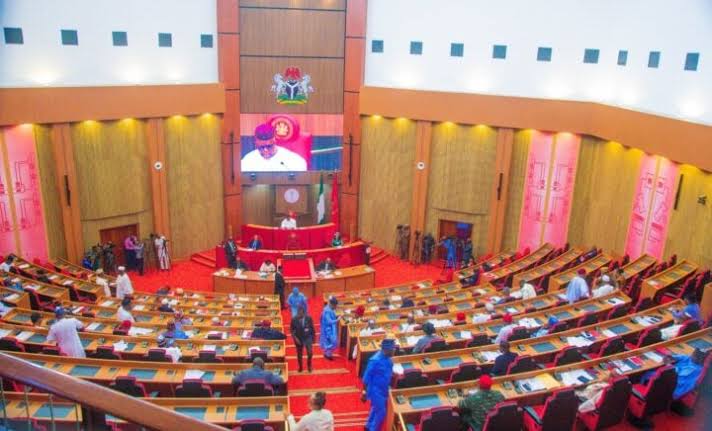

The Senate on Thursday gave approval for the President Bola Tinubu’s controversial Tax Reform Bills to be read for the second time.
The Bills are: ‘A Bill for an Act to Establish the Joint Revenue Board, the Tax Appeal Tribunal and the Office of the Tax Ombudsman, for the harmonisation, coordination and settlement of disputes arising from revenue administration in Nigeria and for other related matters, 2024.
‘A Bill for an Act to Repeal the Federal Inland Revenue Service (Establishment) Act, No. 13, 2007 and enact the Nigeria Revenue Service (Establishment) Act to Establish the Nigeria Revenue Service, charged with powers of assessment, collection of, and accounting for revenue accruable to the Government of the Federation, and for related Matters, 2024.
‘A Bill for an Act to Provide for the assessment, collection of, and accounting for revenue accruing to the Federation, Federal, States and Local Government; prescribe the powers and funtions of tax authorities, and for related matters, 2024.
‘A Bill for an Act to Repeal certain Acts on taxation and consolidate the l;egal frameworks relating to taxation and enact the Nigeria Tax Act to provide for taxation of income, transactions and instruments, and for related matters.
The red chamber had earlier held a one- hour closed session where the federal lawmakers resolved to debate the general principles of the bills.
The Leader of the Senate, Opeyemi Bamidele, read the lead debate when the close session ended and the floor was open to the senators who wanted to contribute.
Opeyemi, while leading the debate on the general principles, indicated that the proposed legislation, if passed into law, will mark a paradigm shift in tax administration in Nigeria, to the advantage of Nigerians.
The senator representing Bayelsa West, Seriake Dickson, commended the executive for coming up with the landmark tax reform bills.
He said the fiscal legislation would entrench fiscal federalism in Nigeria if passed to law.
However, Senator Ali Ndume who is representing Borno South in the Senate, argued that the bills should be withdrawn for proper consultation in order to get the buy-in of the critical stakeholders who are opposed to it.
Ndume’s position was instantly countered by the Senate Chief Whip, Senator Tahir Monguno, who said the views of the stakeholders who are opposed to the bills could be taken at the public hearing after the legislation had passed.
President of the Senate, Godswill Akpabio, who presided over the plenary, put the question on whether the senators would want the bills pass or not and the lawmakers overwhelmingly voted in support.
Senate President, Godswill Akpabio after listening to Ndume, as well as presentations by Seriake Dickson and Mohammed Ali Monguno, who strongly supported the bills, passed them for second reading through voice vote.
The four reform bills’ passage for second reading by the Senate followed presentations made to that effect by the Senate Leader, Senator Opeyemi Bamidele (APC Ekiti Central), in general lead debate on them .
The Senate at the session accordingly passed the bills for second reading through voice votes.
Akpabio therefore mandated its committee on Finance , to organise Public hearing on the bill for inputs from those against the bills like the Governors’s forum, National Economic Council (NEC), Northern Elders ‘ Forum (NEF) etc and report back within six weeks
Senator Dickson, in his contribution during the debate voiced strong support for the initiative, emphasizing its alignment with fiscal federalism.
He acknowledged the concerns raised, particularly regarding the lack of extensive consultation with key stakeholders, including governors and traditional rulers, but maintained that the bills’ core objectives should be upheld.
Dickson underscored the importance of Nigeria’s governments at all levels relying on tax revenues, viewing this shift as essential for sustainable governance.
He commended the bills’ aim to encourage states to generate their own revenue by fostering investment and economic activity.
A major concern highlighted by Dickso was the derivation principle, especially in the context of oil-producing states. Dickson advocated for PAYE taxes of oil workers to be attributed to the states where they work, rather than where corporate offices are located, a move he described as long overdue and essential for equity in revenue allocation.
The senator supported the proposal to ensure VAT collected on goods and services consumed within a state be allocated to that state.
He emphasized that VAT is a consumption tax and should benefit the states where consumption occurs, whether in Bayelsa, Akwa Ibom, Sokoto, or Kano.
Dickson praised the provisions aimed at reducing corporate tax rates from 30% to 25% and exempting lower-income earners from PAYE taxes.
He highlighted the measures as significant steps in alleviating the tax burden on ordinary Nigerians, particularly those in vulnerable economic positions.
While supporting the bills, Dickson acknowledged the concerns of governors and other stakeholders regarding insufficient consultation. He expressed confidence that further dialogue would occur before the legislative process concludes and called for continued engagement to address outstanding issues.
As a self-declared federalist, Dickson emphasized that the proposed reforms align with the principles of fiscal federalism, aiming to empower states and reduce dependence on federal allocations.
He urged his colleagues to pass the bills for a second reading, enabling further scrutiny and public input during the committee stage.
In his speech, Senator Ali Ndume raised concerns about the proposed tax reform bills, emphasizing the need for broader consensus and questioning the timing of their introduction.
While supportive of reform in principle, he highlighted critical issues related to derivation, VAT, and the impact on small and medium enterprises (SMEs).
Senator Ndume expressed concern about the timing, suggesting that introducing tax reforms in the current climate could be misconstrued by the public.


He urged the Senate to consider the sensitivities of the moment, advocating for a more strategic approach to avoid backlash.
Ndume echoed calls for the bills to be withdrawn temporarily to allow for more consultation with state governors, the National Economic Council (NEC), and traditional rulers.
He emphasized that the reforms would be more effective if they had the buy-in of these critical stakeholders, suggesting that swift passage could occur after such consultations.
He identified derivation and VAT as contentious issues arguing that without constitutional amendments, implementing some of the proposals would be problematic.
He supported Senator Seriake Dickson’s point on revenue derivation but stressed the need for clarity and negotiation before passing the bills.
Ndume criticized the provision that applies the same reduced corporate tax rate (25%) to companies with annual turnovers ranging from ₦50 million to billions.
He argued that SMEs, such as those in Nnewi producing goods like shoes, should not be taxed at the same rate as large corporations, as this places an undue burden on smaller businesses.
He warned that reducing VAT for lower-income groups while increasing the corporate tax burden could have unintended consequences. Specifically, he noted that manufacturers might pass increased costs onto consumers, negating the intended benefits of the reform.
Senator Ndume concluded by urging the Senate to consider withdrawing the bills, making necessary amendments based on input from key stakeholders, and reintroducing them for swift passage.
In his contribution to the debate on the proposed tax reform bills, Senator Munguno highlighted the importance of adhering to the established legislative process and expressed strong support for the bills’ general principles, particularly those aimed at reducing the tax burden on Nigerians.
Senator Munguno disagreed with the suggestion by Senator Ali Ndume to withdraw the bills for further consultation with the Nigerian Governors Forum and traditional rulers.
He emphasized that the Nigerian Constitution, particularly Section 60, grants the National Assembly the authority to regulate its proceedings. According to Munguno, the legislative process is clear: after the second reading, the bills are referred to committee for public hearing, where all stakeholders, including governors and traditional rulers, are free to present their views.
He described the suggestion to withdraw the bills as an “academic exercise” outside the established legislative framework.
He stressed that the public hearing phase is the appropriate platform for stakeholders to voice their opinions on the bills. Governors, traditional rulers, and Nigerians from all walks of life are encouraged to participate at this stage to ensure comprehensive consideration of all perspectives.
Senator Munguno praised the bills for their provisions aimed at easing the tax burden on ordinary Nigerians.
He noted key exemptions, including VAT exemptions on essential goods and services such as food, medicine, education, pharmaceuticals, and electricity.
He commended the bill’s focus on protecting low-income earners by exempting those earning below the minimum wage from the Pay As You Earn (PAYE) tax.
Munguno supported the reduction of corporate income tax from 30% to 25%, arguing that it would incentivize companies to hire more Nigerians, thus boosting employment and economic activity.
He viewed this as a significant benefit that would help stimulate the economy while maintaining fairness in the tax system.
Senate President Godswill Akpabio provided insightful commentary on the challenges posed by Nigeria’s current tax system, particularly emphasizing the burden caused by the multiplicity of taxes imposed by various local governments.
His remarks were centered on the need for comprehensive tax reform that would streamline tax collection and reduce the harassment faced by citizens, especially travelers.
Akpabio highlighted a pressing issue faced by travelers in Nigeria constant demands for taxes by different local governments during interstate travel.
He painted a vivid picture of how travelers are stopped repeatedly by tax collectors demanding various permits, such as tire permits and exhaust permits, from different local governments. He cited examples of being taxed by local authorities in states like Edo, Anambra, and Abia, which often leads to long delays and financial extortion. He described this as a major obstacle to free movement and economic activity.
Akpabio called for reforms to address the multiplicity of taxes, which he noted creates fear and discourages travel and business across state lines.
He suggested that any effective tax reform should streamline these processes and eliminate redundant or overlapping tax demands, making it easier for citizens to comply with tax obligations without undue stress or financial strain.
He reminded his colleagues that the discussion was still on the general principles of the bills, with the specifics to be addressed during the public hearing.
Akpabio reassured that the Senate would consult widely, involving experts, traditional institutions, governors, and other stakeholders, to ensure that the final legislation serves the best interests of Nigerians.
Akpabio urged his colleagues to allow the bills to proceed to the second reading. He emphasized the importance of moving forward so that the bills could be thoroughly reviewed, debated, and improved during the public hearing stage.
He stressed that the Senate’s ultimate goal is to pass legislation that benefits all Nigerians.
Senator Akpabio’s remarks underscored the urgency of addressing the chaotic tax environment in Nigeria, particularly the harassment caused by multiple local government taxes.