


By Ola Awoniyi
The passage of the National Minimum Wage (Amendment) Bill 2024 by the National Assembly is now history. The Bill, which President Bola Ahmed Tinubu has already signed into law, amended the National Minimum Wage Act 2019 by increasing the Minimum Wage from 30,000 Naira to 70,000 Naira and reducing the time for periodic review of the National Minimum Wage from five years to three years.
In passing the Bill, the National Assembly did what the time demanded. But no one is commenting on the parliament’s responsiveness in the prompt or speedy passage of the Bill. Isn’t it noteworthy that the lawmakers did what was expected and did it timeously?

Given the flak that the National Assembly got over the passage of the Bill that brought back the old National Anthem, it is necessary to point this out. Of course, opinions are divided on the issue. Some people have asked: Why revert to the old National Anthem? Some also queried the speed with which the National Assembly passed the Bill, accusing the parliament of failing to subject it to a public hearing, one of the critical stages in lawmaking. But that accusation is unfair; it is like calling a dog a bad name to hang it because the Senate subjected the Bill to a Public Hearing. The Attorney-General of the Federation and Minister of Justice, Chief Lateef Fagbemi, and Senior Lawyer Mike Ozekhome participated in the Public Hearing. But those crucifying the National Assembly for what happened or did not happen missed or deliberately ignored that fact. Some critics didn’t even notice that it was an Executive Bill.
The Nigeria Labour Congress also accused the Executive and the Legislature of prioritising the National Anthem over the welfare of workers for passing the Bill before the National Minimum Wage Bill. Senior Lawyer Femi Falana and some civil society organisations demanded that the National Minimum Wage Bill be passed at the same speed as the Bill to Provide for the National Anthem of Nigeria and Related Matters. Interestingly, the National Assembly was being pressured to speedily process a Minimum Wage Bill that was yet to be transmitted by the Executive.
The lawmaking process has stages. A legislative proposal or a Bill passes through the First Reading, Second Reading, Public Hearing, Clause-by-clause consideration of the Bill at the Committee of the Whole, or Committee of Supplies if it is a money Bill, and finally, the Third Reading. Before the Bill is transmitted to the Executive for Presidential assent, the two Chambers – the Senate and the House of Representatives, must have reached concurrence.
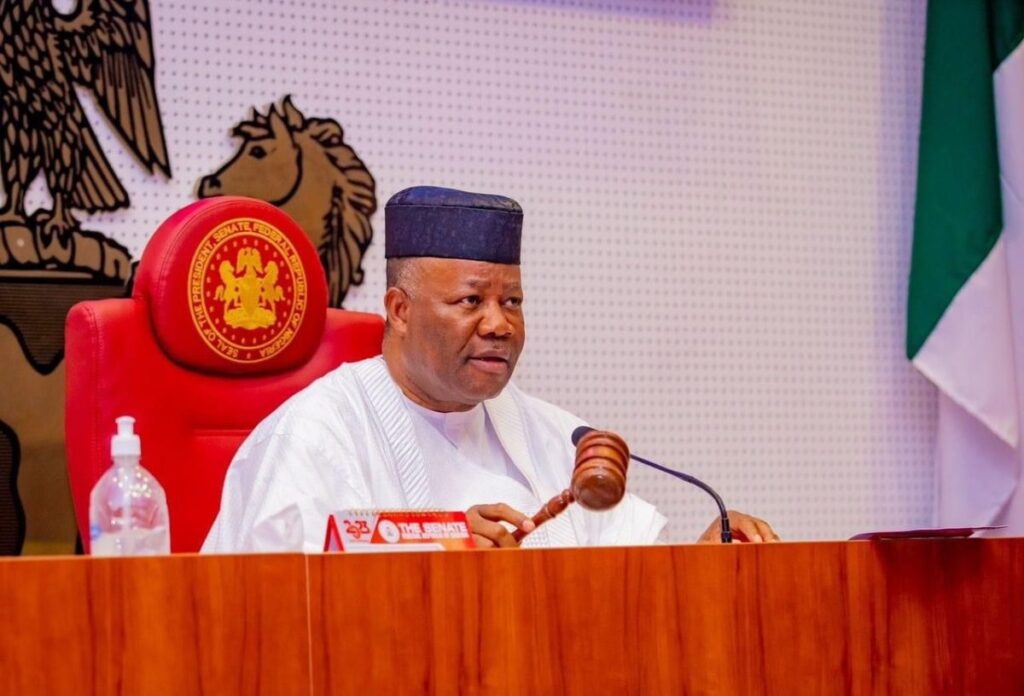
But the pressure was unnecessary. Even when negotiations and consultations were yet ongoing on the Minimum Wage, the President of the Senate, Godswill Obot Akpabio, had assured the nation of “speedy consideration and passage” of the new National Minimum Wage Bill whenever the proposal was presented to the National Assembly:
“Let me assure you that we stand by this commitment. We cannot afford to fail the nation at this critical time,” Akpabio was quoted as saying in a message at a retreat held for some federal lawmakers in Abuja. The National Institute for Legislative and Democratic Studies organised the retreat.
At the commencement of the Plenary on Tuesday, 23rd July 2024, the Senate President acknowledged the receipt of the new National Minimum Wage Bill transmitted by the President. On the same day, without delay, the Bill passed the necessary stages of the lawmaking process simultaneously in both Chambers. Falana, in his earlier statement on the National Anthem Bill, had urged that the Minimum Wage Bill be passed within 48 hours. But the Senate did even better. It passed the Bill within one hour. That was faster than the passage of the National Anthem Bill.
However, the speedy passage of the Bill by the National Assembly was not because of the pressure mounted on it from outside. The National Assembly was determined to have the issue of National Minimum Wage concluded as early as possible. They decided not to proceed on their 2024 annual recess until the issue was concluded logically. Negotiations involving the government, labour, and the organised private sector were concluded at the tripartite committee level. Also, the President consulted other critical stakeholders, particularly the State Governors, to enhance consensus building. This made the job of lawmaking on the issue easier for the parliament. After all those negotiations and meeting of minds, all that was needed was a parliamentary seal. And this the lawmakers offered in the national interest.
By passing the bill with dispatch, the federal lawmakers loudly stated that they care about the Nigerian workers. Bills may take several months or years to pass. Some are even passed across dispensations.
Fair observers will acknowledge that since the inception of the Akpabio 10th Assembly, legislative proposals that directly impact people’s lives have received accelerated and expeditious consideration. This demonstrates that the 10th Assembly is people-centric.
However, despite this people-oriented disposition, the National Assembly still faces a trust deficit arising from an unfair perception of the institution as a mere money guzzler. This perception didn’t start with the 10th Assembly; it is a baggage that its predecessors also carried.
This age-long perception is that lawmakers are concerned only about what they can take for themselves. This explains why critics are constantly on alert for a whiff of scandal and an error of commission or omission by the institution. And when that appears, they swiftly cash in and feast on it. With this mindset, discussing any well-delivered aspect of its mandate, like the passage of the new National Minimum Wage Bill, becomes an aberration.
At the inception of the 10th Assembly, Godswill Obot Akpabio, President of the Senate and Chairman of the National Assembly, promised that the Assembly would be a Peoples’ Parliament. Evidence abounds in the number and quality of the Bills since passed, as well as in its various legislative interventions, that this has been the case. The 10th Assembly will live by that promise always.
***Awoniyi, Media Aide to Senate President, writes from Abuja