
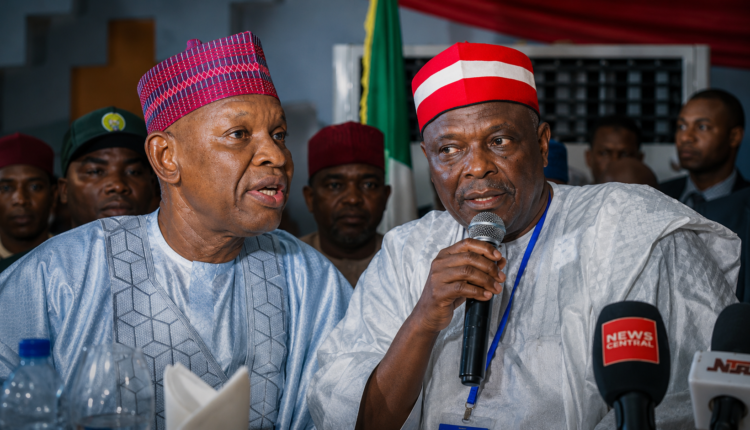

The deepening political rift between former Kano State Governor Rabiu Musa Kwankwaso and his successor, Abba Kabir Yusuf, has taken a new turn, with allegations of anti-corruption interference and attempts to influence the 2027 electoral contest now at the centre of their dispute.
Kwankwaso, the Nigeria Democratic Congress vice-presidential candidate for the 2027 general elections, accused Yusuf of allegedly using the Economic and Financial Crimes Commission and proxy organisations to damage his reputation and weaken his political influence ahead of the polls.
But the Kano State Government has rejected the allegations, insisting that the governor has no involvement in Kwankwaso’s dealings with the anti-graft agency and describing the accusations as politically motivated.

The former governor made the allegations in a statement on Friday, November 27, in which he expressed disappointment over the breakdown of a relationship he said had lasted 43 years.
Kwankwaso recalled that Yusuf had served as his personal assistant, principal private secretary and commissioner before becoming the preferred candidate of the Kwankwasiyya movement in the 2019 and 2023 governorship elections.
He alleged that the trust built over the years had been abused, claiming that the governor was now determined to drag him and members of his family into public controversy.
According to Kwankwaso, Yusuf personally submitted a request to the EFCC several months ago, seeking an investigation against him, but allegedly turned to the Society for Anti-Corruption and Good Governance Initiative after failing to secure the desired action from the commission.
He linked the allegation to a protest staged by the organisation at the EFCC headquarters in Abuja on November 25, where it submitted a petition seeking an investigation into properties allegedly linked to him in Abuja, Kano and Nasarawa states.
Kwankwaso further accused the governor and some members of his cabinet of using media platforms to circulate selective information aimed at portraying him negatively.
He also alleged that the political pressure extended beyond him to members of his camp, particularly the NDC’s Kano governorship candidate, Aminu Abdussalam.
The former governor claimed that attempts were being made to influence the Independent National Electoral Commission and the judiciary to frustrate his camp’s participation in the 2027 governorship election.
He warned that the alleged actions could heighten political tension and threaten peace in Kano State.
However, the state government, in a statement signed by the Commissioner for Information and Internal Affairs, Sunusi Bature Dawakin Tofa, said Yusuf had absolutely no involvement in Kwankwaso’s dealings with the EFCC.
It argued that the former governor had engagements with the anti-corruption agency long before the present administration came into office, making it wrong to associate the governor with the matter.
The government also dismissed Kwankwaso’s attempt to link Yusuf with the internal crisis and court cases involving the NDC, describing them as party matters outside the governor’s control.
It accused the former governor of making Yusuf a convenient target to attract public sympathy and regain political relevance ahead of the 2027 elections.
The administration urged Kwankwaso to address the challenges within his political camp rather than blame the Kano Government for his political difficulties.
It maintained that Yusuf was elected to govern the state and would not be distracted by what it described as political blackmail and unfounded allegations.
The government added that the people of Kano would have the opportunity to decide the political future of the state through the ballot in 2027.
The latest exchange exposes the widening gulf between two politicians whose political fortunes were closely connected for years, with their disagreement now extending into questions about the independence of anti-corruption institutions and the fairness of the coming electoral contest.
Kwankwaso, while making his allegations, commended the EFCC for what he described as its professionalism and impartiality, urging political actors to respect the independence of public institutions.
The allegations against Yusuf, however, remain claims by the former governor, while the state government has firmly denied any involvement. Neither the allegations of political interference nor the alleged attempt to influence electoral and judicial institutions has been independently established.