

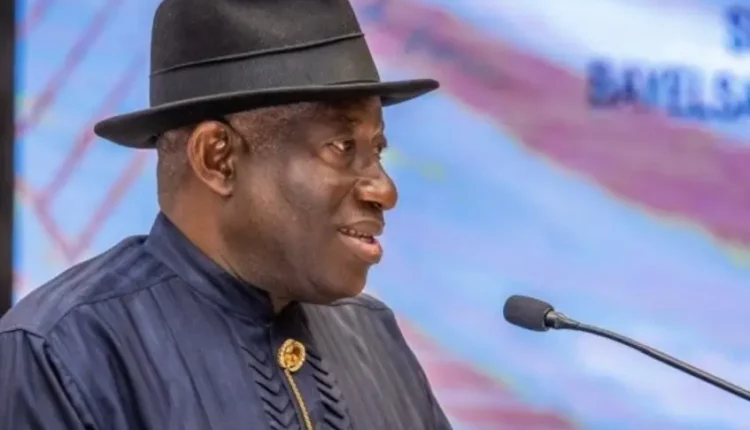

Former President Goodluck Jonathan has called for a comprehensive overhaul of Nigeria’s democratic system, warning that opaque political practices, weak institutions and identity-driven leadership selection are undermining national development.
Jonathan made the call on Saturday in Lagos while delivering an address as Chairman of the Occasion at the Herbert Macaulay Memorial Colloquium.
He challenged political leaders to rebuild the country’s democratic institutions around popular participation, the rule of law, separation of powers, human rights, judicial independence and accountability.


Jonathan described Nigeria’s current democratic practice as “opaque and amorphous”, arguing that the country would struggle to achieve meaningful progress without fundamental institutional reforms.
“We must review our opaque and amorphous democratic system and align it with the fundamental pillars of democracy,” he said.
The former President also criticised Nigeria’s political recruitment process, saying religion, ethnicity and language often influence leadership selection more than competence, character and capacity.
He said the practice had persisted since the pre-independence era and continued to prevent capable Nigerians from emerging as leaders.
“Our political recruitment process has been problematic, even from the pre-independence era,” Jonathan said.
He urged Nigerians to abandon what he described as primitive approaches to leadership selection and prioritise merit and competence.
Jonathan also called for stronger educational institutions, saying Nigeria needed functional education capable of driving technological advancement, innovation and knowledge creation.
Looking towards Nigeria’s centenary of independence in 2060, he urged political leaders to develop a clear national development agenda with measurable targets, timelines and identifiable responsibilities.
He warned that without deliberate action, another generation could inherit the same challenges confronting the country today.
Jonathan identified leadership failures, corruption, institutional weaknesses, policy inconsistency, insecurity, poor infrastructure and dependence on raw material exports as major obstacles to national development.
He cited the progress recorded by countries such as South Korea, India and Singapore in industrialisation, technology, education and healthcare, urging Nigeria to convert its human and natural resources into sustainable development.
The former President also called on Nigerians to preserve the country’s history and recognise the contributions of its founding nationalists.
He described Herbert Macaulay as a courageous nationalist, journalist, engineer and political activist who challenged colonial injustice and advocated greater political participation.
Jonathan said the founding nationalists envisioned a united and prosperous country where citizens would enjoy equal rights, dignity and opportunities regardless of their ethnic, religious or linguistic backgrounds.
He urged younger Nigerians to sustain that vision through innovation, enterprise, civic participation and accountability.
Earlier, former Peoples Democratic Party Deputy National Chairman, Chief Olabode George, appealed to President Bola Tinubu to return the property housing the General Post Office in Lagos to the Macaulay family.
George said the family intended to establish a permanent memorial hall on the property to preserve the nationalist’s legacy and educate younger generations about his contributions.
Macaulay, born on November 14, 1864, died in 1946, 14 years before Nigeria gained independence in 1960.