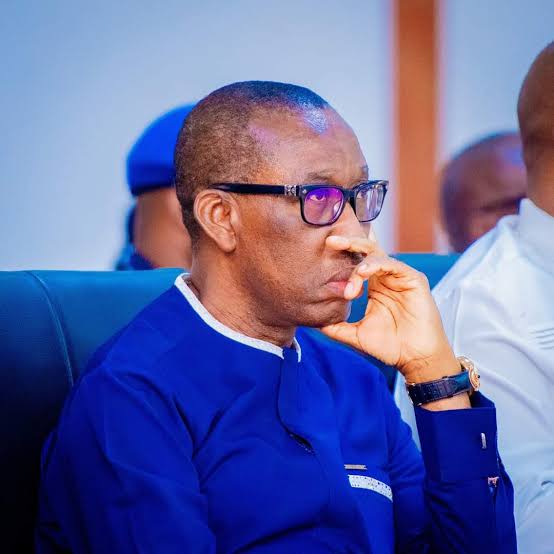
The Human Rights Writers Association of Nigeria (HURIWA) has shifted the spotlight from allegations to accountability, pressing the Economic and Financial Crimes Commission (EFCC) to explain what it calls a troubling silence in the high-profile probe of former Delta State Governor, Ifeanyi Okowa.
This was contained in a statement issued by its national coordinator, Emmanuel Nnadozie Onwubiko.
At the heart of HURIWA’s intervention is not just the allegation of mismanaged 13% derivation funds, but what the group frames as a credibility test for Nigeria’s anti-corruption system. While Okowa was reportedly questioned by the EFCC in November 2024 amid claims of massive financial impropriety, the absence of clear updates since then has, according to the group, created an “information vacuum” now filled with speculation.
That vacuum, HURIWA argues, has become more politically sensitive following Okowa’s defection to the ruling All Progressives Congress(APC) in October 2025. The group stops short of making direct accusations but insists the sequence of events has amplified public suspicion about whether political alignment can influence the pace—or outcome—of corruption investigations.
By issuing a seven-day ultimatum, HURIWA is effectively forcing a binary outcome: either visible prosecutorial action or an official explanation. Anything less, the group warns, risks reinforcing a narrative that anti-graft enforcement in Nigeria is selective or negotiable.
The statement also draws a wider arc, linking the Okowa case to a pattern of unresolved high-profile probes. It references past scrutiny involving Senate President Godswill Akpabio and recalls remarks by Adams Oshiomhole that have, in public discourse, been interpreted as suggesting political defections can reshape legal exposure.
Rather than dwell solely on criticism, HURIWA pushes structural reforms. Its proposed “Certificate of Clearance” for political aspirants and a public registry of ongoing investigations reflect a broader attempt to institutionalize transparency—effectively moving anti-corruption from episodic enforcement to a rules-based system visible to voters.
The underlying message is clear: unresolved allegations are no longer just legal matters—they are political liabilities capable of shaping voter perception ahead of the 2027 elections.
For HURIWA, the EFCC’s response to the Okowa case is more than a procedural update; it is a referendum on whether Nigeria’s anti-corruption fight can maintain independence in a politically fluid environment.
Okowa Probe: HURIWA Tests EFCC’s Credibility with 7-Day Transparency Demand