


By Friday Idachaba, Lokoja
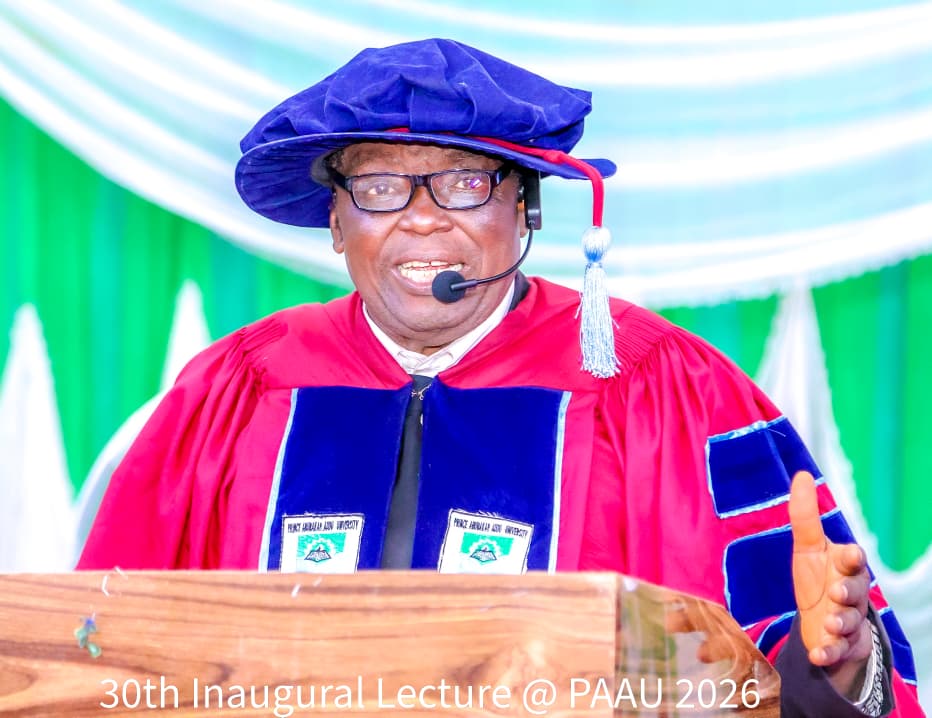
A professor of Science Education at Prince Abubakar Audu University (PAAU), Anyigba, Lawrence Achimugu, has called for a state of emergency on teachers’ welfare and education funding, warning that poor remuneration and inadequate resources are undermining effective teaching and learning in Nigeria.
Achimugu, who is also Dean of the Faculty of Education, said innovative teaching methods would remain largely ineffective unless governments addressed the poor working conditions, inadequate infrastructure and weak institutional support confronting teachers.


He made the call while delivering the university’s 30th inaugural lecture, titled “Monkey De Work, Baboon De Chop: The Dark Shadow over Innovative Teaching Methods in Science Education.”
The professor argued that science education must go beyond memorising facts to equip learners with critical-thinking, problem-solving and practical skills required for innovation and national development.
He identified inquiry-based, problem-based and project-based learning, alongside Science, Technology, Engineering and Mathematics (STEM), digital laboratories, artificial intelligence-supported learning and blended instruction, as approaches capable of improving science education.
However, he lamented that inadequate funding, overcrowded classrooms, poor infrastructure and insufficient teacher training continued to limit their adoption across the country.
Explaining his lecture’s title, Achimugu said the expression “Monkey De Work, Baboon De Chop” reflected the injustice of expecting teachers to take on additional responsibilities and adopt new teaching techniques without corresponding pay, recognition or institutional support.
Drawing on more than 42 years of teaching experience across primary, secondary and tertiary institutions, he warned that continued neglect of teachers could weaken morale, undermine professional commitment and prevent innovative methods from delivering their expected benefits.
He proposed a new remuneration framework, which he called the “Living Salary Scale”, urging governments at all levels to improve teachers’ salaries, incentives and employment benefits.
Achimugu also called for increased public investment in education, urging the Federal Government to work towards the allocation benchmarks of 26 per cent of the annual budget and 15 per cent of Gross Domestic Product to the sector.
On university education, he recommended the reintroduction and compulsory application of the Postgraduate Diploma in Education (PGDE) as a minimum teaching qualification for university lecturers, arguing that subject knowledge alone was insufficient without pedagogical competence.
He warned that weaknesses in science education could limit the supply of skilled professionals in medicine, engineering, agriculture and technology, with consequences for healthcare, industrialisation and environmental sustainability.
In his remarks, PAAU Vice-Chancellor, Professor Salisu Ogbo Usman, said the lecture reaffirmed the university’s commitment to scholarship and the application of research to societal development.
Usman stressed that effective science teaching should promote experimentation, curiosity, critical thinking and practical problem-solving rather than rely solely on memorisation.
He congratulated Achimugu and commended the Inaugural Lecture Committee, chaired by Professor S. S. Arogba, for organising the event.
The lecture brought together members of the university community and invited guests to examine the challenges facing science education and the reforms needed to improve teaching and learning.