

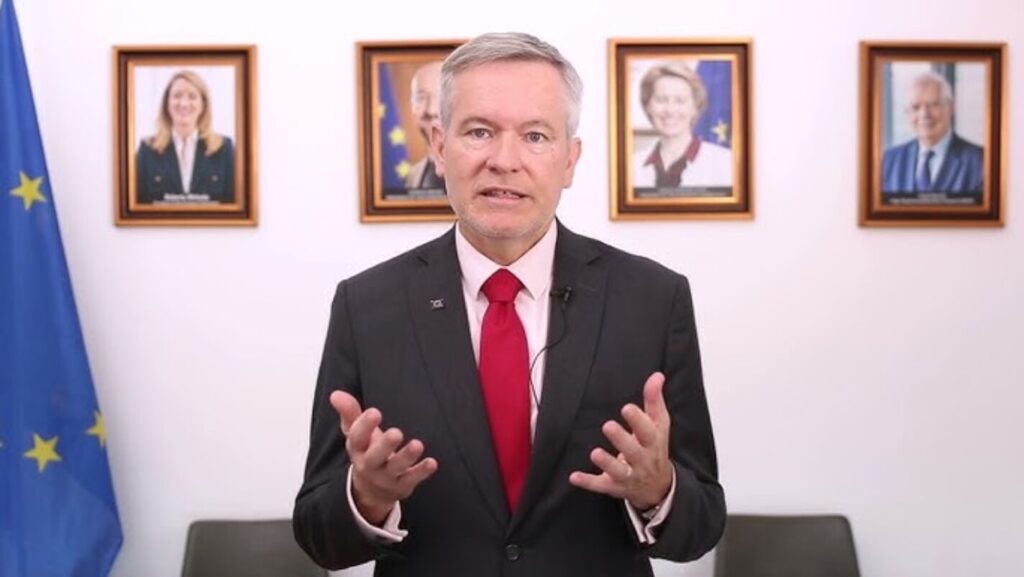

The European Union has committed nearly €45 million in humanitarian assistance to Nigeria, warning that emergency relief alone cannot break the cycle of poverty without sustained investment in social protection, security and economic opportunities.
EU Ambassador to Nigeria and the Economic Community of West African States, Gautier Mignot, said millions of Nigerians facing deprivation, displacement and insecurity needed more than temporary assistance to rebuild their lives.
Speaking on Saturday in Abuja at the 2026 International Day for the Eradication of Poverty, Mignot stressed that humanitarian aid must be linked to long-term recovery, economic resilience and sustainable pathways out of poverty.
“Humanitarian needs cannot wait, and poverty either,” he said.
The event was held under the theme, “United for Peace and Human Rights: Safe Homes for All.”
Mignot said the EU’s humanitarian assistance, delivered through the European Civil Protection and Humanitarian Aid Operations (ECHO), focused particularly on conflict-affected and crisis-prone communities.
He said emergency interventions must go beyond immediate relief to help vulnerable households rebuild their livelihoods and escape persistent deprivation.
The ambassador cited Nigeria’s 2022 National Multidimensional Poverty Index, which estimated that about 133 million Nigerians, representing 63 per cent of the population at the time, were experiencing multidimensional poverty.
He said the figures reflected overlapping disadvantages in healthcare, education, housing, living standards and access to essential services.
According to him, poverty goes beyond a lack of income to include limited access to decent employment, basic services and opportunities for meaningful participation in society.
Mignot warned that poverty reduction efforts could not succeed without peace, security, dignity and respect for human rights.
He acknowledged the Federal Government’s social investment and cash transfer programmes, as well as livelihood and economic empowerment initiatives.
He also welcomed renewed government investment in social protection through initiatives including the Renewed Hope Social Protection Programme and the Household Prosperity and Empowerment Social Protection Project, known as HOPE-SP.
The ambassador said the EU was supporting Nigeria through its Supporting Sustainable Social Protection Systems in Nigeria (SUSI) programme.
The initiative is implemented in partnership with government institutions and organisations including UNICEF, GIZ, the International Labour Organisation, ActionAid Nigeria and Oxfam.
It seeks to strengthen social protection policies, improve institutional capacity and help authorities identify and support poor and vulnerable households.
Mignot said the programme was operating at national and state levels, including in Abia, Benue, Oyo, Sokoto, Kebbi, Adamawa and Borno states.
He said expanding the social register and improving data systems would help authorities identify vulnerable households and direct public resources to communities with the greatest needs.
According to him, evidence-based poverty assessments could help governments develop better-targeted interventions by identifying disadvantages in health, education, nutrition and living standards.
Mignot also disclosed that the EU had supported the review of Nigeria’s National Social Protection Policy, approved by the National Economic Council.
He said the partnership also covered the development of state-level policies and a social protection bill.
The ambassador said the EU’s broader cooperation with Nigeria extended to governance, justice, conflict prevention, healthcare, education, agricultural value chains, women’s empowerment and social cohesion.
He welcomed Nigeria’s ongoing transition towards greater government responsibility for funding and coordinating humanitarian assistance.
However, he reaffirmed the EU’s commitment to supporting poverty reduction and strengthening the resilience of vulnerable communities.
Mignot commended the Minister of Humanitarian Affairs and Poverty Reduction, Dr Bernard Doro, for his efforts.
He stressed that tackling poverty required coordinated action and a sustained commitment from government, development partners and communities.
He said the ultimate objective was to build a more inclusive and resilient Nigeria where citizens could live in dignity, enjoy their fundamental rights and access opportunities to improve their lives.
The challenge, he added, is to translate humanitarian commitments and social protection policies into tangible improvements in the lives of Nigerians struggling with poverty.