

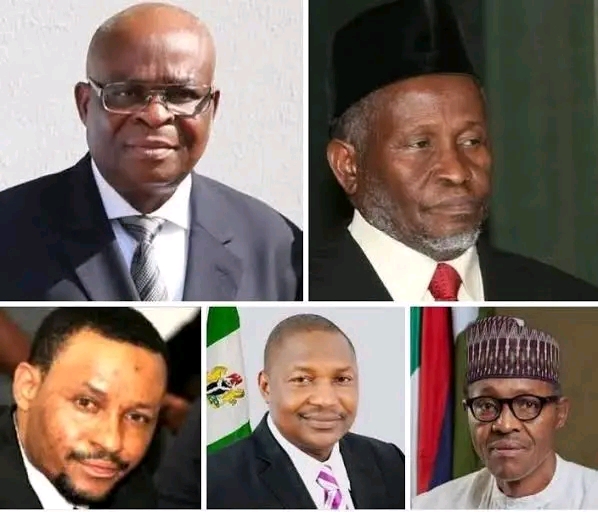

Perhaps, the story of Justice Walter Onnoghen is a life lesson we should all learn from.
If, after reading this story, you learn nothing about life, then perhaps you never will.
In 2019, as the general elections approached, the Buhari-led government grew suspicious of the Supreme Court under the leadership of Walter Onnoghen.
The Supreme Court had earlier delivered judgments that did not go down well with the Federal Government.
In 2016, the Supreme Court acquitted Senate President Bukola Saraki, whom the Buhari administration was prosecuting over allegations relating to his asset declaration. (See Saraki v. FRN.)
It became apparent that if the Buhari-led government proceeded with the 2019 elections with Walter Onnoghen still serving as Chief Justice of Nigeria, there could be uncertainty about the judicial implications of the elections.
The Federal Government appeared determined to get Onnoghen out of the way.
But before that could happen, it needed a crack from within, and a few names came into the picture.
The first was Abubakar Malami, who was then the Attorney General of the Federation.
Malami quietly obtained an ex parte order from the Code of Conduct Tribunal for the suspension of Walter Onnoghen as Chief Justice of Nigeria.
The order was issued on January 23, 2019, and President Muhammadu Buhari acted on it two days later, suspending Onnoghen and swearing in an acting CJN.
The second person was Justice Danladi Umar, the then Chairman of the Code of Conduct Tribunal.
Umar presided over the tribunal that granted the ex parte order and subsequently conducted the trial that led to Onnoghen’s conviction for false asset declaration.
The trial lasted 94 days.
Eventually, the Buhari-led government had its way, and Onnoghen was removed from office without the ordinary constitutional process for removing a judicial officer being followed through the National Judicial Council.
The next person was Justice Ibrahim Tanko Muhammad, the most senior Supreme Court justice after Walter Onnoghen.
He was expected to be among those who would insist that the executive comply with the constitutional provisions governing the removal of a Chief Justice of Nigeria.
But he did not.
Instead, Justice Ibrahim Tanko Muhammad accepted the appointment as acting CJN and was sworn in on January 25, 2019, the same day Onnoghen’s suspension was announced.
Ordinarily, one might have expected the matter to become history and everyone involved to move on with their lives.
But life has a way of confronting us with the consequences of our actions.
Everyone on the list I have mentioned eventually faced challenges of their own.
Starting with Abubakar Malami, the former Attorney General.
Malami was later charged by the Tinubu administration in a 16-count case involving allegations of money laundering, conspiracy and the concealment of illicit funds running into billions of naira.
In July 2026, a Federal High Court ordered the final forfeiture of more than 48 properties linked to him following proceedings brought by the Economic and Financial Crimes Commission (EFCC).
What about Danladi Umar, who presided over the tribunal that convicted Onnoghen?
In November 2024, the Senate voted 74 to 10 to remove Umar as Chairman of the Code of Conduct Tribunal over allegations of misconduct and corruption.
In July 2026, he was remanded in custody in connection with a separate corruption case. He was subsequently granted bail in the sum of ₦100 million.
What about Justice Ibrahim Tanko Muhammad, who took Walter Onnoghen’s place on the very day of his suspension?
On June 14, 2022, 14 Supreme Court justices reportedly petitioned against him over allegations of corruption and the diversion of funds meant for their welfare.
He resigned as Chief Justice of Nigeria on June 27, 2022, after his resignation was announced the previous night.
He subsequently died on December 16, 2025, at the age of 71, while receiving medical treatment in Saudi Arabia.
And lastly, Muhammadu Buhari, the president under whose administration all this happened, is also no longer alive.
Yet, five years and six months after his removal from office and conviction by the Code of Conduct Tribunal, Walter Onnoghen was discharged and acquitted by the Court of Appeal on November 4, 2024.
He has since withdrawn from the public spotlight, living a quiet and private life.
I always say that a man cannot sow rice and expect to reap beans.
History has a way of coming full circle, and the decisions we make today may have consequences we cannot predict tomorrow.
— Ekene Aninze, Esq.
#TVAuthority