


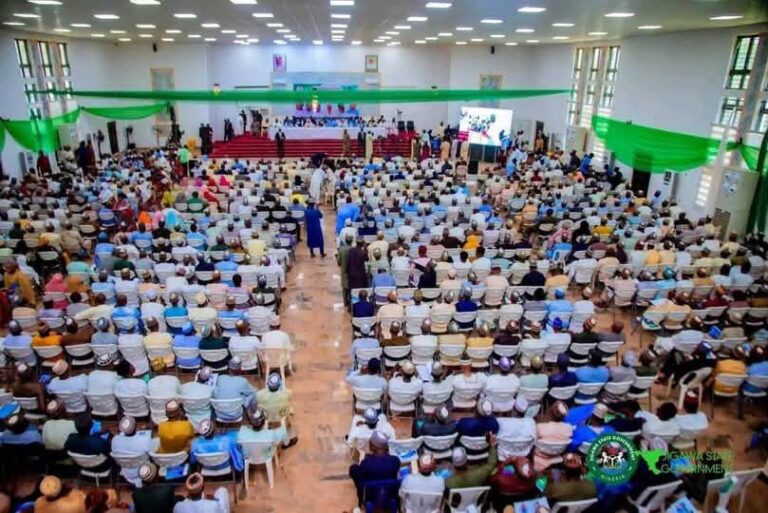
Concerned academics in Jigawa State have disowned an alleged endorsement of Governor Umar Namadi and President Bola Tinubu, accusing the state government of turning an education-focused intellectual engagement into a political gathering.
The academics said they attended the meeting expecting to discuss the state’s worsening educational challenges and offer research-based solutions, only to discover that the programme had been redirected towards political endorsements.
In a statement signed by Professor Muhammad Abdu Mago on behalf of concerned members of the Jigawa Academic Forum, the group said the development amounted to a serious breach of the trust placed in the organisers.

According to the academics, members were invited individually to a roundtable with the state government and attended out of respect for the office of the governor.
Some, they said, came prepared with papers, data and proposals on issues including out-of-school children, school infrastructure, girl-child education and poor learning outcomes.
“But there was a sudden hijack of the process; the meeting was turned into a political campaign platform,” the statement said.
The group alleged that the education agenda was abandoned and replaced with a staged vote of confidence and endorsement for Namadi and Tinubu.
It further alleged that cameras were brought into the venue and that prepared statements were read, while photographs and other recordings from the meeting were subsequently used to portray participants as political supporters.
The academics insisted that their presence at the meeting did not amount to support for either the governor or the President.
They also questioned the presence of Ibrahim Masari, Special Assistant to the President on Political Matters, at the event.
Mago asked why Masari, whom he described as an indigene of Katsina State and not a member of the academic forum, was present at a meeting supposedly convened to address Jigawa’s educational development.
The academics said the incident was particularly disturbing because the forum was created to provide independent intellectual scrutiny and advice on education, rather than serve as a political platform.
They recalled that the Congress of Jigawa Academics, which preceded the current Jigawa Academic Forum, was established during the administration of former Governor Sule Lamido as a non-partisan platform for academics of Jigawa origin.
Mago said the forum was intended to remain independent of whoever occupied the Government House.
He accused the current administration of attempting to compromise that independence in order to create an impression of academic support for its political activities.
The group said the state’s educational challenges required evidence-based engagement rather than political mobilisation.
It alleged that Jigawa still struggles with significant problems involving out-of-school children, inadequate school infrastructure and poor educational outcomes.
The academics also criticised what they described as the government’s failure to demonstrate sufficient achievements in the education sector.
They specifically alleged that the administration had not completed a single educational project in its three years in office, a claim that could not be independently verified from the statement.
The group therefore rejected what it described as a purported endorsement of Namadi and Tinubu, insisting that endorsement was neither contained in the invitation nor included in the agreed programme.
“The purported endorsement being circulated in the media does not represent us, our views, or our collective will,” the statement said.
The academics also warned against using photographs, signatures or video recordings obtained at the meeting to suggest political support from participants.
They said doing so could damage public confidence in the neutrality of the academic community and weaken the forum’s ability to scrutinise government policies.
Mago said academics should remain willing to criticise government and offer solutions regardless of the political party in power.
“Our duty is to critique, advise and proffer solutions to government, irrespective of who is in power,” he said.
The group consequently declared that the Jigawa Academic Forum would remain non-partisan and would not endorse politicians.
“As academics, we will only endorse ideas. There shall be no political endorsement. Our credibility is our only capital,” the statement added.
The academics said they remained open to genuine engagement with the government on education but would resist attempts to turn the forum into a political structure.
They described the controversy as a test of the forum’s independence and vowed to preserve its role as an intellectual platform for confronting Jigawa’s educational challenges.
