


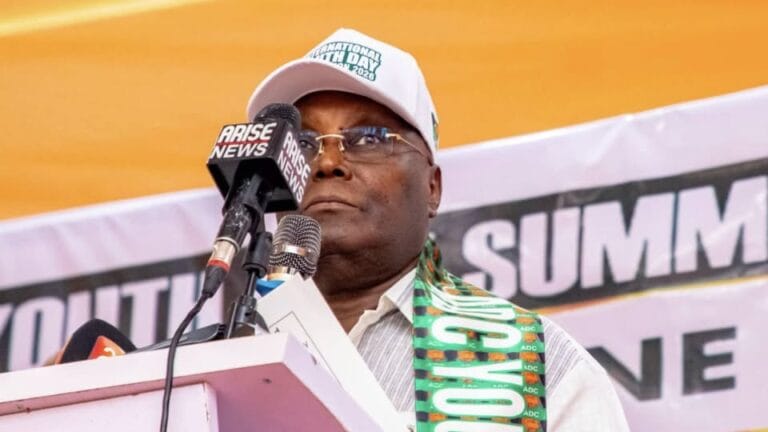
The Presidential Candidate of African Democratic Congress(ADC) Former Atiku Abubakar has criticised Nigeria’s growing raw-material exports, saying the country is losing the bigger economic benefits by shipping resources abroad instead of processing them locally.
The Former Vice-President raised the issue as raw-material exports rose by 106 per cent to ₦3.84tn in the first half of 2026, from ₦1.86tn during the same period in 2025.
But while exports are rising, Atiku said Nigerian manufacturers are sitting on about ₦2.14tn worth of unsold goods.

He described the situation as a major contradiction in the economy.
Atiku spoke through his Senior Special Assistant on Public Communication, Phrank Shaibu, on Tuesday.
He said Nigeria was exporting cocoa beans instead of cocoa products, hides instead of leather goods, and cotton instead of garments.
“There is nothing wrong with exporting. The problem is exporting the cheapest part of the value chain and buying back the expensive part,” he said.
Atiku said Nigeria must increase local processing before exporting its agricultural and mineral resources.
He argued that this would allow the country to create more jobs and retain more value from its natural resources.
The former vice-president also blamed high fuel, electricity, transport and credit costs for putting pressure on manufacturers.
He said the weak purchasing power of Nigerians was making it difficult for businesses to sell their products.
According to Atiku, the ₦2.14tn in unsold manufactured goods reflects the pressure facing both businesses and households.
He proposed cheaper long-term financing, industrial clusters, agro-processing and mineral processing as part of his economic recovery plan.
Atiku also proposed a production-linked subsidy, saying government support should depend on actual production and measurable benefits to Nigerians.
He further proposed a $10bn financing programme for young entrepreneurs and start-ups.
Atiku said Nigeria’s ambition to build a $1tn economy should be matched by stronger production, more jobs and improved living standards.
“You cannot build a $1 trillion economy by making your own people poorer,” he said.
He accused the Tinubu administration of pursuing an economic direction that, in his view, leaves Nigeria exporting raw resources while importing higher-value finished products.
The Federal Government had not responded to the latest allegations at the time of filing this report.
