


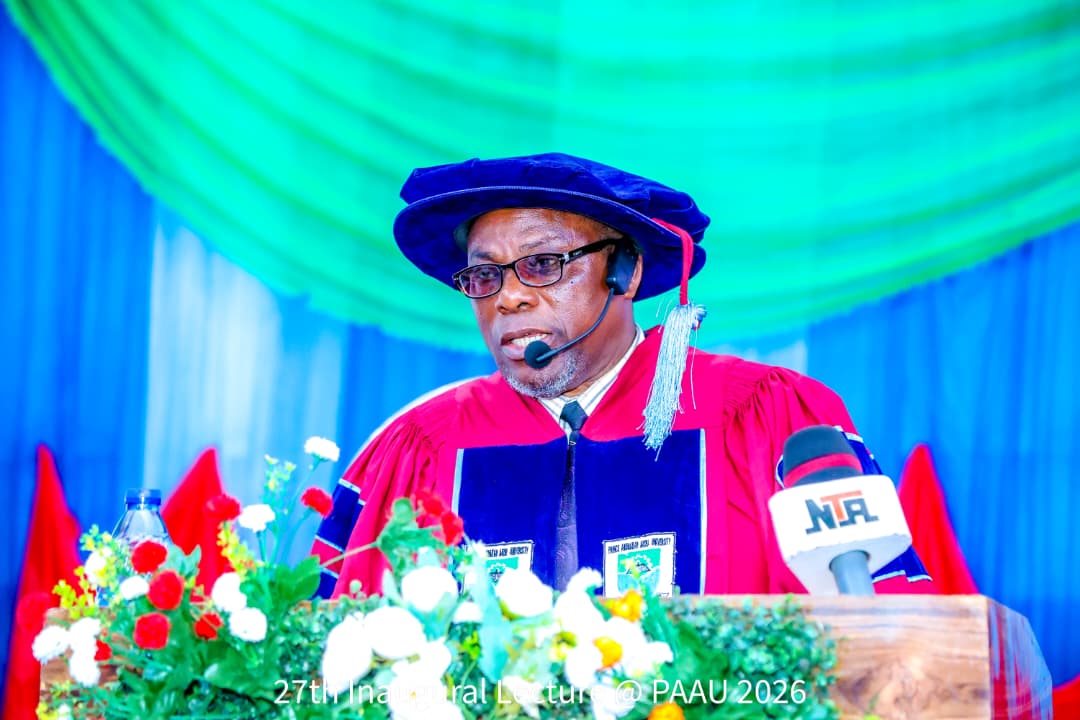
By Friday Idachaba, Lokoja
A Professor of Dramatic Literature and Film Studies at Prince Abubakar Audu University (PAAU), Anyigba, Oja Paul Egwemi, has called for a major overhaul of theatre and performance curricula in Nigerian universities to make them more responsive to the country’s development challenges.
Egwemi made the call while delivering PAAU’s 27th Inaugural Lecture, titled “The Gowns We Wear, The Towns We Go: Rethinking Performance Curricula for Development in Nigeria Amid a Polycrisis,” at the university auditorium in Anyigba.
He said the country’s universities must urgently close the gap between academic training and the realities confronting communities across Nigeria.
According to him, Nigeria is facing a “polycrisis” involving interconnected problems such as poor governance, economic instability, insecurity, environmental pressures and social fragmentation.
Egwemi argued that although Nigerian universities have invested heavily in drama and film education over the years, much of the knowledge produced in the classroom has not been sufficiently translated into practical solutions for communities.
To address the problem, the don unveiled a Polycrisis-Responsive Curricular Theatre for Development (PRCTfD) model.
He said the model is built around five key pillars: participatory knowledge production, interdisciplinary collaboration, digital and community communication, sustainability through community ownership, and impact evaluation with reflective learning.
Egwemi said Theatre for Development (TfD) could provide a strong link between university scholarship and community realities if properly integrated into academic curricula.
He explained that theatre should no longer be seen as a one-way process in which students simply take knowledge from the classroom to communities.
Rather, he said, the process should allow universities and communities to jointly produce knowledge and develop practical solutions.
Drawing from TfD projects carried out in Ayah, Odolu, Ofabo and Ajagwumu communities, the lecturer said participatory theatre had helped uncover challenges involving education, healthcare, water supply, markets and other areas.
He, however, noted that some interventions struggled to survive because of weak community ownership and inadequate follow-up.
“Consultation should not be mistaken for genuine participation,” Egwemi warned, stressing that community members must be involved from research and script development to performance, post-performance discussions and follow-up activities.
The don also called for stronger collaboration between Theatre for Development practitioners and specialists in microbiology, healthcare, education, environmental studies and other relevant disciplines.
He said such partnerships, including collaboration with non-governmental organisations, would provide the technical expertise required to make community interventions more effective and sustainable.
Egwemi further urged universities to abandon short-term, semester-based community projects in favour of continuous and context-sensitive engagement.
He also advocated greater use of indigenous media, local languages and folk traditions in theatre education and practice.
He maintained that performance education must go beyond entertainment and economic benefits to become an instrument for promoting civic consciousness, encouraging dialogue and mobilising communities for collective action.
The don therefore called for sustained funding to enable universities to maintain meaningful engagement with communities.
Earlier, the Chairman of the Inaugural Lecture Committee, Prof. S.S. Arogba, congratulated Egwemi on the academic milestone and commended his contributions to Dramatic Literature and Film Studies.
The Vice-Chancellor of PAAU, Prof. Salisu Ogbo Usman, also congratulated the lecturer and praised the subject of the inaugural lecture.
Usman, represented by the Deputy Vice-Chancellor (Administration), Prof. Rufai Sani Abdullahi, said closing the gap between the “gowns we wear” and the “towns we go” was crucial to national development.
