
Douglas Baye-Osagie
dbayeosagie@yahoo.com
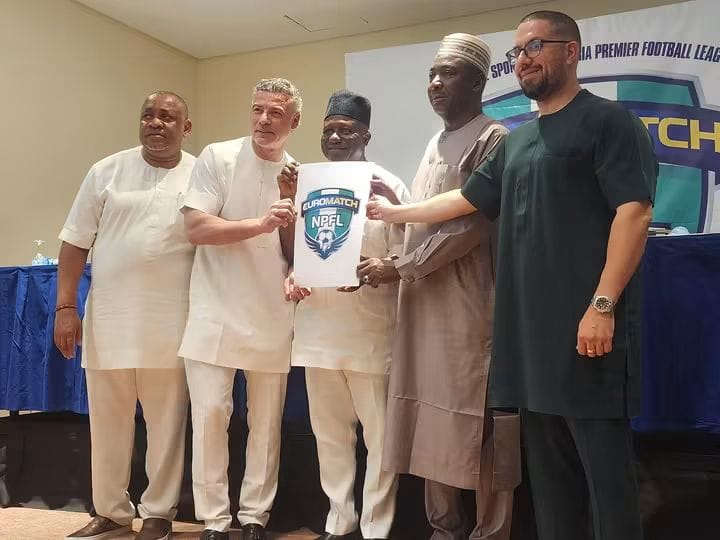
After almost a decade in the wilderness, Nigerian club football has finally landed a title sponsor again, The EuroMatch Group, a betting company based in Poland.
The EuroMatch Group’s $7.5 million, three-season deal may not match South Africa’s R900 million Betway Premiership agreement, but for the NPFL, it is oxygen.
If this is to be the final act of this NFF board, then it might just be the best place to draw the curtains on four years that have largely been disappointing and sour for the fans of the game in Nigeria.
As chaotic and disorganized as it can get here, It is a signal that some people are still willing to put real money on the table for our local game. For too long, NPFL clubs played in near-empty stadiums with no television packaging, no billboards, and no sense of a national product. A sponsor changes that conversation.

Welcome, EuroMatch. Your arrival marks the return of proper commercial thinking to the league. Football administration in Nigeria has struggled with financing, and private investment, even from a betting company, gives the league the breathing room it desperately needs .
The money is good. But visibility is everything.
Alongside the EuroMatch deal, the NPFL has also secured a partnership with Murphy Ben International (MBI) that will see the league launch an official YouTube channel with LIVE HD broadcasts of matches for FREE.
This is the part that will market our players.
For the first time in years, a scout in Belgium, a fan in Kano, and a parent in Enugu can watch the same NPFL game on the same day. More cameras = More coverage = More eyes on our players.
As NPFL Chairman Gbenga Elegbeleye said: _“Let our players shine. Let the world know them.”_ That starts here.
The good is obvious. Money means better pitch maintenance, better refereeing logistics, better transport for clubs, and now hopefully consistent broadcast quality. A league not seen is a dance in the dark. Football has to be seen and packaged to be exciting, and sponsorship + TV is what buys cameras, commentary, and highlights.
We hope part of this deal is tied directly to players’ welfare. Our boys deserve prompt salaries, decent kits, health insurance, and safe travel. With 60% of the $2.5m annual EuroMatch fee — that’s $1.5m per year — going directly to the 20 clubs, the league must ensure it reflects in wages and welfare.
It also means viewership and commercial value. With a title sponsor comes branding and advertising. With free-to-air YouTube comes accessibility. When fans can actually watch their teams, they will care more. When they care more, attendance goes up. When attendance goes up, clubs can survive.
This is how South Africa rebuilt the PSL. Betway’s huge investment did not just rename the league. It helped professionalize operations, fund marketing, and put the product on TV every week. We are not there yet, but EuroMatch + MBI is at least the first step.
But we must also talk about the other side of the coin. Betting companies do not make money when people win. They make money when people lose. That is the business model, and it comes with pressures.
The biggest pressure is on young fans. When the league itself carries a betting name, gambling becomes normalized. A 16-year-old watching NPFL on YouTube will see betting ads on the perimeter boards, on jerseys, and in social media content. It tells them that betting is part of football. Too many young Nigerians have already ruined their lives through betting, and I hope this deal does not deepen that problem.
That normalization is dangerous. Across Africa and the world, we have seen how players themselves fall for it. The temptation is real, especially for players who are owed months of salaries. When betting companies infiltrate dressing rooms, there is a big credibility problem.
In Uganda, the federation banned several players from clubs like Gaddafi FC and Kitara after a match-fixing syndicate was uncovered. In 2026, three players from Buhimba United were suspended over betting-related manipulation.
In Turkey in 2025, Fenerbahçe’s Mert Hakan Yandaş and Galatasaray’s Metehan Baltacı were among 20 people arrested in a match-fixing probe. Yandaş was accused of betting on his own team’s games.
Go further back to Germany 2005. Referee Robert Hoyzer was jailed for fixing matches for a Croatian gambling syndicate. He admitted to influencing penalties and red cards. He was banned for life.
Brazil’s “Máfia do Apito” in 2005 saw FIFA referee Edílson Pereira de Carvalho admit he took R$10,000 to R$15,000 per match to fix results for betting websites. Eleven games had to be replayed.
These are not stories from far away. They are warnings. Wherever there is big betting money + big TV coverage, there are people looking for ways to influence outcomes. The sad certainty of match fixing is that you never know when it is happening until it is too late.
That is why caution must be the watchword. The NPFL, NFF, and EuroMatch must put integrity structures in place from day one. Education for players and referees. Monitoring of betting patterns. A clear whistle-blowing channel. And real punishments.
We do not want to see referees, who are now regaining their lost reputation, awarding questionable last-minute penalties. We do not want to see players deliberately collecting yellow cards. We do not want to see goalkeepers putting the ball into their own nets.
We also need transparency. How much of the $7.5 million goes to clubs? How much to MBI for production? How much is ring-fenced for players’ welfare and medical support? If fans can see the money working on screen and off it, trust will grow. Publish quarterly reports.
Football is a product. To sell it, you need packaging, stories, and eyes on screens. EuroMatch can fund it. MBI can broadcast it.
A visible league is a valuable league. A valuable league attracts more sponsors beyond betting.
So we welcome the sponsorship, but with open eyes. Let this be the beginning, not the ceiling. Let it raise standards, not risks. If done right, EuroMatch, MBI, and the NPFL can show that Nigerian football is back in business — and that we learned the lessons of the world before we repeated them.