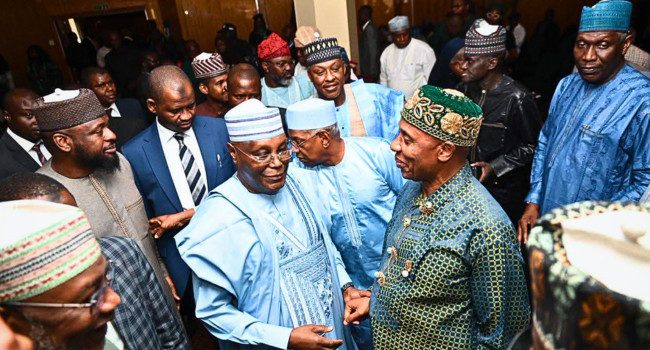
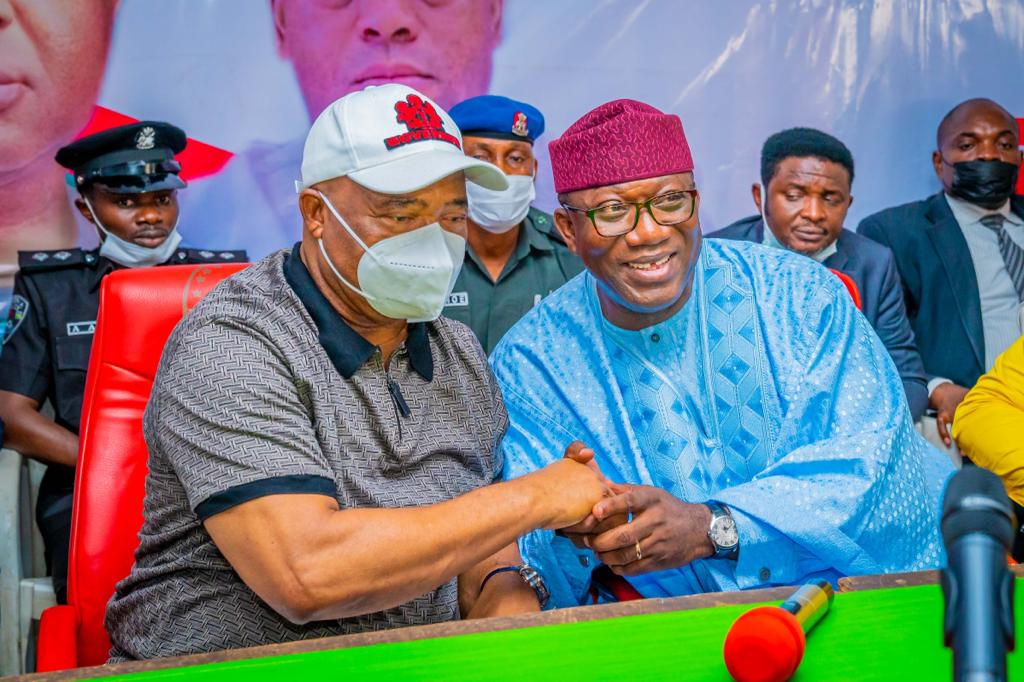
A coalition of opposition leaders, including former Vice President Atiku Abubakar, former Anambra State governor Peter Obi, former Rivers State governor Rotimi Amaechi, and former Senate President David Mark, has rejected the Electoral Act (Amendment) 2026, describing key provisions of the new law as “anti-democratic” and capable of undermining electoral credibility.
At a press briefing in Abuja themed “Urgent Call to Save Nigeria’s Democracy,” the leaders called on the National Assembly to immediately reopen the amendment process and expunge what they termed “obnoxious provisions” from the Act.
The communiqué, read by National Chairman of the New Nigeria Peoples Party (NNPP), Ahmed Ajuji, insisted that the revised law must reflect the collective aspiration of Nigerians for free, fair, transparent and credible elections.
Manual Transmission Clause Under Fire
Central to the opposition’s objections is the amendment to Section 60(3), which permits presiding officers to resort to manual transmission of results in the event of technical or communication failure.
The coalition argued that the clause weakens the mandatory electronic transmission of results and opens potential loopholes for manipulation. They maintained that Nigeria’s electoral infrastructure is robust enough to sustain nationwide electronic transmission, citing prior assurances from the Independent National Electoral Commission (INEC).
They also faulted the amendment to Section 84, which limits political parties to direct primaries and consensus methods for candidate selection. According to them, excluding indirect primaries amounts to unconstitutional interference in the internal affairs of political parties.
FCT Polls and Growing Distrust
The opposition referenced alleged irregularities in the recent Federal Capital Territory local government elections as evidence of what they described as a broader pattern of electoral compromise. They labelled the polls a “complete fraud” and said the outcome has further eroded confidence in the system ahead of the 2027 general elections.
The coalition further condemned reported attacks on leaders of the African Democratic Congress (ADC) in Edo State, warning that political violence and intimidation could destabilise the democratic space if not urgently addressed.
Tinubu Defends Law
President Bola Tinubu signed the Electoral Act (Amendment) 2026 into law on February 18, 2026, following its passage by the National Assembly. The legislation introduced statutory recognition of the Bimodal Voter Accreditation System (BVAS) and revised election timelines.
Defending the law, the President argued that the manual fallback provision is necessary to prevent voter disenfranchisement in areas where electronic transmission may fail. He also questioned Nigeria’s readiness for full real-time electronic transmission, citing risks of technical glitches and cyber threats.
Heated Legislative Battle
The amendment process triggered intense debate in both chambers of the National Assembly. In the Senate, Senator Enyinnaya Abaribe demanded a formal vote to remove the manual transmission proviso, warning against weakening real-time electronic reporting.
After a tense session and procedural disputes, 15 opposition senators voted against retaining the clause, while 55 supported it — allowing the manual fallback provision to stand.
In the House of Representatives, lawmakers similarly clashed over a motion to rescind an earlier decision mandating compulsory real-time transmission of results to the INEC Result Viewing portal (IReV). Despite louder “nays” during a voice vote, Speaker Tajudeen Abbas ruled in favour of rescinding the decision, prompting protests and an executive session.
“We Will Not Be Intimidated”
In their joint declaration, the opposition leaders vowed to pursue “every constitutional means” to challenge the law and defend voters’ rights.
“We will not be intimidated,” they declared, urging civil society groups and citizens to rally behind efforts to safeguard Nigeria’s democracy.
The debate over the Electoral Act 2026 now sets the stage for a broader political confrontation as preparations intensify for the 2027 general elections.
Opposition Heavyweights Reject 2026 Electoral Act, Demand Fresh Amendments