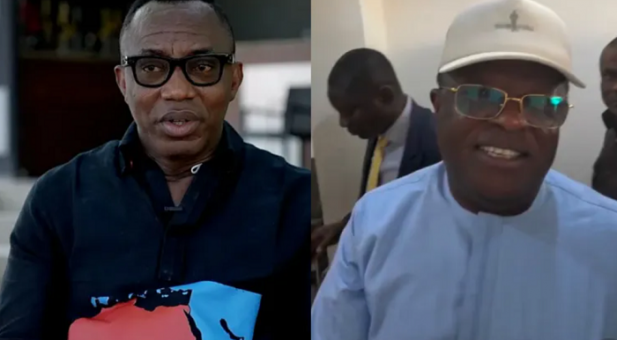
Human rights activist and former 2023 presidential candidate of the African Action Congress (AAC), Comrade Omoyele Sowore, staged a tense confrontation with Minister of Works, Senator Dave Umahi, on Wednesday, February 25, 2026, over allegations involving a detained woman.
The encounter took place at the Nigeria Police Force Headquarters in Abuja and was captured on video, which Sowore shared widely on X and Facebook.
The dispute centers on TracyNither Nicolas Ohiri, who claims that Minister Umahi owes her ₦250 million and, additionally, that he solicited sexual favors years ago. According to Sowore, Ohiri had been arrested in Lagos on allegations of “cyberbullying,” transported to Abuja, and detained — a move he described as illegal and unnecessary.
In the video, Ohiri is seen charging toward the minister before being restrained by security and bystanders in the conference hall. As Umahi attempted to leave, Sowore stepped forward, introduced himself, shook the minister’s hand, and directly challenged him on the use of police officers to settle personal matters.
“It was wrong of him to use policemen to settle personal scores,” Sowore wrote in a post accompanying the video.
Security aides quickly intervened, escorting Umahi out of the hall. Sowore, however, remained vocal about what he described as intimidation tactics against Ohiri.
“Today at the FCT Command of the Nigeria Police Force in Abuja, I confronted the Minister of Works, David Umahi inside a conference room where police operatives had effectively set up shop for him to harass a woman who accused him of owing her and making a pass at her years ago,” Sowore stated.
Sowore said that rather than addressing Ohiri’s claims as a civil dispute, the police escalated the matter into a criminal spectacle. He emphasized that her detention, and the orchestrated meeting inside the police command, was designed to intimidate and demean her.
“A married woman, TracyNither Nicolas Ohiri, had been illegally arrested in Lagos on allegations of ‘cyberbullying,’ flown to Abuja, and detained. Her alleged offense was accusing David Umahi of owing her ₦250 million for over 12 years — a claim that is essentially civil. Yet, the police treated it as a criminal matter,” he wrote.
According to Sowore, the minister’s brief presence at the police command was intended to threaten and belittle Ohiri. After Sowore’s intervention, Umahi left the hall in frustration, but Ohiri remained in custody, reportedly denied bail.
“After Umahi left, they refused to grant her bail or release her. We later learned Umahi promised that she has not seen anything on his way out of the FCT police command,” Sowore added.
The incident highlights ongoing concerns about how civil claims are handled in Nigeria, especially when they involve high-ranking officials. Observers say the case raises questions about due process, police accountability, and the potential abuse of authority in settling personal or financial disputes.
Sowore’s public confrontation represents one of the few occasions where a sitting minister has been directly challenged over alleged misconduct involving law enforcement. By intervening, the activist drew national attention to Ohiri’s situation and underscored broader issues of fairness, transparency, and the rule of law.
“After unlawfully detaining her, the police facilitated a meeting in which Umahi was brought into the command to threaten, intimidate, and denigrate her inside a police facility until we arrived,” Sowore explained.
As of Wednesday evening, the status of Ohiri’s detention remained uncertain. Sowore has demanded that the police release her immediately and treat the matter through proper civil channels rather than criminalizing her claims.
Legal analysts say the case could set an important precedent for how civil disputes involving political figures are handled, noting the potential risks of leveraging state power against private citizens.
Sowore’s actions and posts on social media have sparked widespread public debate, with calls for transparency and accountability, highlighting the tension between citizen activism, law enforcement, and political influence.
Sowore Tackles Umahi Over Alleged Debt Dispute in Abuja