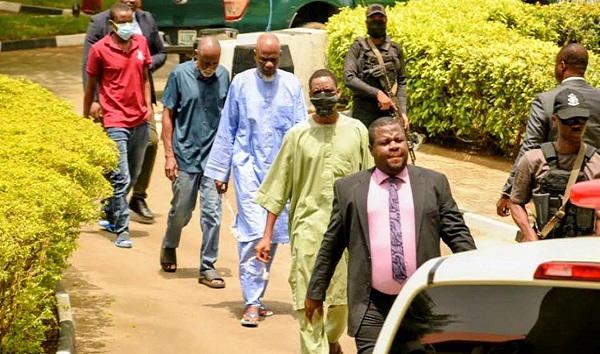

A serving Nigerian Army colonel accused of plotting to overthrow President Bola Ahmed Tinubu’s administration has told military investigators that the alleged coup plan was born not from a quest for power, but from what he described as a deepening national crisis marked by insecurity, corruption, economic hardship and declining military welfare.
In a lengthy statement obtained from confidential investigation documents, Colonel Mohammed Ma’aji said the idea of military intervention began taking shape towards the end of former President Muhammadu Buhari’s administration, when, according to him, kidnapping, banditry, corruption and alleged nepotism had reached a critical point.
What began as frustration, he said, eventually developed into an effort to identify military officers who shared his belief that Nigeria needed a fundamental change of direction.
Ma’aji repeatedly described those involved as patriots motivated by “love of country” and a desire to rescue Nigeria from what they considered a dangerous trajectory.
But the account also reveals how deeply the alleged conspiracy became intertwined with the colonel’s personal resources and professional frustrations.
According to his statement, Ma’aji sold three houses in Kaduna State and a students’ hostel at Ahmadu Bello University, Zaria, to raise money for the movement after efforts to secure wider financial and logistical support proved difficult.
He said some other members also contributed funds, including one officer who allegedly paid N1 million and another who contributed foreign currency.
The disclosures form part of a massive body of evidence being examined in proceedings arising from the alleged conspiracy, including statements, financial records, communications and other documents.
‘The military hierarchy failed’
Ma’aji told investigators that the initial trigger was Nigeria’s deteriorating security situation.
He said troops and civilians were increasingly being killed as kidnapping and banditry spread across parts of northern Nigeria, while he believed the military leadership was failing to respond adequately.
“It was expected that the higher hierarchy of the military could have acted to save the situation. Unfortunately, there was no action from the top,” he said.
According to the colonel, this perceived institutional failure created the environment in which the idea of military intervention began to take hold.
He said the movement initially focused on identifying officers who shared similar concerns and who could potentially support what he portrayed as a patriotic intervention.
The plan, however, did not immediately progress because of shortages of money, manpower and logistics.
Failed promotion reignites movement
The alleged movement was later revived after Ma’aji failed his promotion examination to the rank of brigadier general for the second time in 2024.
He denied that his promotion setbacks were the original reason for the alleged plot, but acknowledged that the development became a turning point.
According to his account, some officers became concerned that he could be prematurely retired and urged him to revive the movement.
He specifically mentioned Lieutenant Colonel Shamsuddeen Bappah, who he said travelled from Ibadan to Abuja to persuade him that they had to continue.
Ma’aji said he initially resisted because he had already spent substantial personal resources and was concerned about the lack of manpower and logistics.
The movement nevertheless resurfaced, with meetings allegedly taking place in Abuja from late 2024 into 2025.
In his statement, Ma’aji said members of the movement believed Nigeria’s condition had deteriorated further under President Tinubu.
He cited the removal of fuel subsidy, naira flotation, multiple taxation, electricity tariff increases, corruption and worsening insecurity among the issues that fuelled their concerns.
He also pointed to youth protests, including #EndSARS, #EndBadGovernance and Take Back Your Country, arguing that the failure of political authorities to adequately respond to public grievances had deepened frustration.
He alleged that excessive force against protesters further widened the gulf between citizens and the authorities.
For Ma’aji, the crisis extended into the military itself.
He complained about the welfare of serving personnel, veterans and wounded soldiers, arguing that members of the armed forces were being asked to make enormous sacrifices while struggling to meet basic family needs.
He told investigators that he had difficulty providing quality education for his five children on his salary and questioned how ordinary soldiers could cope with similar pressures.
He also raised concerns about wounded personnel at the 44 Nigerian Army Reference Hospital in Kaduna, claiming that some soldiers injured in combat had been neglected.
In one of the most striking aspects of his statement, Ma’aji said he believed Nigeria was drifting towards becoming a “banana republic” and argued that the country had functioned better under military rule.
He maintained that the alleged movement was not designed to satisfy personal ambition but to establish what its members believed would be a more prosperous and secure Nigeria.
“The summary of all this is that this action was driven by the desire to have a prosperous nation and country that we all can be proud of,” he said.
Yet the same statement shows that the alleged plan remained incomplete.
Ma’aji said the group had not assembled a fully constituted team, more resources and personnel were still required, and no definitive “D-Day” had been fixed.
He also denied involvement by some senior officers whose names had circulated around the investigation, insisting that awareness of general grievances within the military did not necessarily amount to participation in the alleged conspiracy.
Ma’aji was arrested on September 29, 2025, amid the security investigation into the alleged plot.
He is among serving military officers facing proceedings before a court-martial, while six other defendants, including retired military officers and civilians, are being prosecuted before the Federal High Court in Abuja.
The prosecution alleges that the defendants were involved in various aspects of the alleged conspiracy.
The defence has challenged the admissibility of several statements and interrogation recordings, arguing that they were obtained improperly or involuntarily.
The court has consequently ordered a trial-within-trial to determine the voluntariness of disputed statements.
Former Bayelsa State Governor Timipre Sylva, whose name has also been linked to allegations surrounding the case, has strongly denied any involvement, describing himself as a committed democrat.
The claims contained in Ma’aji’s statement remain allegations and have not been established as facts by a court.
Beyond the courtroom battle, Ma’aji’s account presents a disturbing picture of how personal grievances, military welfare concerns and wider national frustrations can intersect inside a security institution.
His recommendations to government were strikingly different from the alleged action for which he is being prosecuted.
He called for better pay and welfare for soldiers, improved treatment of wounded personnel, stronger pension arrangements for veterans, housing support, expanded military loan programmes and better healthcare.
He also demanded greater transparency in military promotions, criticising what he described as “godfatherism” and calling for an institutional channel through which soldiers could raise grievances without fear of victimisation.
On the economy, he argued that the removal of fuel subsidy should have been phased and urged government to invest the resulting savings in measures that directly reduce hardship.
Towards the end of his interrogation statement, however, Ma’aji appeared to reconsider the path he had taken.
He appealed for forgiveness and leniency, saying his detention and interactions with investigators had changed his perspective.
He said that, if released, he would not contemplate the alleged course of action again.
That admission may ultimately become one of the most consequential elements of the case—not simply because it sheds light on the alleged coup plot, but because it raises a larger question about the point at which frustration inside a military institution can cross the line from grievance into an alleged attempt to seize political power.
For now, that question remains before the courts.
And so does the central dispute: whether Ma’aji’s account represents the justification of an alleged coup plot after the fact—or a rare inside account of how deep institutional and national frustrations allegedly evolved into an attempt to challenge Nigeria’s constitutional order.