

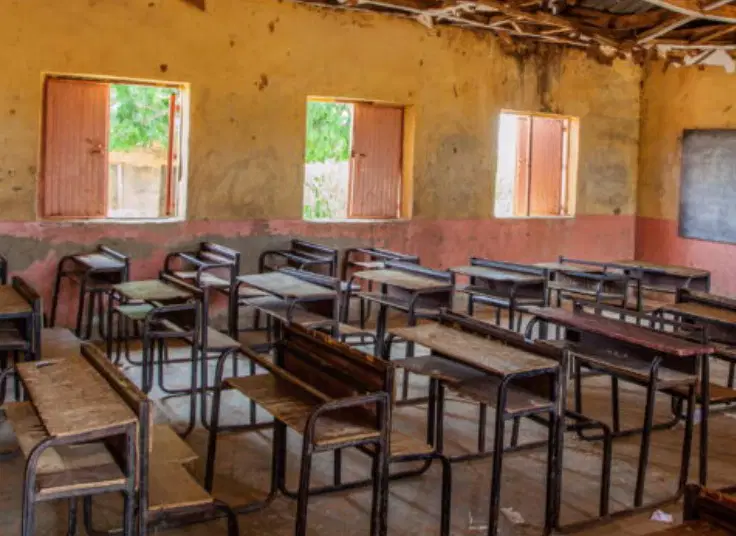
The Human Rights Writers Association of Nigeria (HURIWA) has demanded an immediate forensic investigation into billions of naira allocated to Nigeria’s Safe Schools Initiative, following reports that at least 65 schools across northern Nigeria have been shut or rendered non-functional because of insecurity.
The rights group described the situation as a national disgrace and questioned how terrorists, bandits and kidnappers continue to drive children out of classrooms more than a decade after the Safe Schools Initiative was launched in response to the 2014 Chibok schoolgirls’ abduction.
At the centre of HURIWA’s demand is a question it says government can no longer avoid:

Where did the Safe Schools billions go?
In a statement signed by its National Coordinator, Comrade Emmanuel Nnadozie Onwubiko, on Sunday, the organisation said the closure of schools exposes what it described as a troubling disconnect between government spending and the safety of Nigerian children.
HURIWA cited the Federal Government’s National Plan on Financing Safe Schools for 2023–2026, which projected ₦144.86bn for the programme over four years.
The proposed funding, according to the organisation, comprised ₦32.58bn for 2023, ₦36.98bn for 2024, ₦37.15bn for 2025 and ₦38.03bn for 2026.
HURIWA also recalled reports that more than $30m had been mobilised for the Safe Schools Initiative since its establishment.
Yet, it said, the country is witnessing the disturbing spectacle of schools being shut because authorities cannot guarantee the safety of pupils and teachers.
Sokoto State, HURIWA noted, provides a particularly stark example, with schools reportedly shut indefinitely in 20 of the state’s 23 local government areas because of security concerns.
The organisation said the situation demands more than another security briefing or fresh allocation.
It wants the money trail exposed.
Who received the funds? Who administered them? What contracts were awarded? What security infrastructure was delivered? How many schools were actually secured? And where did the money go where projects were not delivered?
HURIWA called on the Economic and Financial Crimes Commission (EFCC) and the Independent Corrupt Practices and Other Related Offences Commission (ICPC) to immediately launch a joint forensic investigation covering every naira and dollar allocated, released or donated to the initiative.
The group said investigators must establish what was budgeted, what was released, who received the money, which contracts were awarded, what projects were completed and what happened to outstanding allocations.
It further demanded prosecution of anyone found to have diverted funds, inflated contracts, abandoned projects or otherwise abused money meant to protect children.
HURIWA also turned its scrutiny on the National Assembly, challenging lawmakers to explain why the Safe Schools Initiative had not received the level of sustained financial and performance scrutiny demanded by the worsening security crisis.
The group urged both chambers to summon relevant ministers, government agencies, programme managers and contractors for a public hearing into the initiative’s finances and performance.
For HURIWA, the consequences of school closures go far beyond lost classroom hours.
It warned that prolonged disruption of education could expose children to child labour, early marriage, trafficking, recruitment into criminal and extremist networks, radicalisation and permanent educational exclusion.
The organisation argued that Nigeria cannot claim to be defeating insecurity while insecurity continues to dismantle its education system.
It therefore called for an emergency national response involving the Federal Ministry of Education, state education ministries and the Federal Capital Territory education authorities.
Among the measures demanded are intelligence-led security for vulnerable schools, safe transportation, emergency learning centres, stronger protection for teachers, secure boarding arrangements and independent monitoring of high-risk schools.
HURIWA also demanded that any funds recovered from corrupt officials or contractors be ring-fenced exclusively for securing and rebuilding affected schools.
The group urged President Bola Ahmed Tinubu to personally order a comprehensive audit of the Safe Schools Initiative and publish the findings for public scrutiny.
Its message was blunt: the crisis can no longer be treated as merely a question of insecurity when billions have reportedly been committed to making schools safe.
“Nigerian children must not become victims twice — first of terrorism and banditry, and then of corruption and official impunity,” HURIWA said.
The organisation insisted that the Safe Schools Initiative must produce visible protection for the children it was created to serve.
The money allocated to protect Nigerian children, HURIWA said, must finally be seen protecting Nigerian children.
