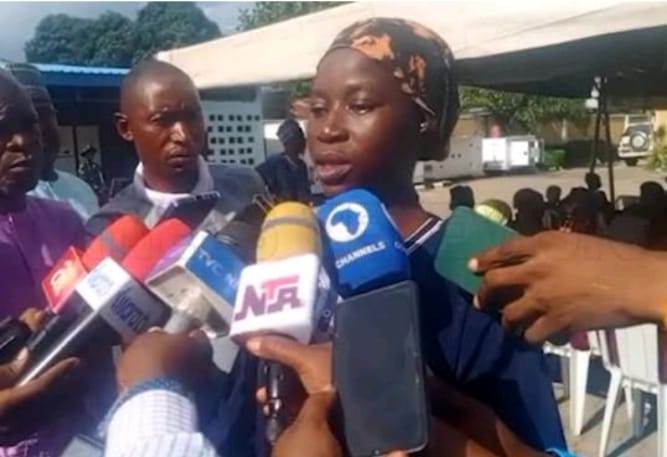

Amirah Salihu became a lifeline for pregnant captives—but refused terrorists’ demand to remain with them
For nearly six months, Amirah Salihu was not simply another captive in the forest.
She became the woman other captives turned to when pregnancy, labour and childbirth arrived in a place without hospitals, medicines or even gloves.
The Kwara nurse has revealed that she helped about 10 pregnant women deliver their babies during captivity, using her bare hands because there was no medical equipment available.
But her ordeal took an even more disturbing turn when her abductors discovered that she was a trained nurse.
According to Salihu, they wanted her to remain with them.
She refused.
“I helped like 10 women for the delivery, without gloves. I used my hands to help them,” Salihu disclosed in an interview with Channels Television’s Politics Today.
Salihu, daughter of the chief of Woro community in Kaiama Local Government Area of Kwara State, was among 176 women and children abducted during the February 3 attack on Woro and neighbouring Nuku communities.
For almost six months, she lived alongside other captives in conditions she described as brutal and degrading.
There was little food, There was no proper shelter.
And the captives were forced to sleep close to a river, exposed to rain and the elements.
Salihu recalled that their daily ration was largely guinea corn with little or no seasoning.
“The kind of food that they were giving us was bad,” she said, describing how the captives were initially given guinea corn with salt and seasoning before the food became even more inadequate.
But when pregnant women began going into labour, her professional training suddenly became more valuable than her captors realised.
There were no delivery rooms, No gloves, No medical instruments and No trained medical team.
There was only Salihu and whatever knowledge she could rely on.
She assisted about 10 women through childbirth, according to her account.
Her usefulness eventually exposed her identity as a nurse—and transformed her position in the eyes of the abductors.
“They wanted to keep me, that I should stay with them,” she said.
But Salihu had one answer.
“No. I want to come back.”
Her determination to return home was intensified by a devastating personal loss.
She alleged that two of her brothers were killed during the attack, claiming her family was targeted because her father had resisted the terrorists’ attempts to enter the community and had previously brought soldiers to protect the village.
After nearly six months, Salihu and the other rescued victims finally regained their freedom on Wednesday.
But their ordeal did not end without further loss.
The Kwara State Government later disclosed that 13 children died during the period, while 12 others remained in the terrorists’ custody.
Governor AbdulRahman AbdulRazaq received the rescued victims in Ilorin and thanked President Bola Tinubu and the military for their roles in the rescue operation.
For Salihu, however, the journey home carries a story far more complex than that of an abductee who survived.
She was a daughter who lost two brothers.
A nurse who delivered babies without the protection of a hospital.
A captive whose skills became so valuable that her captors wanted to keep her.
And, ultimately, a woman who refused to surrender her future to the people who had taken away her freedom.
In the darkness of captivity, Amirah became a lifeline for mothers and newborns—even while desperately waiting for her own way home.