


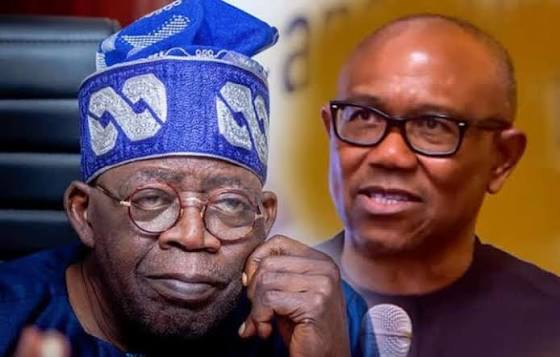
The war of words over Nigeria’s deepening economic crisis intensified on Friday as presidential candidate of the Nigeria Democratic Congress (NDC), Peter Obi, took direct aim at President Bola Ahmed Tinubu over his recent comments on hunger, accusing the President of displaying insensitivity to the plight of millions of struggling Nigerians.
In a statement titled “Hunger and the Insensitivity of Mr. President,” Obi said President Tinubu’s assertion that hunger had always existed in Nigeria—even before he was born—was not only ill-timed but also failed to acknowledge the severity of the economic hardship currently confronting citizens.
The President had made the remark while receiving a delegation of Catholic bishops in Abuja, where he defended his administration’s economic reforms and noted that hunger was a long-standing national challenge rather than a problem created by his government.

But Obi insisted that the issue before Nigerians was not whether hunger existed in the past, but whether it had become worse under the present administration.
“While it is true that hunger has been a part of human existence and has existed in our country for decades, such a statement appears insensitive to the plight of millions of Nigerians who face worsening economic hardship today,” Obi said.
The former Anambra State governor argued that leadership is measured not by explanations for inherited problems but by the capacity to solve them.
According to him, available indicators show that Nigeria’s food security and poverty situation have deteriorated significantly since the Tinubu administration took office in 2023.
Obi claimed that the number of Nigerians facing acute food insecurity had risen from about 17 million before the current administration to roughly 35 million, while those living in extreme poverty had also increased sharply.
He attributed the worsening humanitarian situation to persistent insecurity, declining agricultural productivity, rising inflation, weak economic management and insufficient investment in sectors capable of stimulating production and creating jobs.
Obi maintained that although the current administration inherited enormous economic and security challenges, Nigerians expected decisive policies that would ease their suffering rather than explanations that appeared to normalise it.
“The true measure of leadership is not the magnitude of the problems inherited but the effectiveness of the solutions delivered,” he said.
He urged the Federal Government to channel greater investment into agriculture, education, healthcare, security and small businesses, arguing that those sectors remain the foundation for sustainable economic recovery and poverty reduction.
Reiterating his long-held economic philosophy, Obi said Nigeria must shift from a consumption-driven economy to one anchored on production, innovation and value creation if it hopes to reverse rising poverty and unemployment.
He ended the statement with his familiar refrain: “A New Nigeria is Possible.”
Obi’s latest criticism underscores mounting political pressure on the Tinubu administration as millions of Nigerians continue to grapple with high food prices, inflation and declining purchasing power. With the 2027 general elections drawing closer, the economy, cost of living and food security are expected to dominate the national political conversation, providing fresh ammunition for opposition parties seeking to challenge the government’s record.
