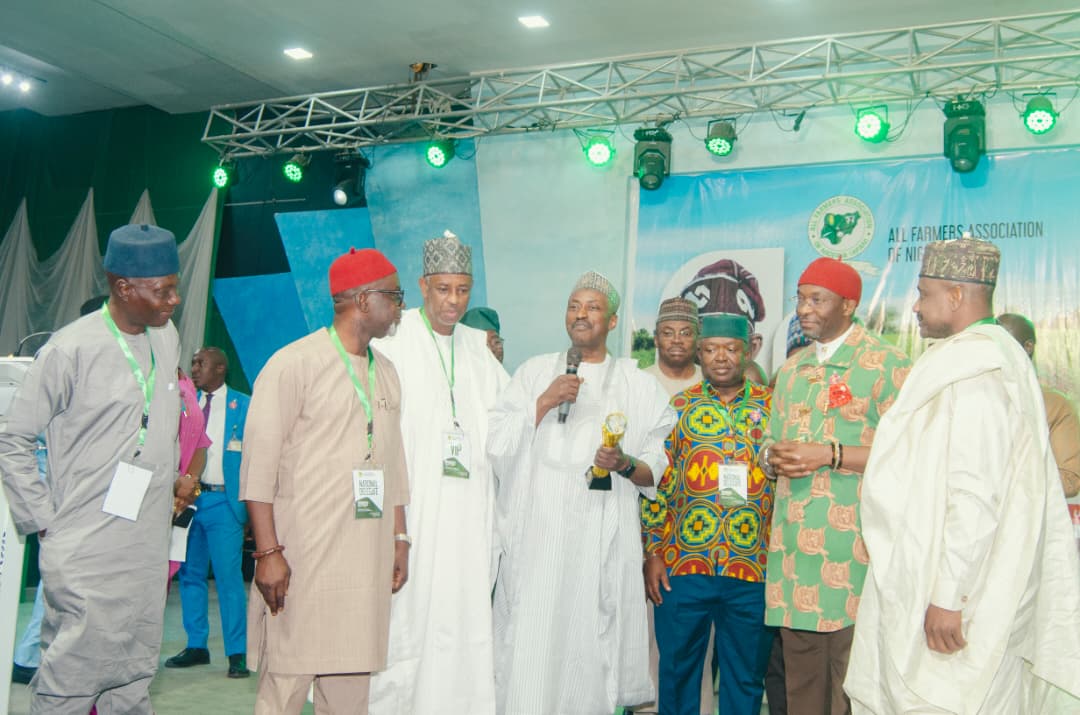
The All Farmers Association of Nigeria (AFAN) has positioned the General Assembly of Farmers (GAF) as a decisive force in reshaping Nigeria’s agricultural landscape at a time of mounting food insecurity, climate stress and insecurity.
AFAN President, Dr Farouk Mudi, said the GAF has created a long-awaited national platform that unites farmers across the country and strengthens their voice in policy, investment and agricultural reform.
Speaking at the close of the three-day assembly in Abuja, Mudi described the gathering as a strategic reset for Nigerian agriculture, capable of unlocking reforms needed to stabilize food production and restore farmer confidence.
Held under the theme “Empowering Farmers, Fostering Collaboration,” the meeting drew participants from across the agricultural value chain and reinforced the Federal Government’s pledge to place farmers at the heart of national development planning.
Mudi warned that climate volatility, insecurity and rising production costs were pushing farmers to the brink, noting that unpredictable rainfall patterns, flooding and shifting seasons were disrupting planting and harvesting cycles nationwide.
He revealed that more than 500,000 hectares of rice and maize farms had been lost to erratic weather, while soaring fertilizer and agrochemical prices continued to limit farm expansion and productivity.
According to him, GAF marks the beginning of a stronger, more coordinated AFAN, expected to drive policy realignment, attract targeted interventions and stimulate large-scale agricultural transformation across the federation.
He reaffirmed the association’s support for the National Livestock Transformation Plan, describing it as key to promoting modern ranching, easing farmer-herder tensions and restoring safety to farmlands.
Mudi also criticized Nigeria’s dependence on imported staples such as wheat, sugar and fish, arguing that funds spent annually on imports should be channeled into empowering local producers and strengthening domestic food systems.
He recalled that agriculture once anchored Nigeria’s rural economy and education system, but years of neglect, insecurity and climate pressures had weakened output and discouraged youth involvement.
Expressing optimism, Mudi said the GAF platform would help reposition agriculture as a secure, profitable and youth-attractive sector capable of driving economic growth and ensuring long-term food security.
Representing Vice President Kashim Shettima, the Senior Special Assistant to the President on Public Health, Dr Uju Rochas-Anwukah, reaffirmed the Federal Government’s commitment to farmers, stating that national survival depends on their success.
She said the Nutrition 774 Initiative highlights the link between agriculture and public health, stressing that nutrition begins with food production, not medical intervention. Under the Renewed Hope Agenda, she noted, agriculture is viewed as an economic, security and nation-building priority.
“Nigeria cannot solve malnutrition without fixing food systems, and food systems cannot be fixed without farmers,” she said.
Also speaking, the Minister of Defence, Gen. Christopher Musa (rtd), acknowledged persistent security threats facing farmers and pledged improved protection for farming communities, urging farmers to report incidents promptly to security agencies.
GAF Emerges as Game Changer for Nigeria’s Agricultural Future – AFAN