


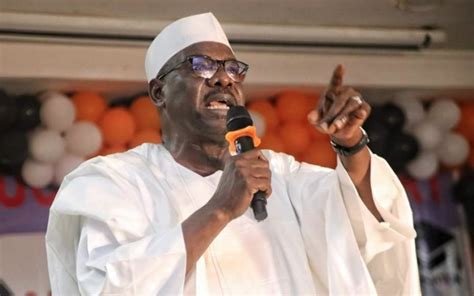
Former Senate Leader, Senator Ali Ndume, has urged President Bola Tinubu to urgently improve the remuneration and welfare of military personnel, warning that expanding the Nigerian Army without adequately motivating its personnel could undermine the effectiveness of the security architecture.
Ndume, who represents Borno South in the National Assembly, made the call while commending Tinubu for approving the expansion of the Nigerian Army from eight to 12 divisions and the recruitment of 28,000 additional personnel.
He said the government must complement the expansion with better pay, training, equipment and ammunition, stressing that the success of the initiative would depend not only on increasing troop strength but also on keeping personnel motivated and properly equipped.
According to him, the Federal Government should urgently review the remuneration of soldiers and other security personnel, with the basic salary of military personnel increased to at least the naira equivalent of $300.
“ It is not the number that really matters but TEAM — Training, Equipment, Ammunition and Motivation.
“They need to be well remunerated. The morale of those in operation is very low.
“Apart from training and adequate procurement of modern arms and ammunition, I urge the present administration to consider urgent review of their remuneration,” Ndume said.
The senator added: “Even if we have to borrow, let Mr President borrow to equip the Nigerian Armed Forces and other security forces.”
Ndume also proposed that each of the six geopolitical zones should have at least five attack helicopters to facilitate rapid response to security emergencies and provide aerial cover for ground troops.
He further urged the government to establish a Special Task Force Brigade in each of the Army’s divisions, equipped with Mine-Resistant Ambush-Protected (MRAP) vehicles, Armoured Personnel Carriers (APCs) and attack helicopters.
The new Army divisions, approved for Makurdi, Ilorin, Jalingo and Benin City, are expected to improve military coordination and response time across the country.
Presidential spokesman, Bayo Onanuga, had said the approval underscored Tinubu’s commitment to equipping the Armed Forces to effectively confront Nigeria’s evolving security challenges and strengthen national defence capabilities.
Ndume welcomed the approval for the recruitment of 28,000 additional personnel, but maintained that manpower expansion must go hand in hand with adequate training, modern equipment and improved welfare.
He also commended troops of the Nigerian Army and other security agencies operating on the front lines for their sustained offensive against insurgents, saying their efforts were yielding visible results in the North-East and other parts of the country.
The former Senate Leader specifically applauded troops of Operation Hadin Kai Theatre Command, particularly the 82 Task Force Brigade in Gwoza, for the recent rescue of more than 100 abductees.
He noted that the operation came after the earlier rescue of about 360 people from terrorist captivity, describing the development as evidence of the courage and commitment of troops fighting insurgency.
