


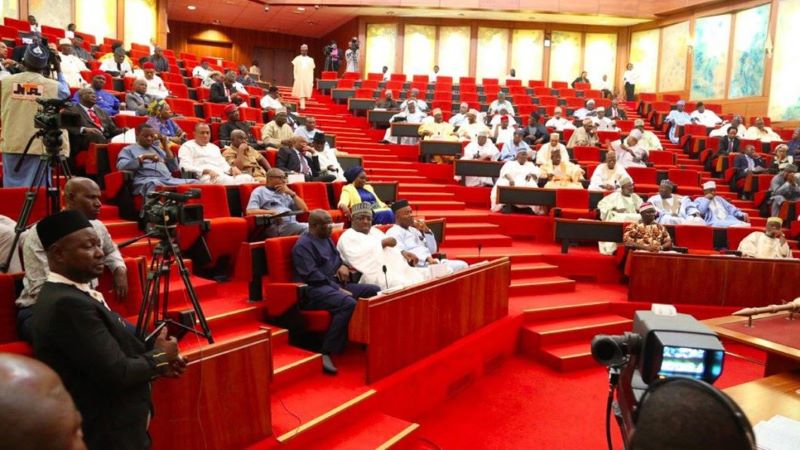
The Senate on Wednesday began legislative action on a sweeping bill that could fundamentally reshape the management of foreign aid and donor-funded interventions in Nigeria, moving to subject billions of naira channelled through non-governmental organisations (NGOs), development partners and sub-national entities to stricter government regulation and parliamentary oversight.
The proposed legislation, sponsored by Senator Ibrahim Hassan Dankwambo (Gombe North), scaled second reading amid growing concerns by lawmakers over accountability deficits, weak financial transparency and the potential national security implications of unregulated foreign funding.
If enacted, the bill would establish, for the first time, a comprehensive legal framework requiring all donor-funded projects and foreign assistance programmes operating in Nigeria to be registered, monitored and integrated into the country’s fiscal and development planning process.

Opening the debate, Dankwambo said despite Nigeria being one of Africa’s largest recipients of grants, humanitarian support, technical assistance and concessional financing from bilateral and multilateral partners, there is no single legal mechanism coordinating or tracking the inflow and utilisation of such funds.
He argued that donor interventions currently operate through a fragmented structure spread across ministries, departments and agencies, with many projects implemented outside the national budget, leading to duplication, poor coordination and weak accountability.
According to him, the proposed law seeks to bring all foreign assistance under constitutional oversight by establishing a National Donor Coordination Framework, creating a central database of donor-funded projects, compelling mandatory registration of foreign-funded interventions, integrating donor programmes into government budgets, requiring public disclosure of funding and implementation details, and prescribing penalties for the diversion, misuse or failure to register foreign assistance.
The proposal received overwhelming support from senators, many of whom warned that substantial donor funds channelled through NGOs and state governments currently operate with little public accountability.
Deputy Senate President Barau Jibrin said while donor assistance received directly by the Federal Government is usually captured in the national budget, significant sums routed through NGOs remain largely beyond public scrutiny.
“We can’t tell what money goes into the coffers of NGOs. Fraudsters set up bogus, pseudo NGOs and collect money from there,” Barau said, arguing that the absence of an effective regulatory framework has persisted for years.
Senate Chief Whip Tahir Monguno described the legislation as timely and necessary, noting that development partners often determine how funds are disbursed without sufficient domestic coordination.
Former Kebbi State Governor, Senator Adamu Aliero, said previous oversight exercises by the Senate had exposed cases where donor funds could not be properly accounted for, stressing that the legislation should expressly extend to NGOs and state governments to strengthen legislative oversight.
Chairman of the Senate Committee on Finance, Senator Sani Musa, said the bill would improve transparency, enhance donor confidence and align Nigeria with global best practices in aid management.
He also raised security concerns over donor-funded activities that allegedly escape government scrutiny.
“Most of the aids coming to so-called NGOs are not subjected to scrutiny. We have seen instances where such arrangements create security concerns because we do not know who is accounting for what. Is it insurgents taking money meant for victims?” Musa queried.
Former Edo State Governor, Senator Adams Oshiomhole, backed the proposal, insisting that every foreign donor fund entering Nigeria should be fully disclosed, documented and subjected to legislative oversight.
He advocated mandatory disclosure of all resources transferred to NGOs and civil society organisations, alongside stiff penalties for organisations that fail to comply with the proposed law.
President of the Senate, Godswill Akpabio, also threw his weight behind the bill, warning that foreign funding operating outside an effective regulatory framework could pose significant risks to national security and undermine accountability.
Following the debate, the Senate referred the bill to its Committees on National Planning and Economic Development and Finance for further legislative work, directing them to report back within four weeks.
