


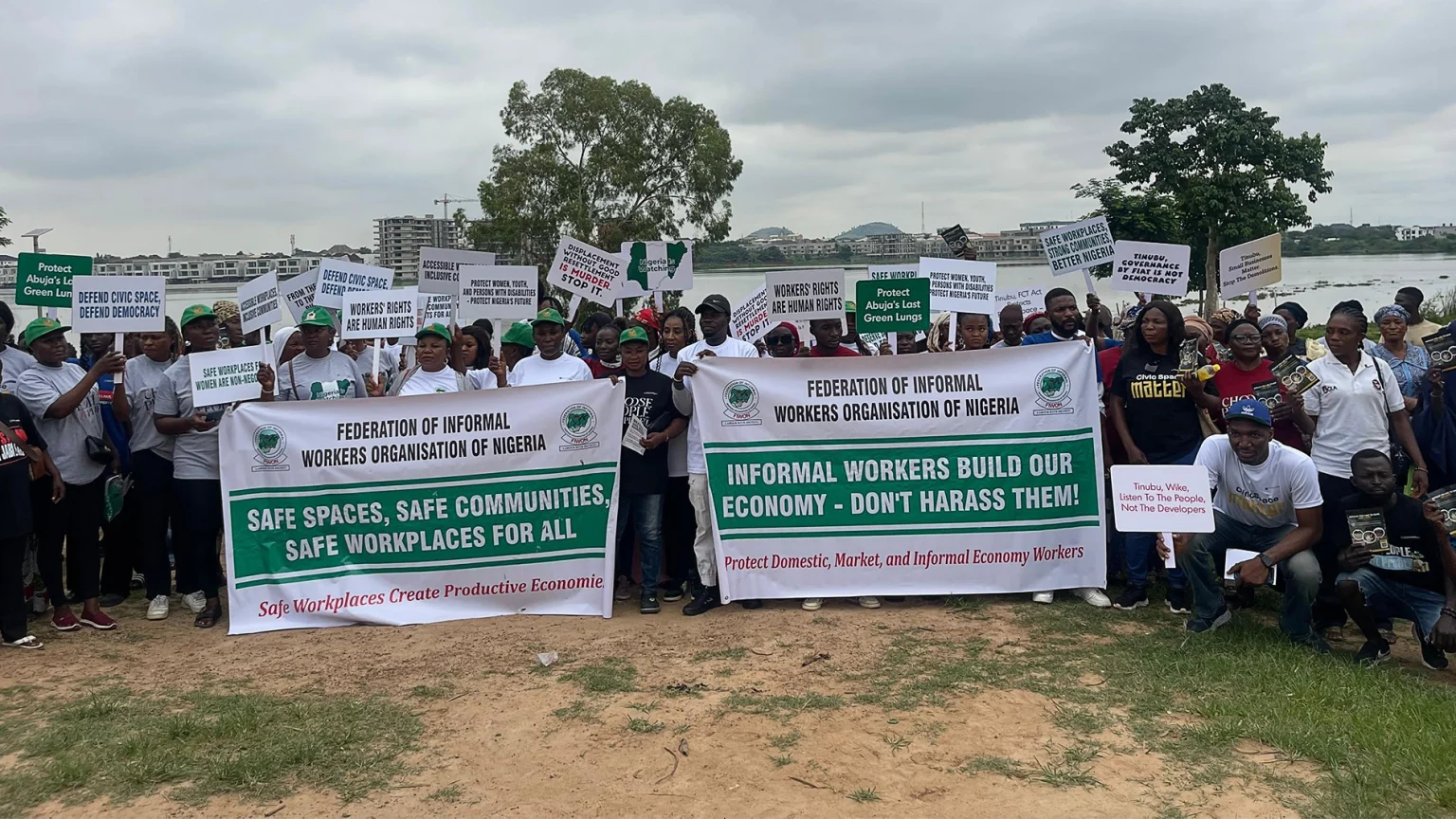
Concerns over transparency, public access and the livelihoods of hundreds of informal workers spilled onto the grounds of Jabi Lake Recreational Park on Tuesday as residents, civil society organisations and traders staged a protest against the Federal Capital Territory Administration’s (FCTA) redevelopment of the iconic waterfront.
The protesters accused the FCTA of pushing ahead with a multi-billion-naira transformation of one of Abuja’s most popular public spaces without adequately consulting affected communities or disclosing the terms of its agreement with private developers.
Led by Accountability Lab Nigeria, the Federation of Informal Workers Organisation of Nigeria (FIWON) and the Solidarity Center, the coalition demanded an immediate suspension of ongoing construction activities and the public release of all documents relating to the project, including the Memorandum of Understanding (MoU) signed by the administration.
At the centre of the dispute is the future of Jabi Lake Park, a recreational hub that has, for nearly two decades, served as both a leisure destination and a source of livelihood for hundreds of traders, artisans, transport operators and other informal workers.
Speaking during the protest, Country Director of Accountability Lab Nigeria, Friday Odeh, said the coalition was alarmed by what it described as the secrecy surrounding the redevelopment project.
According to him, the FCTA entered into an agreement with private firms in February this year to convert the waterfront into a luxury tourism destination, yet details of the arrangement remain hidden from the public.
For the protesters, the issue goes beyond urban renewal. They argue that the redevelopment raises broader questions about who benefits from public assets and whether economic development should come at the expense of vulnerable citizens.
“This is public land that belongs to ordinary people. We are not against development. We are against doing it in secret and at the expense of the poor and informal workers,” Odeh declared.
The coalition alleged that demolitions and evictions linked to the project have already displaced numerous small-scale operators who depended on activities around the park for survival, with some reportedly receiving little notice and no compensation.
The groups also questioned the environmental implications of the project, expressing concern that no Environmental Impact Assessment has been publicly released despite reports that the redevelopment could include residential and commercial components.
For many of those gathered at the protest, Jabi Lake represents one of the few remaining open public spaces in Abuja where residents from different social classes can relax without financial barriers.
They warned that transforming the park into an exclusive high-end destination could effectively shut out low-income residents and alter the character of a public asset originally conceived for collective use.
Also addressing protesters, FIWON representative Blessing Yusuf called for the immediate suspension of all fencing, demolition and construction activities until meaningful consultations are held with affected stakeholders.
She insisted that transparency, accountability and public participation must guide any redevelopment process involving public land.
The coalition is demanding the publication of the MoU and land documents connected to the project, an independent Environmental Impact Assessment, compensation and resettlement plans for displaced workers, and assurances that the park will remain affordable and accessible to the public.
The protest comes months after the FCTA, under the leadership of Nyesom Wike, signed agreements with Akida Hills Limited and Suburban Broadband Limited to redevelop the park as part of its broader urban renewal programme.
While the administration has promoted the project as a catalyst for tourism, investment and job creation, Tuesday’s protest underscored a growing debate over the balance between development and inclusion, and whether Abuja’s public spaces can be modernised without displacing the communities that have long depended on them.
