

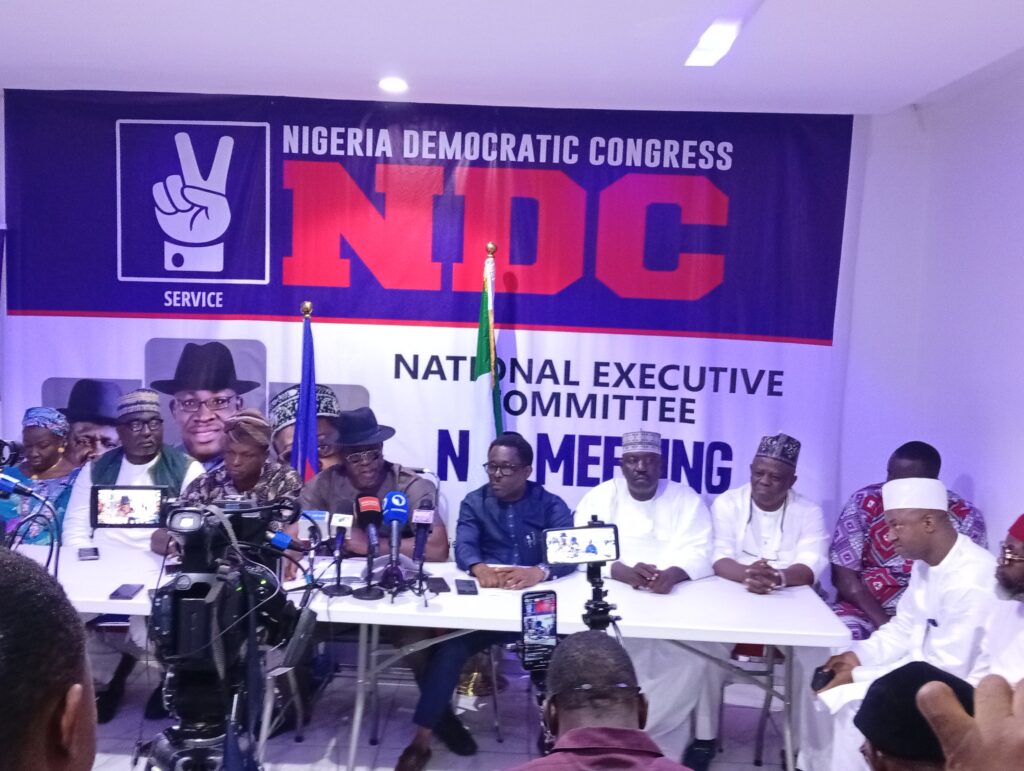

The Nigeria Democratic Congress (NDC) has accused the Independent National Electoral Commission (INEC) of frustrating its participation in the 2027 electoral process by allegedly withholding access credentials required for the nomination of its candidates.
The allegation comes as the opposition party battles to preserve its legal status following a recent Federal High Court judgment in Lokoja that set aside an earlier order directing INEC to register the party.
NDC officials claim that before the court ruling, the party had taken steps to upload details of candidates who emerged from its internal nomination process but was unable to complete the exercise because INEC failed to provide the access code required for entry into the commission’s Candidate Nomination Portal.
Speaking on Sunday, the party’s National Publicity Secretary, Osa Director, said repeated efforts by party officials to obtain the code from the electoral commission yielded no result.
According to him, INEC officials merely assured the party that they would revert to its request, a response he said effectively prevented the NDC from meeting the requirements for candidate submissions before the court judgment created uncertainty over its registration.
“The party approached INEC for the access code needed to upload the particulars of its candidates, but we were told they would get back to us. That never happened,” he said.
The development has opened a new front in the dispute between the party and the electoral commission, with NDC arguing that the alleged denial raises concerns about equal access to the electoral process and the rights of political parties to participate in democratic contests.
Party officials insist that the NDC remains a legitimate political platform pending the determination of its appeal against the Lokoja judgment and should not be excluded from any stage of the electoral process.
The controversy follows last week’s ruling by Justice Isa Dashen of the Federal High Court in Lokoja, which vacated an earlier judgment that compelled INEC to register the NDC as a political party and ordered a fresh hearing of the matter.
Despite the legal setback, the NDC maintains that it has operated as a political party since its registration, conducting congresses, conventions and candidate selection processes in line with electoral guidelines.
Political observers say the latest dispute could further test the relationship between INEC and emerging opposition parties as preparations for the 2027 general elections gather momentum.
The issue is particularly sensitive because INEC had earlier announced plans to issue access codes to political parties for electronic submission of candidates’ particulars through its nomination portal.
The NDC argues that failure to provide the code effectively shut it out of a critical stage of the electoral process and could disenfranchise both aspirants and supporters who had invested in the party’s activities.
As of press time, INEC had not issued an official response to the specific allegation. However, the commission has consistently maintained that political parties must comply with applicable legal and administrative requirements in all electoral processes.
The dispute is expected to add to ongoing debates about political inclusion, judicial intervention in party registration matters and the broader state of electoral competition ahead of the 2027 polls.