


Nigeria’s legal system is undergoing a quiet but profound transformation, driven less by statute books alone and more by the disruptive force of technology. At the centre of this shift is the growing body of jurisprudence on electronic evidence — an area that continues to redefine how courts interpret truth in the digital age.
Against this backdrop, the forthcoming scholarly engagement with the works of Justice (Prof.) Alaba Omolaye-Ajileye offers more than an academic event. It represents a timely interrogation of how Nigerian law is adapting to evidence that now lives on servers, smartphones, and digital networks rather than in paper files.
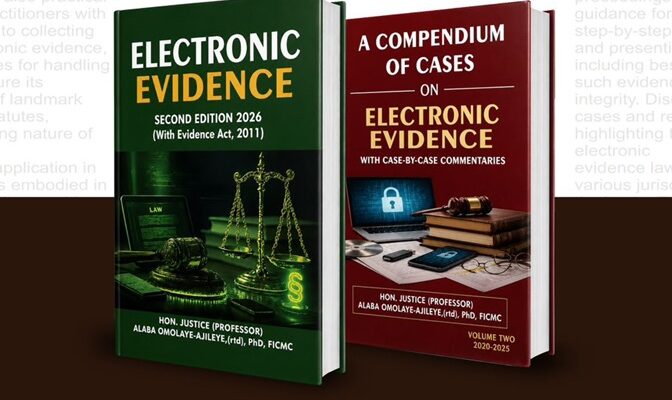
The spotlight will fall on two major publications: Electronic Evidence (Second Edition, 2026) and A Compendium of Cases on Electronic Evidence, Volume Two (2020–2025). Together, they map both the doctrinal foundations and the evolving case law that continue to shape admissibility, authenticity, and reliability standards in Nigerian courts.

What makes electronic evidence particularly complex is not merely its form, but its fluidity. Unlike traditional documentary evidence, digital material can be easily altered, duplicated, or transmitted across multiple platforms, raising persistent questions about integrity and chain of custody. Nigerian courts, like many across the world, are still refining how best to respond.
The significance of Justice Omolaye-Ajileye’s work lies in its attempt to systematise this evolving terrain. The updated second edition builds on earlier jurisprudential analysis that has already become a reference point for judges, practitioners, investigators, and law students grappling with Section 84 of the Evidence Act and its practical application in an increasingly digital courtroom.
Even more instructive is the companion volume, which compiles judicial decisions from 2020 to 2025 — a period marked by rapid expansion in cyber-related litigation, electronic transactions, and digitally sourced criminal investigations. The book effectively captures how appellate and trial courts are gradually constructing a coherent framework around electronic proof.
The scholarly review of these works by Professors Alex A. Izinyon, OFR, SAN, and Dakas C.J. Dakas, SAN, further underscores their doctrinal importance. Both jurists bring complementary strengths: Izinyon’s expertise in advocacy and dispute resolution, and Dakas’ deep engagement with constitutional law and legal reform. Their perspectives are expected to sharpen debate on whether Nigeria’s current evidential standards are sufficiently robust for the digital era.
Beyond the technicalities of admissibility and authentication lies a broader jurisprudential question: how does the law preserve fairness in an environment where information is both abundant and vulnerable to manipulation? This is where electronic evidence becomes more than procedure; it becomes a test of institutional trust.
The event will also feature the unveiling of an educational foundation dedicated to indigent students — a gesture that situates the scholarly work within a wider philosophy of access and social justice. In many ways, this reinforces a recurring theme in modern legal thought: that law does not exist in isolation from society’s inequalities.
As Nigeria’s courts increasingly confront disputes shaped by digital footprints, the relevance of structured, authoritative texts such as those authored by Justice Omolaye-Ajileye becomes more pronounced. They provide not only guidance but also a stabilising reference point in an area of law still in flux.
Ultimately, the significance of the forthcoming engagement extends beyond book reviews. It reflects a legal system negotiating its place in a rapidly digitising world — where the credibility of justice may depend as much on how data is interpreted as on how law is written.
