

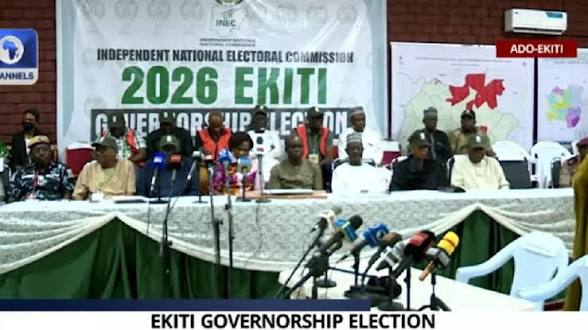

The outcome of the Ekiti State governorship election may have settled the contest for political office, but allegations of vote buying and concerns over voter participation have reignited debate about the credibility of Nigeria’s electoral process.
Governor Biodun Oyebanji of the All Progressives Congress (APC) secured a decisive victory, polling 319,224 votes to defeat his closest rivals across the state’s 16 local government areas.
While the Independent National Electoral Commission (INEC) described the election as largely peaceful and credited the deployment of the Bimodal Voter Accreditation System (BVAS) for improving accreditation, election observers and civil society groups raised concerns about alleged voter inducement in parts of the state.
Reports from observers indicated that some voters were allegedly offered between ₦10,000 and ₦15,000 in exchange for support, while party agents were accused of using various methods to verify voting preferences before distributing payments.
The Centre for Democracy and Development (CDD), the Centre for Journalism Innovation and Development (CJID), and other election-monitoring groups reported incidents they said suggested vote-buying activities and other irregularities during the poll.
The allegations emerged despite repeated warnings by security agencies. The Nigeria Police Force had cautioned political actors and voters against electoral offences, including vote buying, vote selling, intimidation and ballot snatching, warning that offenders would face prosecution.
Similarly, operatives of the Economic and Financial Crimes Commission (EFCC) were deployed to monitor compliance with electoral laws during the election.
The election was also the first governorship poll conducted under the leadership of INEC Chairman, Professor Joash Ojo Amupitan, who assumed office in October 2025 with promises to improve transparency, logistics and public confidence in elections.
Analysts say the Ekiti election has once again highlighted a recurring contradiction in Nigeria’s democracy: improvements in election technology and administration often coexist with persistent concerns about voter inducement and declining public trust.
Although voter registration figures have continued to rise, turnout remains relatively low compared to the number of eligible voters, a trend many observers attribute to growing voter apathy and skepticism about the electoral process.
Political analysts argue that while reforms such as BVAS and recent amendments to the Electoral Act have strengthened aspects of election management, enforcement against electoral offences remains a critical challenge.
The amended Electoral Act signed earlier this year expanded penalties for vote buying and related offences, yet concerns persist over the effectiveness of enforcement mechanisms.
For many observers, the Ekiti governorship election has become more than a contest won and lost. It has evolved into another test of whether Nigeria’s democratic institutions can translate electoral reforms into greater public trust, stronger accountability and elections that are both technologically credible and politically transparent.
As attention gradually shifts to future elections, the issues raised by the Ekiti poll are expected to remain central to discussions about electoral integrity, voter confidence and the future of democratic governance in Nigeria.