


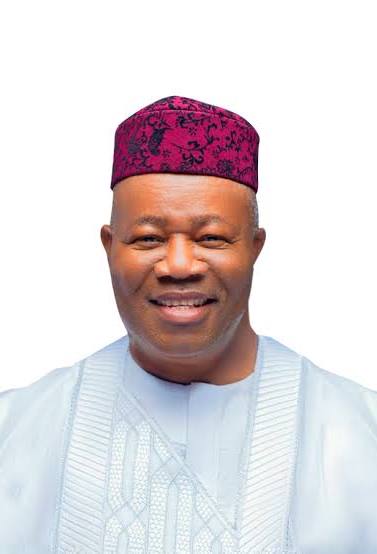
President of the Nigerian senate Godswill Akpabio’s attempt to clarify his remarks to senators who lost APC primaries has ignited a fresh political debate over what he really meant
The controversy has exposed the deep anxieties coursing through the National Assembly as the battle for political survival ahead of the next elections gathers momentum.
For weeks, the atmosphere in the Senate has been anything but calm.
Several lawmakers entered the primary season expecting smooth paths to renomination only to find themselves blindsided by fierce intra-party battles, shifting political loyalties, and the growing influence of governors and power brokers who increasingly control party structures at the state level.
For some senators, years of legislative experience proved insufficient against the political machinery deployed against them.
It was against this backdrop that Akpabio sought to address his colleagues on the fallout from the primaries.
While congratulating senators who secured their party tickets, he acknowledged the painful reality that every democratic contest inevitably produces winners and losers. Democracy, he argued, should remain the ultimate beneficiary of the process.
However, it was not his appeal to democratic values that captured attention.
Instead, lawmakers left the chamber focused on what many considered the most significant part of his intervention: an assurance that efforts were underway to ensure there would be “very few disappointments.”
The statement immediately triggered speculation across political circles.
To senators who had lost primaries or were battling unfavourable outcomes, the remarks sounded less like a routine expression of sympathy and more like a signal that the APC leadership was working on a political rescue plan.
Within hours, discussions spread through the corridors of the National Assembly and party circles, with many interpreting the comments as an indication that certain outcomes could still be reviewed before the final list of candidates emerged.
That interpretation was strengthened by the prevailing political reality within the ruling party, where disputes arising from primaries often end up before reconciliation committees, party leaders, or even the courts.
Yet as public debate intensified, the Senate President’s office issued a strongly worded clarification.
In the statement signed by his Special Adviser on Media and Publicity, Eseme Eyiboh, Akpabio insisted that he neither promised senatorial tickets nor guaranteed political salvation for any senator.
According to the statement, the Senate President merely empathized with affected lawmakers and informed them that the APC leadership was addressing concerns arising from the primaries through established party mechanisms.
The clarification stressed that Akpabio would not interfere with the autonomous processes of the party and lacked the authority to make commitments regarding candidate selection.
But while the denial may settle the official position of the Senate President’s office, it does not entirely erase the political questions raised by his original remarks.
If there was never any assurance beyond routine party reconciliation, critics ask why the comments generated such widespread expectations in the first place.
Conversely, Akpabio’s supporters argue that political opponents deliberately exaggerated his remarks, transforming a message of encouragement into an alleged promise he never made.
Either way, the episode reveals the depth of uncertainty gripping the Senate.
Many lawmakers are confronting a reality in which electoral victories can no longer be guaranteed by incumbency alone. Governors have become increasingly influential in determining who emerges from party primaries, while federal legislators are discovering that national prominence does not always translate into control of local political structures.
For senators who have already lost their tickets, the clarification may be difficult to digest.
The hope generated by the promise of “very few disappointments” has now collided with an official disclaimer insisting that no guarantees were ever offered.
The controversy also raises broader questions about the balance of power within the APC.
If the Senate President cannot influence the fate of senators in his own chamber, it underscores the growing dominance of party structures and state-level political actors over federal lawmakers. If, on the other hand, efforts are indeed underway to resolve grievances behind closed doors, the coming weeks could reveal whether the denial was a matter of clarification or political damage control.
What is beyond dispute is that Akpabio’s remarks touched a nerve at a time when political careers hang in the balance.
In a Senate chamber filled with winners, losers, and those still hoping for a second chance, the promise of “very few disappointments” was always bound to resonate.
Now, with the Senate President publicly distancing himself from the interpretation many attached to those words, the debate has shifted from what was said to what was actually meant.
And in Nigerian politics, that distinction can often be the difference between reassurance and controversy.
