

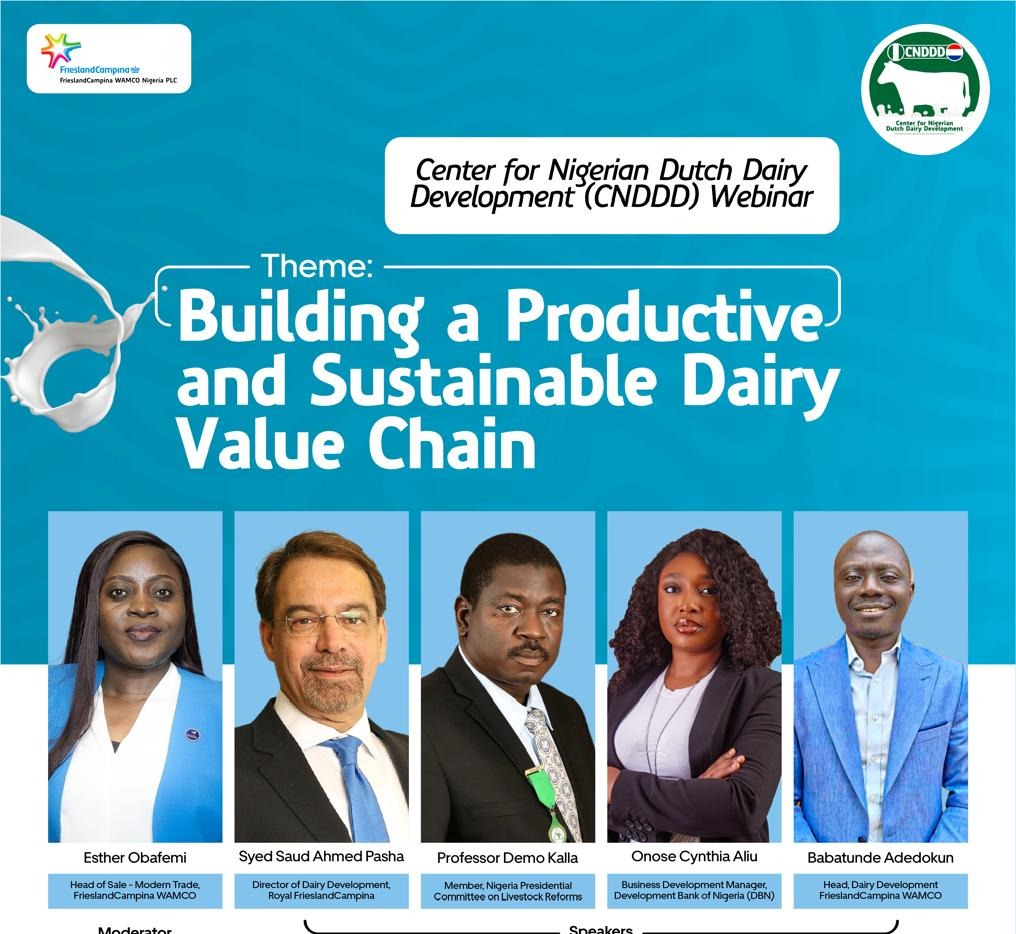

The Federal Government has reaffirmed its commitment to repositioning Nigeria’s dairy industry through coordinated reforms, strengthened partnerships, and the implementation of a newly validated national policy framework.
Speaking at the 2025 FrieslandCampina WAMCO CNDDD Annual Dairy Development Webinar, Co-Chair of the Presidential Livestock Reforms Implementation Committee (PLRIC) Professor Attahiru Jega has declared that Nigeria is at “a turning point” and must take decisive action to build a productive and sustainable dairy value chain.
The keynote speaker Represented by Professor Demo Kalla indicated that demand for dairy and other animal-sourced foods is expected to surge dramatically as Nigeria’s population grows. Citing FAO projections, he said dairy consumption in West Africa could increase by more than 500% by 2050, a trend that presents both major economic opportunities and urgent challenges for the country.
Despite the rising demand, domestic production continues to fall far short of national needs. Persistent constraints—including weak feed and pasture systems, farmer–herder conflicts, low breed productivity, climate pressures, inadequate financing, and poor adoption of modern technologies—have hindered growth in the sector.
“These are not insurmountable challenges,” he said. “With the right policies, investments, and partnerships, Nigeria can reverse decades of underperformance.”
He highlighted two landmark actions taken by President Bola Ahmed Tinubu’s administration:
The establishment of the Federal Ministry of Livestock Development, aimed at driving systemic reforms.
The creation of the Presidential Livestock Reforms Implementation Committee (PLRIC) to ensure strategic coordination across ministries, states, and stakeholders.
A major step forward, he added, is the recent validation of the National Dairy Policy Implementation Framework, which provides a long-term roadmap for transforming the dairy ecosystem.
The keynote acknowledged growing investments by private firms such as FrieslandCampina WAMCO, Arla Foods, Danone, L&Z, Sebore Farms, and others that have expanded milk collection, training, and backward integration.
Development partners—including DDP, ALDDN, GIZ, and the EU-VACE TARED programme—were also recognised for their contributions to capacity building, climate-smart dairy research, and value chain improvements.
“These efforts are commendable, but they must be scaled and harmonised within a national framework,” he noted. “The sector needs synergy, consistency, and structured collaboration.”
The Centre for Nigerian Dutch Dairy Development (CNDDD) was praised as a model of collaboration between government, academia, and industry, particularly in strengthening technical skills, research, and innovation in the dairy sub-sector.
He outlined four strategic pillars essential for achieving dairy self-sufficiency. The first, productivity, focuses on expanding pasture systems, improving livestock genetics, and enhancing veterinary services. The second, sustainability, emphasizes climate-smart production, efficient water use, and adoption of renewable energy. Innovation forms the third pillar, with digital tools deployed for traceability, financial inclusion, disease surveillance, and market integration. Finally, partnerships are crucial, strengthening collaboration across government, the private sector, academia, and development partners to ensure a holistic approach to the nation’s dairy transformation.
The speaker urged stakeholders to shift from “isolated interventions to coordinated national action,” emphasising the need for modern production clusters, cold-chain expansion, cooperative models, stronger regulatory systems, and the proposed Dairy Academy for human capital development.
“Our vision is to build a dairy industry that delivers affordable nutrition, transforms smallholders into prosperous producers, and ensures that no child suffers stunting because milk is too costly or unavailable,” he said.
He concluded by calling on participants to think boldly and deepen partnerships.
“With our population, market, natural resources, and expertise, Nigeria can become a leading dairy producer in Africa,” he asserted. “If pursued with patriotic commitment, the dairy sector will stand as a central pillar of national development and economic transformation.”
Prof. Kalla in his remarks said the National Dairy Policy provides a clear framework to drive public–private investment toward milk self-sufficiency, higher productivity, and a globally competitive Nigerian dairy sector. Developed through extensive stakeholder engagement with the FMAFS, FMITI, and industry partners, the policy charts a roadmap to transform the sector from low-productivity operations to modern, technology-enabled, commercially viable enterprises. With stakeholder validation of its implementation framework, the government is poised to create an enabling environment that fosters innovation-driven value chains and empowers smallholders and private investors.
Key opportunities include expanding domestic milk production, strengthening cold chain and logistics, mobilizing technology, driving backward integration by processors, creating jobs, improving nutrition, and reducing imports. The policy also addresses major challenges such as poor husbandry, low feed quality, high disease burdens, weak animal health systems, climate change pressures, inadequate grazing and water resources, poor infrastructure, and limited access to finance with weak value-chain coordination.