

***“He was abducted, not extradited. Nigeria is burying justice alive,” says Fr. Odimmegwa
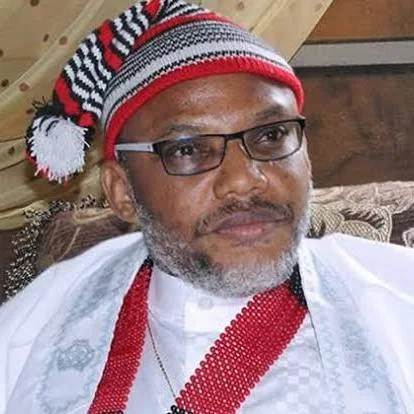
Fresh outrage has trailed the continued detention of the Indigenous People of Biafra (IPOB) leader, Mazi Nnamdi Kanu, as a United States–based Catholic priest, Rev. Fr. Augustine Odimmegwa, on Sunday condemned his prolonged incarceration, describing it as “a national shame and a blatant violation of international law.”
In a strongly worded statement made available to journalists, Fr. Odimmegwa — who heads Rising Sun, a U.S.-based nonprofit human rights advocacy group — accused the Federal Government of “burying justice alive” through its refusal to obey court rulings that ordered Kanu’s release.
“We are saying it loud and clear: Mazi Nnamdi Kanu should not be in detention for one more day,” he declared.
“He was abducted, not extradited. When a man is seized illegally from another country, no court in Nigeria has the authority to try him. The law is clear.”
Kanu, who was forcibly returned from Kenya in June 2021, has remained in detention under the custody of the Department of State Services (DSS) despite a 2022 Court of Appeal judgment that discharged and acquitted him.
The appellate court ruled that his arrest and rendition violated international norms and stripped the Federal High Court of jurisdiction to continue his trial. But the Supreme Court, in December 2023, stayed that ruling, allowing the Federal Government to refile charges — a decision that drew widespread condemnation from rights groups and legal experts.
Fr. Odimmegwa condemned the development as “judicial double-speak,” accusing the apex court of compromising its own doctrine of finality.
“The Court of Appeal said he was free. That should have been the end. Instead, the Supreme Court bent its own rules to please political interests,” he said.
“He was even charged under a dead law — the repealed Terrorism Prevention (Amendment) Act 2013. How can justice survive when the law itself has been buried?”
The priest’s remarks come amid renewed protests in Abuja, Enugu, and Owerri, where demonstrators have taken to the streets demanding Kanu’s release and compliance with court orders.
Carrying placards that read “Free Nnamdi Kanu Now,” “Obey Court Orders,” and “Justice for One, Justice for All,” the protesters insisted that the government’s disobedience threatens the rule of law.
Kanu’s younger brother, Emmanuel Kanu, who addressed one of the rallies, said the agitation transcended ethnic and political divides.
“This is not about tribe or politics. It’s about justice. Nigerians joined because they know if injustice can happen to one man, it can happen to anyone,” he said.
International rights organizations, including Amnesty International and the International Society for Civil Liberties and Rule of Law (Intersociety), have also condemned Kanu’s continued detention, calling it “a blot on Nigeria’s human rights record.”
Fr. Odimmegwa insisted that the struggle for Kanu’s freedom is not about sympathy but about the sanctity of the law.
“We are not asking for favours; we are demanding justice under the law,” he said.
“If one man’s rights can be trampled, then no one is safe. Justice for one is justice for all.”
He warned that Nigeria’s democracy risks losing moral legitimacy if court orders continue to be ignored.
“A nation cannot claim to uphold democracy while jailing citizens in defiance of its own courts,” he stated.
“The world is watching. Freedom cannot breathe when truth is buried. The time to release Nnamdi Kanu is now.”
Observers see the Kanu case as a litmus test for Nigeria’s rule of law and judicial independence. While government prosecutors maintain that his trial is lawful, critics argue that every day he spends in detention in defiance of court rulings deepens the perception of selective justice.
As calls for his release echo from within and beyond Nigeria’s borders, one question continues to hang over the nation’s conscience: Can justice still stand where the law itself is ignored?