


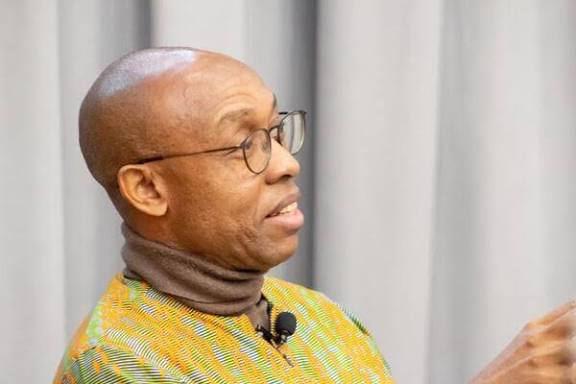
With Nigeria’s new electoral umpire, Professor Joash Amupitan, stepping into an office clouded by distrust, rights advocate and former National Human Rights Commission Chairman, Professor Chidi Odinkalu, has issued a sobering warning: “Resist political capture — or risk losing the soul of INEC.”
Speaking on Politics Today on Channels TV, Odinkalu described the Independent National Electoral Commission (INEC) as “a territory ruled by political principalities,” cautioning that the new chairman must summon courage to reclaim the institution from entrenched political interests.
“INEC is a very lonely place. Every major politician has a plant in the commission,” Odinkalu said.
“Before the new chairman says good morning, there will be someone reporting that to a politician. It’s a place ruled by multiple principalities.”
Odinkalu, a classmate of Amupitan in law school, praised the new chairman as “bright, decent, and honest,” but warned that integrity alone won’t be enough.
“INEC will test him beyond anything he has faced. The people interested in what he eats for breakfast or how he prays are too many. He will need all the courage and faith he can muster.”
Odinkalu reserved his harshest words for immediate past INEC Chairman, Professor Mahmood Yakubu, whom he accused of “ruining Nigeria’s elections” and plunging the commission into a credibility crisis.
“Mahmood Yakubu perfected the art of conducting elections with four results — one announced, one on IReV, one given to party agents, and another tendered in court,” he said.
“He brought elections in Nigeria into disrepute and destroyed the credibility of INEC.”
Citing comparative data across successive INEC chairmen, Odinkalu traced the steady rise and fall of electoral credibility through the proportion of election results decided in court — a metric he described as “the truest test of integrity.” Maurice Iwu (2005–2010) — 86% of election results ended up in court, symbolising chaos and deep distrust.
Attahiru Jega (2010–2015) — 51% in 2011 and 44% in 2015, marking a dramatic improvement with reforms such as the biometric register and Smart Card Reader, Mahmood Yakubu (2015–2023) — 83% in 2023, reversing previous gains and returning the system to near-Iwu levels of contestation.
“Under Maurice Iwu, 86 percent of results ended up in court. Jega reduced that to 44 percent by 2015. But Mahmood Yakubu took us back to 83 percent by 2023. That tells you everything you need to know about how credibility collapsed,” Odinkalu said.
He argued that the 2023 elections represented “the lowest point” in INEC’s history, leaving behind a battered institution and a disillusioned electorate.
Odinkalu urged Amupitan to start rebuilding credibility through upcoming off-cycle governorship polls, describing them as “laboratories for reform.”
“His first test is the Anambra governorship election coming in two weeks,” he said.
“Then Ekiti and Osun before 2027. Nigerians will judge him by how he handles these elections. Nobody expects perfection, but people want to see progress.”
He advised the new INEC boss to measure success not by political praise, but by a reduction in post-election litigation — the true yardstick of institutional trust.
“The chairman’s biggest job is not just conducting elections, but preventing one political interest from becoming the dominant principality in the commission,” Odinkalu added.
Odinkalu warned that unless Amupitan rebuilds INEC’s internal accountability and shields it from partisan infiltration, the commission risks further eroding Nigeria’s fragile democracy.
“Mahmood Yakubu left a broken commission. Rebuilding it will require not just competence but courage,” he said.
“The new chairman must decide what to fix first and how to measure progress. The task before him is not an election, it’s restoration.”
Despite his criticism of the past, Odinkalu expressed cautious optimism about Amupitan’s prospects.
“He’s better, a lot better, than the person he’s replacing. If he stays true to his integrity, he can begin the long journey of restoring faith in Nigeria’s elections.”
Odinkalu’s remarks echo a broader national sentiment, that Nigeria’s democracy no longer hinges merely on who wins elections, but on whether voters still believe their votes count. For Amupitan, the challenge is not only to run elections but to re-engineer belief.
The battle for Nigeria’s democracy, as Odinkalu suggests, may no longer be fought at the ballot box, but within INEC itself.

3 Comments
尖端资源,价值百万,一网打尽,瞬间拥有!多重收益,五五倍增,八级提成,后劲无穷!摸币网,最嚣张的上线替下线赚钱网站:https://1925.mobi/
ht6rpc
I likewise conceive therefore, perfectly written post! .