


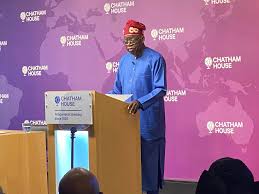
Chatham House, the London-based policy institute, has delivered a stinging rebuke to President Bola Ahmed Tinubu’s recent boast in Brazil that his administration has eliminated corruption in Nigeria.
In a new report, the think tank said sleaze remains “deeply entrenched,” eroding economic foundations, weakening the rule of law, and breeding public distrust in institutions.
It pointed to a compromised judiciary and pervasive political capture as proof that Nigeria’s corruption crisis is far from over.
The report, authored by Dr. Leena Hoffmann and Tommy Hilton, underlined how corruption continues to undercut governance reforms, drive poverty—now afflicting 54% of Nigerians—and fuel emigration, protests, political violence, and extremist insurgencies.
Despite 25 years of reforms, the authors argued, corruption remains Nigeria’s most defining governance feature. The country still ranks among the world’s 40 most corrupt nations on Transparency International’s CPI and lags on the World Bank’s control of corruption index. Within Africa, it stands at 33rd on the Mo Ibrahim governance ranking.

“Corruption diverts public resources away from vital sectors such as education, healthcare and infrastructure, fuelling poverty and inequality,” the report warned, stressing that Nigeria’s economic size masks its low per capita output and stark inequality.
The institute linked today’s failures to decades of military rule, political patronage, and weakened anti-graft agencies, arguing that both elites and citizens alike have normalized bribery and clientelism as the “price for getting things done.”
By puncturing Tinubu’s narrative, Chatham House casts doubt on Abuja’s reform rhetoric and underscores the widening gulf between official claims and Nigerians’ lived reality.
