

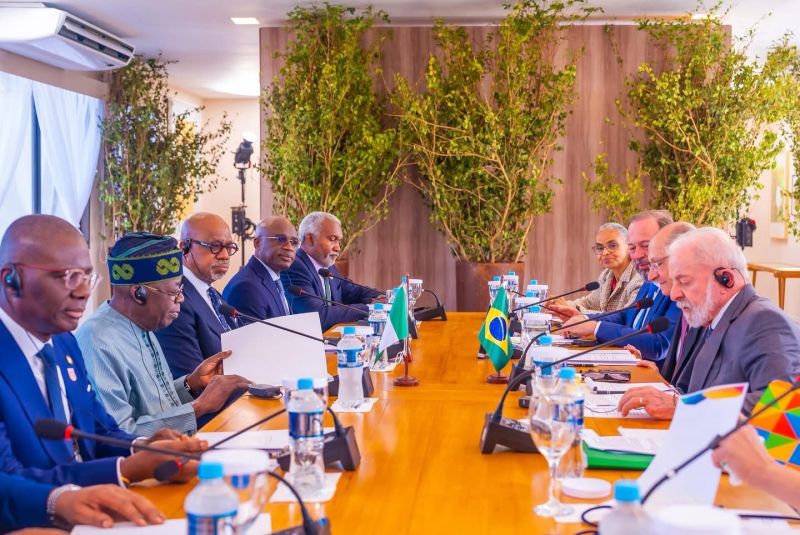

What began as a bold diplomatic stride for Nigeria on the global stage has quickly spiraled into a storm of domestic controversy—ignited not by words, but by a photograph.
During President Bola Ahmed Tinubu’s high-profile bilateral meeting with Brazilian President Luiz Inácio Lula da Silva at the iconic Copacabana Forte, a seemingly innocuous image captured Tinubu flanked by two familiar allies: Lagos Governor Babajide Sanwo-Olu and Ogun Governor Dapo Abiodun. All three men—staunch political allies—hail from Nigeria’s South-West.
To many Nigerians, the optics were more than awkward. They were incendiary.

“This is not just a seating arrangement. It’s a signal. A dangerous one,” said public affairs analyst Dr. Uche Nworah in a scathing Facebook post. “In a country as fragile and diverse as Nigeria, visual representation is political capital. This one sends a message of exclusion.”
No Northern governor. No representation from the South-East or South-South. Not a single high-ranking official from outside the President’s geopolitical zone present in the official frame. As images from the event circulated online, so did the outrage—amplified by citizens, political observers, and ethnic stakeholders who view the moment as a tone-deaf misstep in national representation.
The backlash has been swift and fierce.
On X (formerly Twitter), hashtags like #OneNigeriaNotOneZone and #PresidencyForAll began trending, with users accusing the Tinubu administration of turning national diplomacy into a regional echo chamber.
“Diplomacy abroad is also messaging at home,” wrote one user. “If the face of Nigeria overseas is only South-West, how are we one nation under one flag?”
So far, the Presidency has not issued a statement addressing the concerns, but analysts say the damage to public trust may already be done—especially in regions that feel perpetually sidelined.
“These are not just pictures. These are symbols. And in a multi-ethnic democracy like Nigeria, symbols can ignite fires,” said political commentator Zainab Okonkwo. “This gaffe turns what could have been a unifying global engagement into a spotlight on internal fault lines.”
Insiders say the President’s inner circle may have underestimated the political temperature back home. With secessionist sentiments still simmering in parts of the country, and ethnic divisions often weaponized in political discourse, the exclusion—intentional or not—feeds a larger narrative of imbalance.
What was meant to be a moment of global diplomacy is now a sobering reminder: in Nigeria, who sits where is never just protocol—it’s politics. And politics, especially in a country as complex as Nigeria, is always perception.