


As Nigeria faces mounting economic woes, institutional fatigue, and a restless youth population, a powerful call for transformational leadership reverberated through the capital over the weekend at the 6th anniversary celebration of the National Institute for Legislative and Democratic Studies (NILDS).
The event, held in Abuja, was more than a ceremonial milestone—it became a national symposium on the urgent need for visionary governance.
In his stirring keynote titled “Transformational Leadership for National Transformation,” renowned leadership strategist Linus Okorie challenged the country’s political class to escape the chokehold of transactional governance. “Nigeria doesn’t lack resources or intelligence,” Okorie said. “What we lack is a generation of leaders who think in decades, not in four-year cycles.”
Drawing inspiration from historical and global examples like Admiral Horatio Nelson and Singapore’s Lee Kuan Yew, Okorie underscored three imperatives for Nigeria’s rebirth: long-term vision, people-centered governance, and a restoration of national values. “We need leaders who plant trees whose shade they may never sit under,” he emphasized.
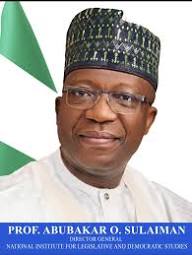
The lecture struck a resonant chord with the audience, especially as it dovetailed into a glowing tribute to NILDS Director-General, Professor Abubakar O. Suleiman, whose six-year leadership was widely lauded as a living example of the principles espoused.
Speaking on behalf of the Senate President, Senator Victor Umeh described Prof. Suleiman’s tenure as “a masterclass in transformational leadership,” saying NILDS had grown “from an institute into an institution—from a concept into a force.”
“Under his watch, NILDS has sharpened the minds of lawmakers, championed policy innovation, and inspired a more thoughtful, responsive legislature,” Umeh said. He drew a symbolic link between Suleiman’s upcoming 60th birthday and Nigeria’s own crossroad moment.
“At 60, a man begins to move from ambition to legacy. And what better legacy than helping a nation find its compass?”
Umeh further contrasted Nigeria’s trajectory with Dubai’s, noting both discovered oil around the same period. “Dubai found oil in 1966, Nigeria in 1956. Look at where they are, and where we are. The difference is not oil—it’s leadership. Leadership with a mission.”
Also delivering remarks, Lionel Ukpoli, MFR, said the gathering was deliberate and timely, pointing to increasing insecurity, economic uncertainty, and waning public trust. “Leadership must now move beyond old paradigms. It’s not about charisma but about the ability to drive meaningful change,” he stated.
A representative of the World Foundation for Women (WFW) added a gender and psychological lens, asserting that transformational leadership is seeded early through socialization and shared identity.
“We must distinguish between those who seek personalized power and those driven by a collective cause,” she said, using Nigerians’ emotional unity during football games as a metaphor for the nation’s untapped collective spirit.
The Director-General of the Michael Imoudu National Institute for Labour Studies (MINILS) Mr Ezekiel Ayorinde also praised Prof. Suleiman’s impact, citing NILDS’s central role in Nigeria’s minimum wage law. “He brought together labor, employers, and lawmakers. That’s real, national leadership,” he said.
Meanwhile, Prof. Suleiman’s own remarks reflected both pride and urgency. While celebrating NILDS’s achievements—including launching Democracy Radio 104.9, youth civic programs, gender advocacy, and AI-driven legislative platforms like LegiPro—he warned of a widening gap between legislation and impact.
“Legislation without knowledge leads to policy failure. That’s why NILDS produces monthly Trust Situation Reports and is launching the country’s first Manual on Security Sector Oversight,” he said.
Suleiman also lamented that much of NILDS’s rigorous research remains underutilized, urging stronger synergy between lawmakers, researchers, and civil society. “Our democracy is not just about elections—it’s about institutions, inclusion, and integrity.
Until we see deliberate reforms in these areas, democratic dividends will remain distant for most Nigerians.”
Under his leadership since 2019, NILDS has been repositioned as a continental hub for legislative development, training over 6,000 lawmakers, aides, and civil servants, and launching a new 2025–2029 Strategic Plan focused on political communication, party reform, and democratic engagement.
During a panel discussion to cap the event, stakeholders agreed that for Nigeria to rise, it must invest in future leaders, dismantle political gatekeeping, and promote values-driven education from the ground up.
As applause echoed through the hall, one message rang clear: the path to Nigeria’s transformation lies not just in changing laws, but in reimagining leadership itself.
“Let this generation,” Okorie concluded, “be remembered not for what it inherited, but for what it reimagined.”
