


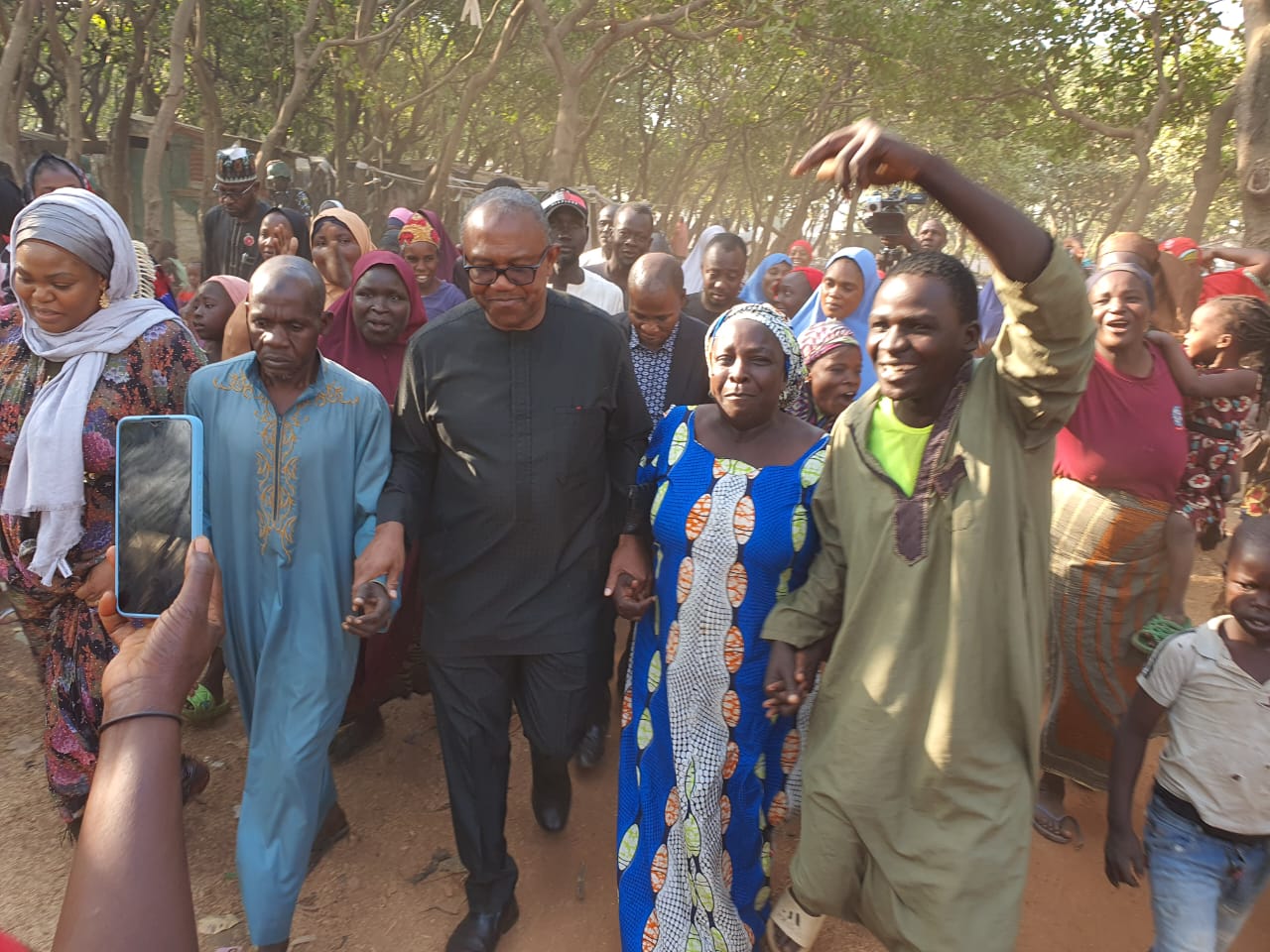
In a New Year visit filled with empathy and urgency, Labour Party’s 2023 presidential candidate, Peter Obi, raised alarm over the Federal Government’s failure to address Nigeria’s growing humanitarian crisis, turning Internally Displaced Persons (IDP) camps into semi-permanent settlements.
Obi, speaking during his visit to the Durumi IDP Camp in Abuja, lamented that the prolonged existence of such camps reflects deeper failures in governance, security, and social welfare. 
He declared that as long as Nigerians remain displaced, “Nigeria itself is an IDP camp.”
Moved by the dire conditions at the Durumi camp, which shelters over 3,000 displaced persons and 340 families, Obi pledged immediate assistance and sustainable solutions.
During the visit, he promised monthly stipends for four unpaid healthcare workers providing services at the camp and announced plans to recruit a volunteer medical doctor to strengthen healthcare delivery.
However, Obi’s intervention did more than address immediate needs; it spotlighted systemic inequalities and the lack of long-term solutions for Nigeria’s displaced populations.
“The state of these camps is a national embarrassment,” Obi stated. “We need policies that protect citizens and prevent displacement not just makeshift solutions that stretch for years.”
He challenged the government to prioritize education, vocational training, and healthcare infrastructure, arguing that displaced children and families deserve dignity and pathways to rebuild their lives.
Obi’s humanitarian efforts extended beyond the IDP camp. He also visited the Tungamadaki Primary Health Centre (PHC) along Airport Road, where he had previously supported renovations.
While acknowledging progress; such as solar-powered electricity and structural upgrades, he noted that inflation had stalled repairs, leaving cracks in walls and unfinished projects.

“We’ve come far, but there’s more to be done,” Obi said, promising additional funds to complete renovations and improve the facility’s capacity to serve rural residents.
Community leaders, including Alhaji Muhammad Akoroh, praised Obi’s intervention as a lifeline for vulnerable communities. “Health is wealth,” Akoroh said. “We need more leaders to take such bold steps.”
While Obi’s support reflected personal goodwill, his actions also raised critical questions about the government’s role in addressing displacement and poverty.
“Should Nigerians rely on personal interventions,” he asked, “or is it time for systemic reforms to prevent displacement and rehabilitate victims?”
His advocacy extended to the need for education reforms at the IDP camp, where children lack access to secondary schools and vocational training, trapping them in cycles of poverty.
Obi’s visit wasn’t just about providing aid; it was a wake-up call to Nigerian leaders.
He demanded accountability and a shift in governance priorities, urging policymakers to tackle root causes such as conflict, inequality, and poor infrastructure, rather than relying on short-term relief measures.
“In 2025, we must confront the truth,” Obi declared. “Our displaced citizens don’t need pity, they need action, fairness, and justice as their rights, not charity.”
Peter Obi’s engagements signaled a grassroots-focused governance model, emphasizing direct interaction with communities over bureaucratic processes.
However, the challenge is whether the momentum will translate into policy reforms that address displacement, or will it remain symbolic?
Obi’s interventions have not only inspired hope but also ignited national conversations about human dignity, governance failures, and the urgency for reform. Whether this sparks lasting change depends on the government’s response and citizen action in demanding a better Nigeria.
