

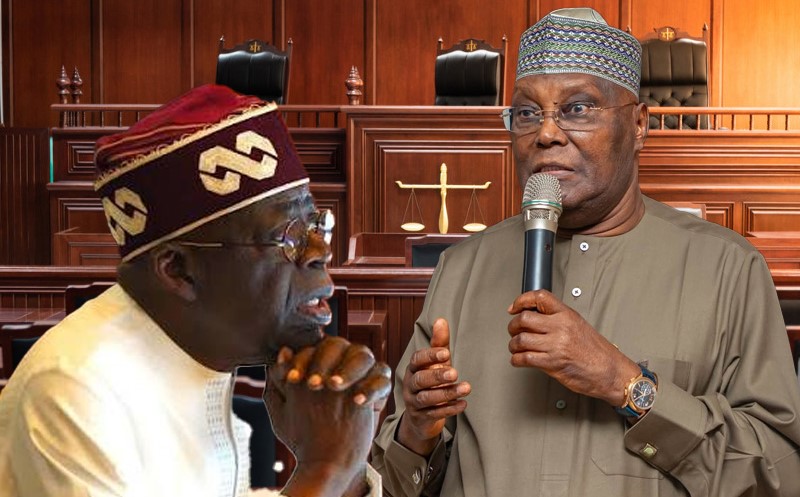

The Federal High Court in Abuja has rejected former Vice-President Atiku Abubakar’s bid to introduce fresh evidence in his legal battle seeking to disqualify President Bola Tinubu from the 2027 presidential election over alleged forgery of his NYSC discharge certificate.
Justice Inyang Ekwo dismissed Atiku’s application to amend his originating summons, ruling that the proposed changes would introduce fresh evidence outside the constitutionally prescribed timeframe for pre-election matters.
The judge held that Section 285(9) of the 1999 Constitution allows parties in pre-election cases 14 days to present evidence, warning that permitting Atiku to introduce new evidence at this stage would circumvent the constitutional provision.


The court agreed with arguments by Tinubu and other defendants that the proposed amendment would fundamentally alter the nature of the suit rather than merely make corrections to the existing case.
Justice Ekwo also faulted Atiku for allegedly attempting to mislead the court by presenting the amendment as one that would not introduce fresh issues, despite its implications for the evidence already before the court.
According to the judge, allowing the former Vice-President to replace existing evidence with new material outside the constitutionally permitted period would cause injustice to the defendants.
The substantive suit, however, remains pending, with the court fixing December 2, 2026, for hearing following an agreement among lawyers representing the parties.
Atiku and the African Democratic Congress (ADC) had approached the court seeking Tinubu’s disqualification from the 2027 presidential election, alongside the All Progressives Congress (APC), over allegations that the President submitted a forged NYSC discharge certificate to the Independent National Electoral Commission (INEC).
The plaintiffs, in suit number FHC/ABJ/CS/1888/2026, asked the court to compel INEC to remove Tinubu and the APC from the list of eligible presidential candidates and political parties for the 2027 election.
Tinubu, the APC and INEC have denied the allegations and challenged the competence of the suit.
Tinubu and the APC argued that the plaintiffs lacked the legal right to institute the case and insisted that no forged NYSC certificate was submitted to INEC for either the 2023 or 2027 elections.
They also maintained that the NYSC had never disclaimed the certificate allegedly issued to Tinubu, arguing that a formal disclaimer from the issuing institution was necessary to establish forgery.
INEC, in its preliminary objection, also urged the court to dismiss the suit, arguing that it was statute-barred, lacked a reasonable cause of action, and constituted an abuse of court process.
The commission further questioned the plaintiffs’ compliance with the Federal High Court’s Pre-Election Practice Directions and challenged the legality of some reliefs sought.
Despite the rejection of Atiku’s fresh evidence, the court is expected to hear the substantive case on December 2, when the parties return to determine the issues surrounding Tinubu’s eligibility to contest the 2027 presidential election.
The allegations of certificate forgery remain disputed and have not been established by the court.