

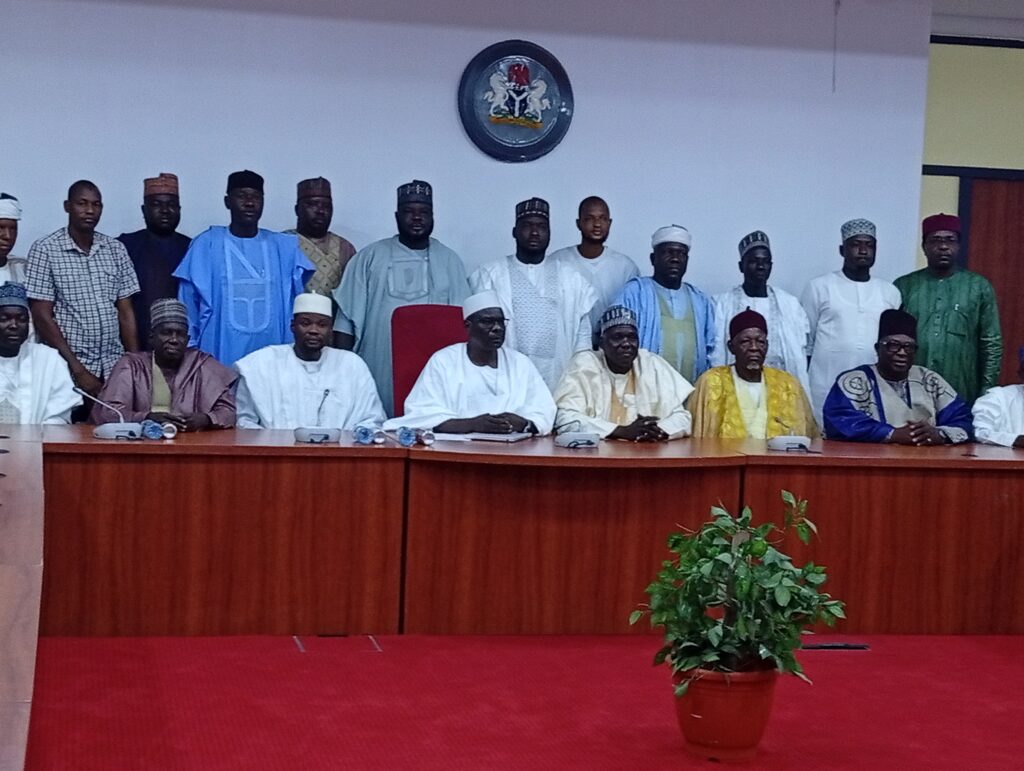

Senator Ali Ndume has challenged politicians who pursue personal wealth and political positions at the expense of their constituents, insisting that leadership must be measured by concrete results, not promises or ambition.
His message comes as proposed erosion-control projects worth ₦66bn across Southern Borno await final approval from President Bola Tinubu, while a bill to establish a Federal College of Agriculture in Shani awaits further legislative action.
About ₦6bn is proposed for erosion-control work in the Aguza area, according to the account of Ndume’s remarks.


“We are now at the last stage. We are waiting for the President’s final approval,” Ndume said in remarks captured in an available transcript.
The projects could address serious erosion challenges facing communities in Southern Borno. But until approval is secured and implementation begins, the intervention remains a proposal—and residents are still waiting for delivery.
Ndume said politicians should stop allowing personal ambition to undermine cooperation needed to bring development to their constituents.
“I have seen how the legislature works, and I know that delivering results often requires patience, cooperation and a clear understanding of parliamentary procedures,” he said.
“We must work together instead of allowing personal ambitions to divide us.”
He was blunt about what he sees as a fundamental failure of political leadership: elected officials who focus on what they can gain from office rather than what they can do for the people who elected them.
“Politics should not be reduced to the struggle for positions or the pursuit of money,” he said.
“Unfortunately, some politicians focus more on what they can gain personally than on what they can do for the people who elected them.”
Ndume also criticised leaders who possess the means to help their constituents but fail to use their resources and influence to address community needs.
“I did not join politics to enrich myself. I joined politics to serve the people,” he said in remarks translated from Hausa.
His challenge places the spotlight on two development priorities in Southern Borno: the proposed erosion-control projects and the planned agricultural college in Shani.
The college bill, sponsored by Ndume, has passed the Senate but still requires concurrence by the House of Representatives and completion of the remaining constitutional steps before the institution can be established under the law.
For Shani, the proposed college could widen access to education, develop agricultural skills and create opportunities in a community where farming is an important economic activity.
Chairman of Borno Mega Shani, Musa Lawal Lubo, led a delegation to thank Ndume for sponsoring the bill, following a directive from the Emir of Shani.
Lubo said Shani had land and facilities suitable for the institution and appealed to the Borno State Government to help facilitate its establishment.
The delegation also made its political position clear ahead of the 2027 general election, declaring support for Ndume and the community’s representative in the House of Representatives.
Lubo said the community based its position on what it believed the lawmakers had done for local development, while stressing that it was not seeking to prevent other aspirants from contesting.
“We cannot tell anybody not to contest, but we have told you the direction of our community,” he said.
Other speakers included the representative of the Emir, Sarkin Yaki (Hani), Alhaji Haruna Adam, and the President of the Shani Emirate Development Association, Mamman Walama.
Ndume’s legislative career spans more than two decades. He entered the House of Representatives in 2003 and moved to the Senate in 2011 to represent Borno South.
That experience informs his argument that legislative results require patience, procedural knowledge and cooperation. But experience alone cannot substitute for delivery.
The immediate questions facing Southern Borno are whether the proposed ₦66bn erosion-control package will secure presidential approval and reach affected communities, and whether the Shani agriculture college bill will clear its remaining legislative hurdles.