

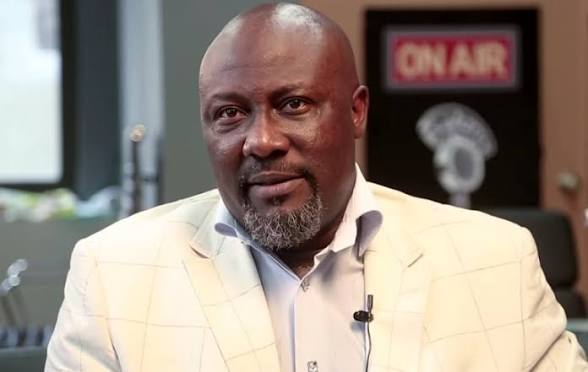

Former Kogi West senator, Dino Melaye, has accused Senate President Godswill Akpabio and House of Representatives Speaker Tajudeen Abbas of weakening the National Assembly’s independence and failing to adequately check President Bola Tinubu’s administration.
Melaye warned that the alleged erosion of legislative oversight could undermine Nigeria’s democracy, arguing that presidential power becomes increasingly difficult to restrain when institutions created to provide checks and balances fail to act independently.
He made the allegations at a press conference on Wednesday, October 14, in a presentation titled “The 10th Assembly: The Pathway to Tinubu’s ‘Lifetime Presidency’.”
The former lawmaker cited the amendment of the Police Act, the declaration of a state of emergency in Rivers State, discrepancies in tax legislation, electoral reforms and government spending as examples of what he described as troubling decisions and omissions by the National Assembly.
He also questioned the legislature’s handling of constitutional amendments, presidential absence and proposals to change the tenure of elected officials.
Melaye argued that his concerns were not based on proof that Tinubu intended to remain in office beyond the constitutional limit, but on what he described as a pattern of legislative deference to the Presidency.
“A lifetime presidency does not begin with the abolition of term limits. It begins when the institutions created to restrain a President stop restraining him,” he said.
He traced his concerns to the July 2024 amendment to the Nigeria Police Act, which allowed an Inspector-General of Police to remain in office until the expiration of the tenure specified in his appointment letter, notwithstanding the ordinary retirement requirements.
Melaye questioned why the executive-sponsored bill passed through all three readings in both chambers on the same day, arguing that the speed raised concerns about the level of legislative scrutiny.
He also noted that former Inspector-General of Police Kayode Egbetokun had previously served as Tinubu’s Chief Security Officer in Lagos, while his successor, Olatunji Disu, had served as the President’s aide-de-camp when he was governor.
Although Melaye acknowledged that the officers’ previous professional relationships with Tinubu did not establish political bias or electoral wrongdoing, he argued that stronger safeguards were needed to protect confidence in the police, particularly given its role in election security.
He also questioned the National Assembly’s approval of the state of emergency declared in Rivers State in March 2025, arguing that the use of voice votes raised questions about whether the constitutionally required two-thirds majority in each chamber had been established.
On the 2025 tax laws, Melaye cited reported discrepancies between versions passed by the legislature and those subsequently gazetted. He argued that publishing certified copies was insufficient without establishing how the discrepancies arose and whether anyone was held accountable.
“Correction is not accountability,” he said.
Melaye further criticised the handling of electoral reforms, particularly the February 2026 controversy over the House of Representatives’ reversal of its earlier position on mandatory electronic transmission of election results.
He questioned Speaker Abbas’s declaration that the ayes had prevailed on a rescission motion, despite protests from lawmakers who maintained that the nays were louder.
The former senator also raised concerns about Section 138 of the Electoral Act 2026, which, according to his presentation, no longer expressly lists lack of qualification as a ground for challenging an election after the result has been declared. He called for scrutiny of the implications for electoral accountability while acknowledging that constitutional qualification requirements remained in force.
On public spending, Melaye questioned the National Assembly’s oversight of Service-Wide Votes, citing allocations of approximately N4.08tn in 2024, N9.31tn in 2025 and N12.83tn in 2026.
He put the combined figure at about N26.22tn and called for greater transparency regarding the release and use of the funds. He acknowledged that the Budget Office had identified specific government obligations covered by the 2026 allocation but maintained that Parliament must ensure adequate accountability.
Melaye also questioned the implications of a proposed six-year single term for presidents and governors, reportedly intended for consideration by the 11th Senate after the 2027 elections.
If Tinubu wins re-election in 2027, his second term under the current Constitution would ordinarily end in 2031. Melaye argued that any future amendment must contain clear transitional provisions to prevent an incumbent from benefiting from an unintended extension of tenure. He acknowledged that no existing provision automatically grants Tinubu an additional two years.
He further questioned the constitutional procedure reportedly followed during the House of Representatives’ consideration of State Police amendments in July 2026, particularly the participation of lawmakers virtually in proceedings requiring a special majority.
The former senator also called for clarity on the application of Section 145 of the Constitution during Tinubu’s reported working vacation between August 30 and September 29, 2026. The provision addresses the transfer of presidential functions to the Vice-President when the President is on vacation or otherwise unable to discharge those functions.
Melaye argued that the National Assembly should publicly explain its interpretation of the provision and demonstrate that constitutional safeguards were being respected.
He also criticised what he described as insufficient independent legislative scrutiny following the reported deaths of 37 detainees in the custody of the Nigeria Security and Civil Defence Corps in Niger State on September 17, 2026.
Although the Federal Government established an investigative committee and the police commenced an investigation, Melaye maintained that Parliament should conduct its own oversight rather than rely solely on an inquiry initiated by the Executive.
He urged Akpabio and Abbas to defend the legislature’s constitutional authority, strengthen scrutiny of public expenditure and ensure that legislative and constitutional procedures were followed.
“The oath they took was to the Constitution, not to the President,” he said.
Melaye warned that precedents tolerated by the current National Assembly could weaken democratic safeguards for future administrations.