

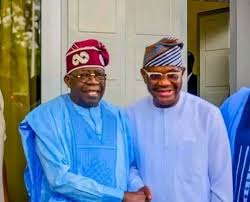

By Olaide Ahli
There is a difference between making noise and winning a political argument.
In the unfolding confrontation between the Minister of the Federal Capital Territory, Nyesom Wike, and Kwara State Governor Abdulrahman Abdulrazaq, that difference is becoming increasingly difficult to ignore.

Wike has talked.
He has attacked.
He has named AbdulRahman publicly.
He has questioned his political position and accused him, alongside Imo State Governor Hope Uzodimma and Ogun State Governor Dapo Abiodun, of working against his Rainbow Coalition.
But what has AbdulRahman done?
Almost nothing publicly.
And that, in my view, is precisely where the political significance of this episode lies.
AbdulRahman did not need to enter Wike’s shouting contest. He did not need to trade insults or organise a media counterattack. He simply maintained his position while the controversy moved from the level of personal exchanges into the larger question of how President Bola Tinubu’s 2027 political machinery should operate.
That is where the story changed.
Wike wanted influence. The governors demanded boundaries.
Wike has consistently presented his Rainbow Coalition as a vehicle for mobilising support for President Tinubu’s re-election, rather than an arrangement designed to destroy the APC.
But the APC Governors’ Forum took a different position.
The governors said they would not participate in, support or endorse political arrangements capable of undermining the APC, weakening the party or adversely affecting its candidates.
That was not merely a disagreement between politicians.
It was a disagreement over political territory.
Who controls the campaign machinery?
Who determines the political structure at state level?
Who coordinates support for the President?
And, perhaps most importantly, can an influential politician operating outside the formal APC hierarchy establish a parallel political structure across states controlled by APC governors?
Those were the real questions.
And AbdulRahman, as Chairman of the Nigeria Governors’ Forum, was never going to ignore the implications.
Then Wike started barking at AbdulRahman
Instead of keeping the disagreement institutional, Wike repeatedly brought AbdulRahman into the public argument.
He called out the Kwara governor and questioned his opposition to the coalition.
On September 22, Wike specifically named AbdulRahman, Uzodimma and Abiodun as the governors he said were opposed to his political project. He also argued that their opposition was connected to their political interests and the future control of legislative positions.
But AbdulRahman did not respond in kind.
That is important.
Because when one politician is constantly attacking another and the other refuses to be dragged into the exchange, the political effect can be very different from what the attacker intends.
Wike may have wanted a confrontation.
AbdulRahman refused to provide one.
And sometimes, refusing to fight on another man’s terms is itself a political victory.
Tinubu’s balancing act tells the story
The biggest evidence of how serious the disagreement has become is not found in Wike’s interviews.
It is found in the emerging structure being discussed around President Tinubu’s 2027 campaign.
Reports published on September 21 indicate that Wike is expected to receive a defined campaign responsibility covering Rivers State and the Federal Capital Territory, rather than operate with an unrestricted role across the wider political structure.
That distinction matters.
Wike remains useful to Tinubu.
That much is obvious from the President’s continued political relationship with him and Wike’s prominent position in the administration.
But keeping Wike does not necessarily mean giving him an open field.
That is the difference.
Tinubu can recognise Wike’s political value while simultaneously defining the boundaries within which that influence operates.
And that is precisely where AbdulRahman’s position becomes significant.
Tinubu keeps Wike—but the boundaries are clearer
The emerging arrangement tells a simple political story.
Tinubu does not want to lose Wike.
But neither does the President appear willing to allow the disagreement between Wike and the APC governors to consume the ruling party’s political structure.
So what happens?
Wike is retained.
His political usefulness is recognised.
But his reported campaign responsibility is being defined around Rivers and the FCT.
That is not the same thing as giving him unrestricted control of the APC’s political machinery across the country.
And this is where AbdulRahman’s quiet position becomes difficult to dismiss.
The governor did not need to defeat Wike in a shouting match.
He did not need to challenge him on television.
He did not need to answer every accusation.
The political system itself began addressing the question.
The irony of Wike’s attacks
There is a certain irony in the entire episode.
Wike’s repeated attacks have actually kept AbdulRahman’s position at the centre of the conversation.
Every time Wike mentions AbdulRahman, he reminds the public that the Kwara governor is one of those resisting his political arrangement.
Every time Wike complains about the governors, he confirms that there is a serious disagreement over the boundaries of his political operation.
And every time the Presidency moves towards defining those boundaries, the original concern of the governors becomes harder to dismiss.
In other words, the more Wike barks, the clearer the boundary becomes.
AbdulRahman’s silence was not surrender
This is where those who interpreted AbdulRahman’s silence as weakness may have misunderstood the politics.
Silence in politics can be strategic.
A politician who responds to every attack can easily become trapped in the agenda of the person attacking him.
AbdulRahman avoided that trap.
He did not allow Wike to determine the terms of the conversation.
He allowed the issue to move beyond personalities and into institutions, party structures and presidential decision-making.
That was the smarter battlefield for a governor and Chairman of the Nigeria Governors’ Forum.
Wike had the microphone.
AbdulRahman had the restraint.
And eventually, the argument reached the Presidency.
The quiet victory
Calling this a victory does not mean claiming that Wike has been politically defeated.
He has not.
Wike remains Minister of the FCT, a prominent political figure and an important ally of President Tinubu. He has also continued to insist that his Rainbow Coalition is aimed at supporting Tinubu’s re-election.
But politics is not always about total victory or total defeat.
Sometimes the victory is in where the boundaries are finally drawn.
Wike wanted to demonstrate that he could operate a broad political coalition beyond conventional party structures.
The APC governors pushed back.
AbdulRahman became one of the governors Wike singled out.
And now reports indicate that Wike’s emerging campaign assignment is being defined around Rivers and the FCT.
That is the political development that should be watched.
Not the insults.
Not the interviews.
Not the barking.
The boundary.
AbdulRahman did not need to bark back
There is an old African wisdom that the dog may bark at the moon, but the moon does not stop moving.
That is the lesson of this episode.
Wike has spoken loudly.
AbdulRahman has remained largely silent.
Tinubu has had to balance Wike’s political usefulness against the concerns of his governors and the need to maintain a coherent campaign structure.
The result is an arrangement in which Wike remains relevant but his reported operational responsibility is being more clearly defined.
And that is why AbdulRahman’s silence deserves to be understood differently.
He did not defeat Wike with noise.
He did not defeat Wike with insults.
He did not defeat Wike on television.
He simply refused to follow him into the noise.
Tinubu keeps Wike. But Wike’s political reach is being defined.
For AbdulRahman, that is the quiet victory.
And perhaps the biggest lesson is this:
In politics, the person who shouts the loudest does not always determine where the line is drawn.