

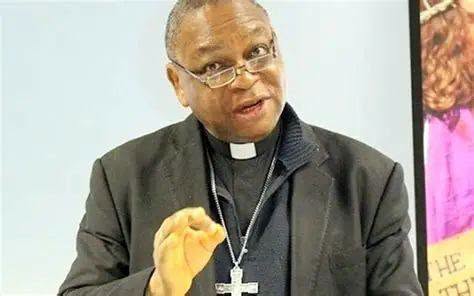

Former Minister of Youth and Sports Development, Solomon Dalung, has accused the administration of President Bola Tinubu of embracing praise while vilifying critics, saying the government’s response to recent comments by Cardinal John Onaiyekan reflects an intolerance for dissent.
In a statement on Monday, Dalung argued that the Presidency and its supporters applauded Pastor Enoch Adeboye when he defended the Tinubu administration on insecurity, but questioned the motives of Onaiyekan after the Catholic cleric voiced concerns over insecurity, poverty and governance.
According to him, the contrasting reactions reveal a troubling pattern in which supportive voices are celebrated while critical opinions are dismissed as politically motivated.

“One disturbing pattern is beginning to define this administration. It is not how it responds to praise. It is how it responds to criticism,” Dalung said.
He argued that governments should be judged by their willingness to engage with criticism rather than their ability to attract commendation.
“The real question is not whether Cardinal Onaiyekan is right. The real question is why those in power seem more interested in discrediting those who raise concerns than in addressing the concerns themselves,” he stated.
Dalung rejected suggestions that the Catholic cleric’s comments were politically motivated, insisting that Onaiyekan has consistently spoken on issues of governance, justice, insecurity, corruption and national unity under successive administrations, including those of former Presidents Goodluck Jonathan and Muhammadu Buhari.
According to the former minister, the cardinal’s public interventions did not begin with the current administration but have remained a constant feature of his engagement with national issues.
He maintained that a government confident in its record should respond to criticism with facts rather than questioning the motives of those expressing dissent.
Dalung also defended the right of religious leaders to participate in national discourse, stressing that they remain citizens with constitutional rights to comment on matters affecting the country.
“Religious leaders are citizens before they are symbols. They have every right to speak. We have every right to disagree. What we should resist is the temptation to measure the value of their words solely by whether they align with our politics,” he said.
He warned that democracy is weakened when criticism is treated as hostility and praise becomes the only acceptable form of public engagement, urging political leaders to embrace accountability rather than dismiss opposing voices.