

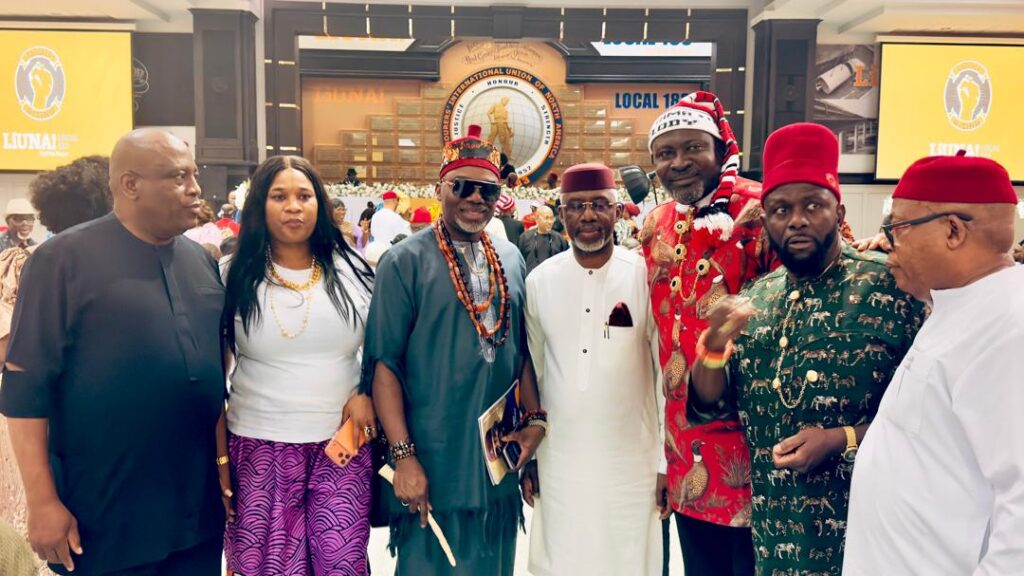

Former Chief of Staff to the Imo State Governor, Hon. Uche Nwosu, has called for a comprehensive overhaul of the traditional Igbo apprenticeship system to make it more responsive to the demands of the modern economy.
Nwosu, who spoke at the 2026 Igbo National Convention in Canada, described the apprenticeship system as one of the most powerful expressions of Igbo enterprise, ingenuity and communal responsibility, saying it had historically helped produce entrepreneurs, business owners and employers across the South-East.
Speaking on the theme, “Rebuilding the Igbo Apprenticeship System for a New Generation,” Nwosu said the traditional system, popularly known as Igba Boi, Imu Ahia and Imu Oru, had long incorporated principles that are now widely associated with mentorship, practical training, business incubation, networking and enterprise development.
According to him, the system was designed not merely to provide young people with employment, but to equip them with the knowledge and resources required to eventually establish their own businesses.
He said apprentices traditionally learnt through observation and practical experience, acquiring skills in customer relations, negotiation, stock management, market development, business reputation and resilience.
“The apprentice learned how to serve customers, negotiate prices, manage stock, build relationships, understand markets, protect a reputation and survive difficult seasons,” he said.
Nwosu noted that the most remarkable feature of the system was the expectation that successful entrepreneurs would deliberately train people who could eventually become their competitors.
He said the philosophy reflected the Igbo principle of “Onye aghana nwanne ya”, which he interpreted as a commitment to ensuring that no one is left behind.
According to him, the apprenticeship system also played an important role in rebuilding Igbo economic life after the Nigerian Civil War, when many families lost businesses, property, savings and other means of livelihood.
He, however, acknowledged that the traditional model had weaknesses that needed to be addressed if it was to remain relevant to younger generations.
Nwosu cited cases of apprentices who completed their service without being properly settled, informal agreements that created disputes, exploitation of young people and the inadequate inclusion of women and girls.
He also identified gaps in modern skills, including technology, financial management, digital marketing and other competencies required to compete in today’s global economy.
“A tradition does not survive because we refuse to change it. A tradition survives because we protect its values while improving its methods,” he said.
Nwosu therefore advocated a modern apprenticeship framework based on written agreements, clearly defined responsibilities, structured training plans, safe working conditions, transparent settlement arrangements, certificates of completion and credible dispute-resolution mechanisms.
He also called for greater participation of women, arguing that the future of Igbo enterprise could not be secured while a significant portion of the community’s talent remained excluded from apprenticeship and settlement opportunities.
The former Imo State Chief of Staff also challenged Igbo professionals and business leaders in the diaspora to go beyond financial remittances and invest their knowledge, skills, networks and access to international markets in the development of young people in the South-East.
He proposed what he described as a simple commitment: “One successful Igbo professional, one apprentice, one future enterprise.”
Nwosu said an Igbo professional in Canada, for instance, could mentor a technology entrepreneur in Enugu, while healthcare professionals, engineers and business owners could support young people in areas including healthcare, construction, renewable energy, manufacturing, project management and international trade.
“Our people in the diaspora possess knowledge, technology, relationships and access to global markets. These must become part of the new Igbo apprenticeship system,” he said.
He argued that if 1,000 successful Igbo professionals adopted the initiative, the community could create a new generation of entrepreneurs rather than merely job seekers.
“We would not simply produce job seekers. We would produce business owners.
“We would not simply send assistance. We would create independence.
“We would not simply celebrate successful individuals. We would build successful communities,” he said.
Nwosu also urged organisers of the proposed Igbo House in Canada to make the facility more than a cultural centre.
He proposed that the facility should serve as a platform for mentorship, skills acquisition, business networking, investment and preparation of young people for the global economy.
According to him, an Igbo House should become a place where young people can meet investors, experienced professionals can mentor the next generation and members of the community can gain exposure to technology and international opportunities.
“An Igbo House should be more than a building where we preserve clothing, food, music and dance.
“It should become a living business school,” he said.
Nwosu urged successful Igbo people to rethink how they measure personal achievement, saying the critical question should not only be what an individual has accomplished but also who they are preparing to succeed them.
“The question we must ask every successful Igbo person is no longer only, ‘What have you achieved?’
“We must also ask, ‘Whom are you preparing to rise?’” he said.
He maintained that wealth that ends with one person was temporary, while knowledge that was not transferred would eventually disappear.
Nwosu urged the Igbo community to preserve the values of the traditional apprenticeship system while introducing technology, accountability, education, inclusion and global opportunities.
He concluded with an appeal for the community to ensure that prosperity was transferred from one generation to another.
“Let us rise, and as we rise, let us raise others,” he said.