


***Demands Justice, Compensation, Structural Response to Xenophobia
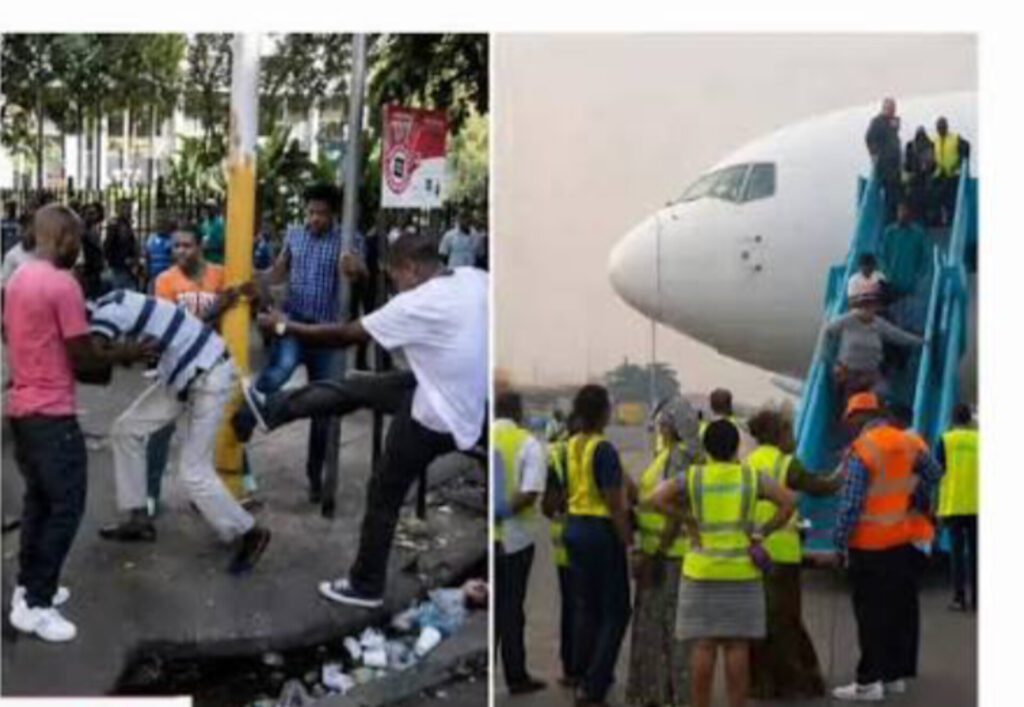
The Human Rights Writers Association of Nigeria (HURIWA) says it is receiving with deep concern and cautious approval the Federal Government’s announcement to evacuate over 1,000 Nigerians from South Africa following renewed waves of xenophobic attacks targeting African migrants, including Nigerians.
While the Association acknowledges the government’s decision to fund and facilitate the evacuation as a necessary emergency response, it warns that evacuation alone is a dangerously incomplete response to what is clearly a recurring pattern of violence, discrimination, and state failure to protect foreign nationals.
In a statement by its National coordinator Emmanuel Nnadozie Onwubiko HURIWA says the real question is not how Nigerians are brought home—but what they are being forced to abandon, and what justice will follow them back.
Across South Africa, thousands of Nigerians have spent years—some decades—building legitimate lives. They have established businesses, employed workers, paid taxes, acquired property, and integrated into communities. Now, many are being forced to flee under threat of violence, leaving behind everything they have worked for.
HURIWA asks bluntly: what happens to all of that?
What becomes of their shops, homes, investments, vehicles, bank accounts, and livelihoods suddenly abandoned in the face of organised hostility? Will these losses simply be absorbed as personal tragedy, while the Nigerian state celebrates evacuation as success? Or will there be a structured diplomatic and legal pursuit of compensation and restitution?
The organisation insists that evacuation without accountability is not protection—it is managed abandonment.
The situation becomes even more troubling when viewed through the lens of family and human relationships. Many Nigerians in South Africa are married to South Africans, with children whose identities, education, healthcare, and futures are deeply rooted in that society. Forced displacement, HURIWA warns, risks tearing apart families and creating long-term humanitarian consequences that cannot be solved at the airport in Lagos or Abuja.
What provisions, the group asks, have been made for mixed-nationality families? What happens to spouses who cannot immediately relocate? What becomes of children caught between two countries in crisis?
Beyond humanitarian concerns, HURIWA raises a more uncomfortable diplomatic question: has Nigeria truly exhausted all available international and regional mechanisms before resorting to evacuation?
The African Union, SADC framework, and United Nations human rights structures all exist precisely to prevent such failures of protection. Nigeria, the organisation notes, is not a minor actor on the continent. It is a historic leader in African liberation struggles and a major voice in continental diplomacy. Yet its citizens continue to suffer repeated cycles of xenophobic violence in a country it once supported strongly during the anti-apartheid era.
HURIWA therefore demands to know what concrete diplomatic actions have been taken beyond statements of condemnation.
Has Nigeria formally demanded compensation for victims? Has it insisted on prosecutions of perpetrators and organisers of xenophobic attacks? Has it secured binding guarantees against future violence? Has it requested independent investigations into alleged institutional negligence or complicity?
Without clear answers to these questions, the organisation warns, evacuation risks becoming a repetitive cycle of crisis management without resolution.
HURIWA also draws attention to what it describes as a glaring imbalance: South African businesses continue to operate freely in Nigeria, protected by Nigerian laws and security architecture, while Nigerian citizens remain exposed and vulnerable in South Africa.
While the group is not calling for retaliation, it insists that diplomacy without consequence reduces Nigerian citizens to expendable assets in international relations.
At home, HURIWA says the Federal Government must immediately clarify what reintegration plan exists for the returnees. It warns that bringing citizens home without support structures amounts to transporting them from one crisis into another.
The organisation demands answers to key questions: where are the jobs for the returnees? What financial assistance or recovery support is available? What business reconstruction plans exist for those who lost everything? What psychological support systems have been activated for victims of violence and trauma?
HURIWA is therefore calling for the urgent establishment of a Presidential Task Force on the Rehabilitation and Reintegration of Returnee Nigerians from South Africa, comprising relevant ministries, financial institutions, private sector actors, civil society groups, and diaspora representatives.
This body, it says, must move beyond rhetoric and design concrete emergency relief packages, credit access schemes, vocational retraining programmes, business recovery grants, and long-term reintegration strategies.
Finally, HURIWA warns that the persistence of xenophobic violence against Africans in South Africa represents not just a national failure, but a continental shame that undermines the very idea of African unity.
Africa, it says, cannot preach integration while Africans are hunted and displaced within Africa itself.
The organisation concludes with a firm message: Nigeria must stop treating evacuation as the end of responsibility. It must instead pursue justice, demand accountability, secure compensation, protect families, and rebuild lives.
Anything less, HURIWA warns, would be a betrayal of citizenship and a failure of state duty.