

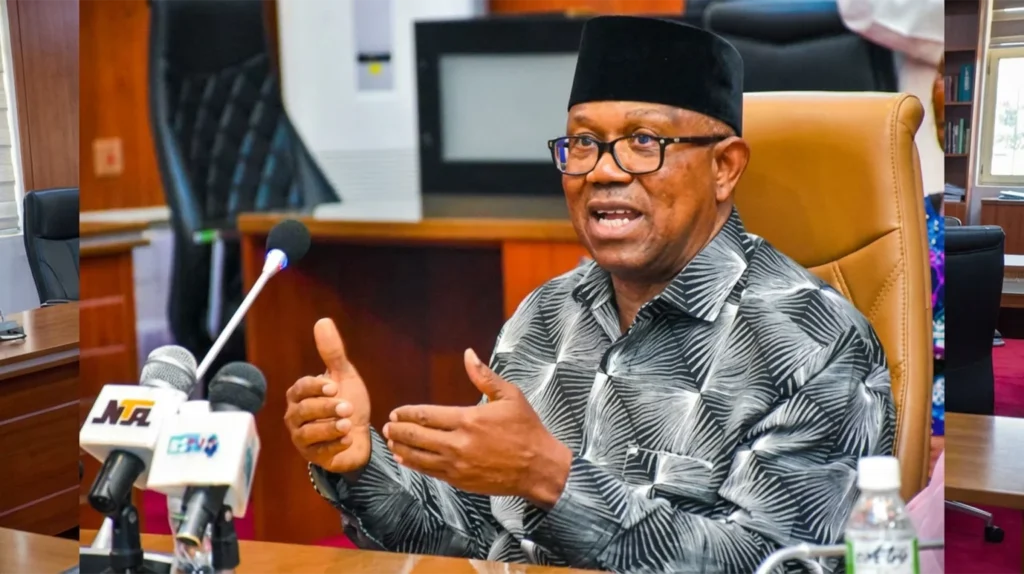

Nigeria Democratic Congress(NDC) presidential Candidate for 2027 Peter Obi has seized on the Federal Government’s reported approval of 1,000 forest guards for Oyo State to launch a broader critique of President Bola Tinubu’s approach to governance, arguing that the initiative exposes what he described as the absence of a coordinated national security strategy.
Rather than celebrating the move as a bold response to insecurity, Obi said the decision raises troubling questions about how security policies are being conceived and implemented at a time when virtually every region of the country is battling violent crime.
The former Anambra State governor contended that Nigeria’s security emergency cannot be addressed through isolated interventions targeted at individual states while communities across the federation continue to face relentless attacks from bandits, terrorists, kidnappers and armed criminal groups.
According to Obi, the key issue is not whether forest guards should be recruited, but whether the Federal Government has developed a comprehensive framework capable of addressing insecurity on a national scale.
He questioned whether similar approvals would be extended to all states confronting security threats or whether federal responses would continue to be determined on a case-by-case basis.
The remarks amount to one of Obi’s strongest criticisms yet of the Tinubu administration’s security management, coming amid growing concerns over persistent killings, abductions and attacks in several parts of the country.
Obi argued that insecurity has become a symptom of wider governance failures, insisting that lasting peace cannot be achieved without simultaneously addressing poverty, unemployment, economic decline and social dislocation.
He maintained that the country’s challenges are rooted in what he called a breakdown of leadership, accusing government at all levels of failing to harness Nigeria’s enormous economic potential to create opportunities for millions of young people.
The former presidential candidate said a nation blessed with vast agricultural resources, solid minerals, tourism assets and human capital should not be struggling with the scale of insecurity currently being witnessed across the federation.
In a pointed reference to some of the administration’s economic reforms, Obi suggested that the same reactive mindset that shaped recent policy decisions is now finding expression in the handling of security matters.
He warned that piecemeal responses to complex national problems risk worsening public frustration and weakening confidence in government institutions.
The intervention comes as Nigerians continue to demand more decisive action against insecurity, with many communities complaining of inadequate protection despite repeated government assurances.
For Obi, the debate goes beyond the recruitment of forest guards. It is about whether Nigeria is confronting insecurity as a national emergency requiring strategic planning or merely responding to crises as they emerge.
His position is likely to resonate within opposition circles already questioning the effectiveness of current security measures and demanding a more comprehensive approach to tackling the country’s deepening security challenges.
As the political conversation gradually shifts toward the 2027 elections, Obi appears determined to frame the security crisis as a test of leadership, competence and national vision.
His argument is clear: Nigeria’s insecurity problem will not be solved by isolated announcements but by rebuilding the economic and governance foundations that make security sustainable.