By Abdulkarim Abdulmalik
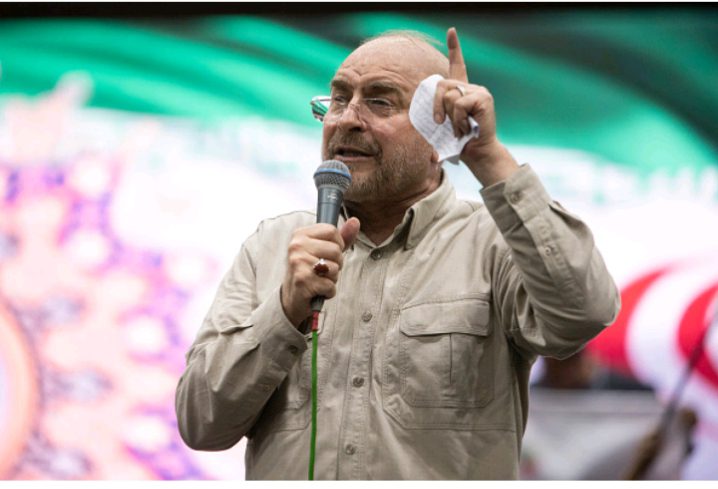
In a moment that captures the fragile tension defining relations between Iran and the United States, Iran’s Parliament Speaker, Mohammad Bagher Ghalibaf has issued a pointed response to recent rhetoric attributed to former U.S. President Donald Trump. The message, delivered in a series of carefully worded statements, reflects both defiance and a conditional openness; an insistence that while Tehran will not bow to pressure, it is not closing the door to dialogue.
At the heart of the exchange lies a familiar fault line: trust. Or, more precisely, the lack of it.
“Americans must decide whether they are ready to earn Iran’s trust or not,” the Speaker declared, framing the issue not as a question of military strength or economic leverage, but of credibility. It is a striking choice of emphasis in a geopolitical environment often dominated by threats, sanctions, and shows of force.

The comments came against the backdrop of renewed tensions in the strategic waterways of the Persian Gulf, where discussions of naval blockades and control of maritime routes have once again raised global concerns.
For Iran, these waters are not merely shipping lanes. They are a lifeline, a symbol of sovereignty, and a pressure point in its long-standing confrontation with Washington.
Ghalibaf’s tone suggests that Tehran was attempting to recalibrate the narrative. “Trump’s recent threats have no effect on the Iranian nation, we have proven it,” he said, emphasizing confidence rooted in decades of resilience under sanctions and isolation.
Records showed that such confidence is not without historical predicate. Since the 1979 Iranian Revolution, Iran has navigated cycles of confrontation with successive U.S. administrations. Sanctions regimes, diplomatic breakdowns, and intermittent negotiations have defined the relationship, creating a pattern of engagement marked as much by mistrust as by necessity.
His remarks transcends mere defiance. He pointed to what he described as “very intensive, serious, and challenging talks,” suggesting that behind the public rhetoric lies a quieter but more complex diplomatic effort. According to him, Iran presented “strong initiatives that showed goodwill and led to progress.”
Such claims may be difficult to accept or dismiss, but they hint at a dual-track approach: public firmness paired with private negotiation. It is a strategy that has characterized past engagements, including the landmark Joint Comprehensive Plan of Action, which temporarily eased tensions before unraveling amid mutual accusations of non-compliance and withdrawal.
The collapse of that agreement continues to cast a long shadow. “We do not trust the Americans… they must earn our trust, and that is difficult due to their past actions,” Ghalibaf emphasized.
The statement sounds as a reminder and also, a warning that any future agreement would require more than promises; it would require guarantees that Iran deems credible.
For Washington, this presents a familiar dilemma. How does one rebuild trust with a state that views past agreements as broken commitments? And how does one do so while maintaining domestic political support and addressing concerns from regional allies?
The Speaker’s words suggests that Tehran believed time might be on its side. “The Iranian nation is advancing on its path and relies on its own capabilities,” he said, echoing a long-standing theme of self-reliance. In practical terms, this refers to Iran’s efforts to strengthen its domestic industries, military capabilities, and regional influence despite external pressure.
At the same time, the message is carefully calibrated to avoid closing off diplomatic options. “If America wants a way out, it must earn the trust of the Iranian nation,” he added, leaving open the possibility of de-escalation albeit, on Iran’s terms.
However, what appears to be the most telling line is: “If you fight, we will fight, and if you come with logic, we will respond with logic.” It is a statement that encapsulates the duality of Iran’s position: prepared for confrontation, yet willing to engage under conditions it considers respectful and equitable.
For observers, the language reflects a broader shift in global politics, where emerging powers and regional actors are increasingly asserting autonomy in the face of traditional superpower influence.
To this end, Iran’s insistence on “earning trust” rather than demanding concessions underscores a desire to redefine the terms of engagement.
It is therefore clear that rhetoric, however carefully crafted, does not exist in a vacuum. The real test will lie in actions on both sides. Naval maneuvers, economic sanctions, and diplomatic signals will all play a role in determining whether this moment marks another cycle of escalation or a tentative step toward dialogue.
For now, the Speaker’s message serves as both a warning and an invitation. It warns that threats alone will not yield results, and it invites a different approach premised on mutual recognition and the willingness to confront the legacy of mistrust that has defined America-Iran relations for more than four decades.
In a world increasingly shaped by shifting alliances and contested narratives, the question remains whether either side is ready to take that step. Time shall tell.