By Ehichioya Ezomon
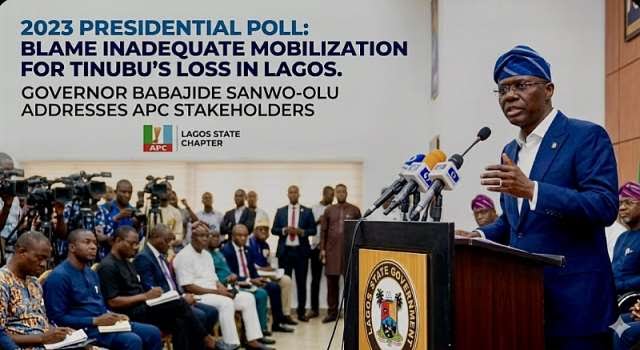
“Don’t let things be like the last time. We all must get our PVCs, because what happened the last time was not good enough and we are still ashamed of it. I am serious; we are honestly still ashamed of it. But for things not to go that route, we all must equip ourselves with our Personal Voter Cards (PVCs), ahead of the next year’s elections.”
This is Lagos State Governor Babajide Sanwo-Olu’s regret almost four years after then-candidate Bola Ahmed Tinubu of the ruling All Progressives Congress (APC) lost his Lagos State residential stronghold and Osun State home base, accordingly, to then-opposition candidates Peter Obi of the Labour Party (LP) and Atiku Abubakar of the Peoples Democratic Party (PDP), respectively, in the 2023 General Election.
Due to his particular hold on the politics of Lagos, which he governed from 1999 to 2007, Tinubu – incumbent President of Nigeria based on the February 25, 2023, poll – was expected to run rings around” or “run circles around” opposition candidates, including former Anambra State Governor Obi, who showed great promise during the campaigns for the poll.
In a shocking outcome, Tinubu didn’t only lose Lagos to Obi, but also Osun to Atiku, former vice president (1999-2007) and thrice presidential candidate in 2007, 2019 and 2023, who’s fighting for his political survival owing to the division in the PDP, leading to his loss of five states, whose governors worked against his election in favour of Tinubu and the APC.
Even as Tinubu won the fiercely-controversial poll that the opposition labelled as “stolen” via alleged connivance of Tinubu, the APC and Independent National Electoral Commission (INEC) – allegation they failed to prove at the election petitions tribunals (Appeal Court and Supreme Court) – the ghost of Tinubu’s stunning defeat in Lagos continues to haunt the state chapter of the APC, as expressed by Governor Sanwo-Olu in the face of “threats” by the opposition for a repeat of the 2023 scenario.
Once beaten, twice shy, Sanwo-Olu, rounding off his eight-year tenure (2019-2027), doesn’t want another defeat of Tinubu on his watch. Hence, his political “Save Our Souls” to members of the Lagos APC, imploring them to arm themselves with their PVCs, to counter the opposition’s avowal to “remove Tinubu from power in 2027” and “retire him permanently from politics.”
As Vanguard reported on March 18, 2026, Sanwo-Olu, through his Chief of Staff, Tayo Ayinde, during the Annual Lagos APC Ramadan Public Lecture in Ikeja, the state capital city, described the 2023 presidential poll result in Lagos as “embarrassing,” vowing to ensure “total victory for the re-election of President Tinubu in 2027.”
Stressing the importance of voter registration and participation as “critical tools in securing electoral victory for the party,” Sanwo-Olu urged members to begin early preparations for the 2027 election, as sustaining the achievements of the current administration at the federal level “depends largely on ensuring the re-election of President Tinubu for a second term.”
Many may not fault Sanwo-Olu for identifying a critical lapse in the process of election, which’s insufficient possession of PVCs by members of the ruling APC in Lagos. But the question is: While Tinubu and the APC scored 572,606 votes (45.04%) to Obi and LP’s 582,454 votes (45.81%) at the presidential election, did the APC members bring in additional PVCs during the governorship poll of March 18, 2023, when Sanwo-Olu and the APC got 762,134 votes (65.95%) (a margin of 39%) over LP’s candidate, Gbadebo Rhodes-Vivour, who polled 312,329 votes (27.03%)?
The problem of Tinubu’s defeat didn’t lie in the APC members not possessing enough PVCs, but lack of effective mobilisation at the grassroots. Recall that post-presidential poll, allegations in that regard surfaced, with many accusing the governor, the APC leaders and local government chairmen of abandoning the grassroots members, who are the foot soldiers and the “real voters” during elections.
Having learned bitter lessons from the Tinubu defeat in Lagos at the February 2023 presidential poll, the “honestly ashamed” and concerned APC leaders revved up mobilisation for the goveorship election of March 18, 2023, and got the members’ participation for the needed numbers for a “landside victory” for Sanwo-Olu over Rhodes-Vivour.
Apart from effective monitoring of the process to curb the “rigging” that dented the 2023 presidential election, the Lagos leaders of the APC, headed by Sanwo-Olu, should employ similar, but doubled mobilisation efforts for the January 16, 2027, poll, to secure “total victory,” and avoid being “embarrassed” and “ashamed” for the second time in four years!
This advisory is apt because of the clamour for “real-time” transmission of results to the INEC Results Viewing (IReV) portal, which displays results from polling units, where rigging of votes begin, and “elections are won or lost.” Even with the “partial” approval of electronic transmission of results in “real-time” to the IReV, the alleged manipulation of the 2023 presidential poll will be a child’s play compared to the feared wholesale rigging of the 2027 ballot.
As starkly shown in 2023, the results from such fraudulent votes at the polling units will be uploaded to the IReV, “for real-time viewing,” to somehow afford the “vote manipulators” the leeway to show the world that their candidate “is winning or has, indeed, won the election” – not from a free, fair, credible and transparent voting, but high-voltage fraudulence at the polling units, which’s the reason for the intense clamour for “real-time” transmission of results from polling units!
Those governing Lagos State under the APC need no telling the impact of letting down their guard before and on Election Day on January 16, 2027. It’ll be politically cataclysmic, to say the least!
Mr Ezomon, Journalist and Media Consultant, writes from Lagos, Nigeria. Can be reached on X, Threads, Facebook, Instagram and WhatsApp @EhichioyaEzomon. Tel: 08033078357